One of the most tried and tested finishing tools available to printers, we look at the latest advancements in guillotine technology, analysing how these new solutions can help print companies become more efficient
Rob Fletcher
January 21, 2026
Printers have been using guillotines to cut and finish print for the best part of 200 years. While modern solutions are a far cry from their ancestral machines, their purpose and end goal is very much the same – to cut printed pieces ready for full finishing and distribution to the customer.
Of course, modern-day guillotines bring with them all manner of special attributes that make the whole finishing process easier for the print service provider (PSP). Whether this is automation to reduce manual touchpoints or user-friendly features like touch-screen controls, guillotines have come a long, long way over the past two centuries.
In this feature, we catch up with several manufacturers active in this sector to not only learn more about their latest offering to the market, but also what printing companies should be looking for when they come to invest in a new guillotine machine.
Automation Equation
Eric Keane, managing director of Intelligent Finishing Systems (IFS) is first up to comment. He sets out how a guillotine is a vital component of any printing operation or in-house bindery, and that as fast-turnaround, short-run jobs increasingly define production demands, investing in a system that is simple to operate and quick to set up is key to maintaining smooth, efficient workflows.
“Before making a purchase, printers should assess how the latest technology can enhance performance and deliver measurable productivity gains,” Keane advises, continuing: “For instance, from the cutting process to integrated quality-checking systems that eliminate operator errors, every stage of production can now be highly automated – delivering consistent, repeatable, high-quality results.
Before making a purchase, printers should assess how the latest technology can enhance performance and deliver measurable productivity gains
“Intuitive technology enhances both setup and operation, enabling a dynamic bindery environment with streamlined production. Touch-screen controls allow for rapid setup, while programmable memory simplifies repeat jobs, boosting efficiency on short-run, fast-turnaround work. Saving just a few minutes per job can significantly increase overall capacity, a critical advantage for binderies managing tighter deadlines and smaller batch sizes.
“Ongoing innovation continues to prioritise the user experience, making operation and paper handling as smooth, efficient, and effortless as possible. This is key to maximising productivity and expanding capacity for today’s demanding short-run, quick-turnaround production.”
With this, Keane draws attention to the latest and most popular offerings from IFS, which includes the high-end BaumannPerfecta collection of high-speed guillotines. These range from the compact BaumannPerfecta 80 cm model to the large-format BaumannPerfecta 225 cm.
At the heart of the new design is a large, inclinable, menu-guided touchscreen interface that helps simplify control of a host of cutting jobs such as single cuts, programmed sequences, repeat cuts, clamping without cutting, and automatic actual-value transfer. Another standout feature is the cutting cell, which extends knife life through a specially engineered damper system. With its modular design, each guillotine can be integrated with peripheral equipment to create complete, fully automated cutting systems.
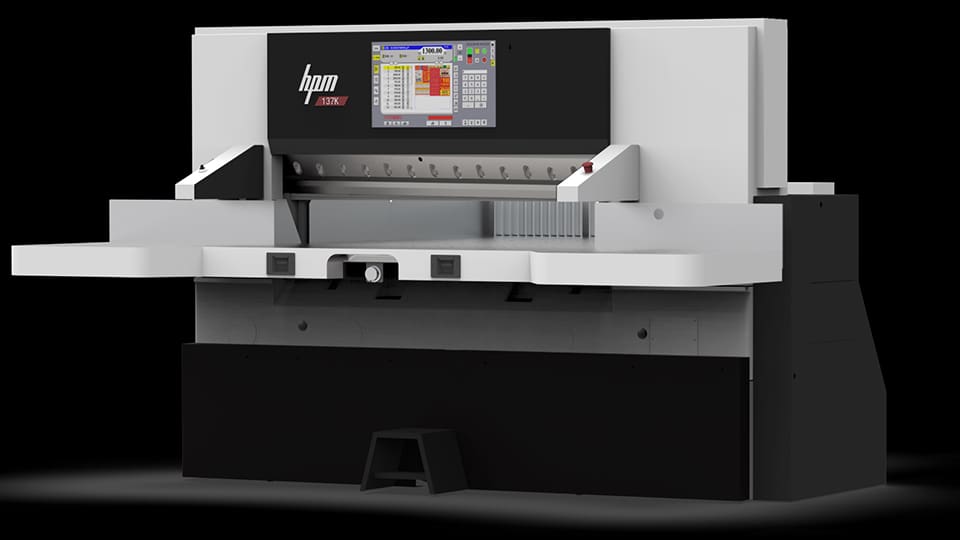
IFS exclusively represents HPM guillotines, which range in size from 92cm up to 188cm
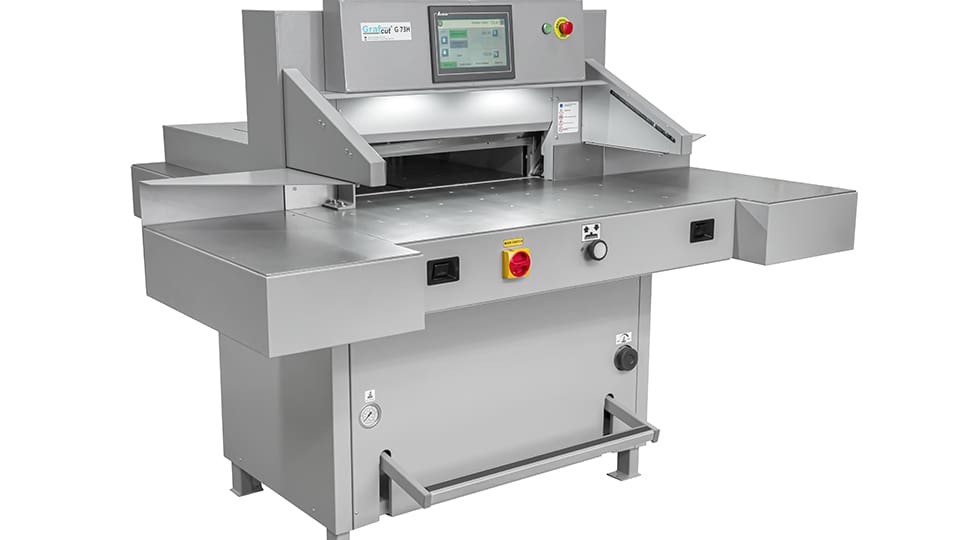
IFS also exclusively offers the GrafCut G73H (73cm) and G80H (80cm) guillotines, featuring 10” touch screens and hydraulic operation of both the blade and clamp, providing more cutting power with less moving parts. Hydraulic clamping pressure is also fully adjustable and the servo-driven back-gauge provides the highest level of cutting precision with speeds up to 135mm/s and 160mm/s.
In addition, IFS exclusively represents HPM guillotines, which range in size from 92cm up to 188cm. These mid-range guillotines can be configured as stand-alone models or combined with automatic-loaders and automatic-unloaders, pile turners with jogging for greater production efficiency.
“Ongoing research and development will continue to prioritise the user experience, ensuring that operation and paper handling are as smooth, streamlined, and intuitive as possible,” Keane says, adding: “This is crucial for managing short-run, fast-turnaround jobs. The automation of the cutting process will keep advancing, along with the integration of intelligent quality-checking systems designed to minimise operator errors and enhance production reliability.”
Don’t Risk Your Reputation
Elsewhere, Christopher O’Brien, director at AfterPrint, warns underinvestment in this type of kit can result in machines that cannot deliver consistent, high-quality, and precise cuts. This, he continues, leads to jagged edges, uneven cuts, and poor-quality production, which requires costly reprints and wasted materials.
“Time lost to troubleshooting, reprinting materials, and performing frequent extensive maintenance can lead to significant inefficiencies and a higher overall operating cost compared with the initial savings on the equipment,” he warns.
Ensuring you are purchasing a high-quality guillotine is essential to the success of any print business
“It takes years to build to a good reputation but minutes to destroy one. In professional print environments, imperfections from poor cutting are immediately noticeable. Inconsistent, low-quality results can have lasting effects with your client, thus damaging your reputation as a business and ultimately costing you customers. As such, ensuring you are purchasing a high-quality guillotine is essential to the success of any print business.”
So, what makes a “quality” guillotine? O’Brien says the most important factors to consider are a proven reliability record, robust build quality, ease of use, and ongoing costs for the service, parts, and blades, which he says is an area that is often overlooked.
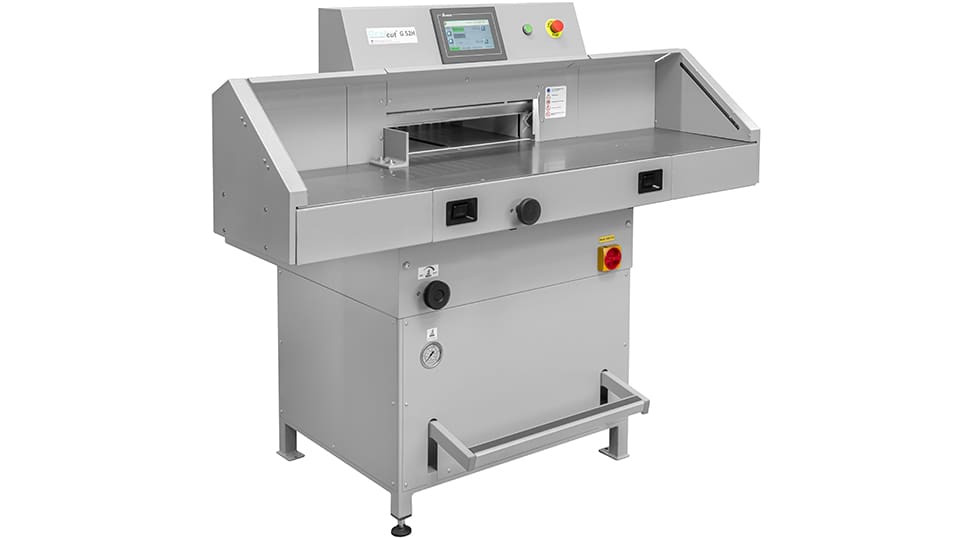
(Above & below) AfterPrint picks out its G52H and G73H hydraulic options as the machines most popular with customers
“Quality is often hard to define, and it is easier to consider a recognised brand as opposed to a different manufacturer you have not necessarily heard as much about,” O’Brien says, continuing: “This is something we come across quite often with our Grafcut Guillotine range. Grafcut may not be as well-known as some of the more established brands even though it has been trading for over 20 years.
“However, Grafcut’s build quality and proven reliability track record is second to none. Just ask any of our long list of Grafcut customers about their machine and the feedback speaks for itself.
Going into more detail on the Grafcut range, O’Brien picks out the G52H and G73H hydraulic options as the machines most popular with customers. Both models have been recently upgraded by Grafcut to include more ergonomically designed cut buttons. The G73H has also had extra features added, including a larger 250mm colour touch screen as standard, as well as the new back gauge control dial located on the front on the machine. Further to this, a newly redesigned Servo-Driven back gauge has been added offering back gauge speeds of up to 135mm/s.
“In our opinion, both the Hydraulic models from Grafcut offer the most powerful package in their target markets,” he says, adding: “Fully hydraulically powered knife & clamp make cutting even the hardest of materials effortless. Furthermore, these hydraulic models power the blade and clamp in both the down and return movement, guaranteeing performance in even the most demanding environments, a feature not found on all models in this target market.”
Development on the range continues and in early 2026, a new flagship model will be added to the Grafcut family in the G80H. With the ability to handle sheets up to 800mm wide, the machine will incorporate the same 250mm colour touch screen as the G73H but with a faster servo-driven back gauge offering speeds up to 160mm/s. Further to this, the blade and clamp drive have been redesigned for faster operation of up to 16 cycles per minute.
Decisive Investment
Also active in this market is Friedheim International, whose finishing sales manager, Howard Cherry, says a modern guillotine remains one of the most decisive pieces of equipment in any print operation.
“No matter how strong the pressroom performance, poor cutting can destroy the saleability of the finished product,” Cherry says, adding: “Mistakes here are also very easy to spot as sharp edges, accurate trimming, and cleanly finished stacks are what give printed work its final sense of completion.
No matter how strong the pressroom performance, poor cutting can destroy the saleability of the finished product
“Operator tools, such as software, pre-programmes, as well as the ergonomics of the machine can give the operator the confidence to cut quickly, whereas old guillotines require a reliance on experience. “It is also important to note that the proper upkeep and maintenance of a guillotine, including keeping blades fresh and sharp, is an ongoing measure of guillotine quality.”
On this, Cherry offers some words of advice to what print companies should look for when in the market for a new machine. He explains that guillotines need productivity features to set themselves apart.
“As we know many guillotines on the market are manufactured under the same roof – this differentiation only comes with the supplier’s ability to support new software retrofit upgrades, and the ability to meet the stringent maintenance schedules,” he says, adding: “These are all factors that should be considered.”
With this, he advises printers to seek guillotines that offer flexibility of application such as a good size cutting width and subsequently cutting software and programmes that reduce changeover times and increase cutting confidence, such as the Straight2Cut packages from BaumannPerfecta.
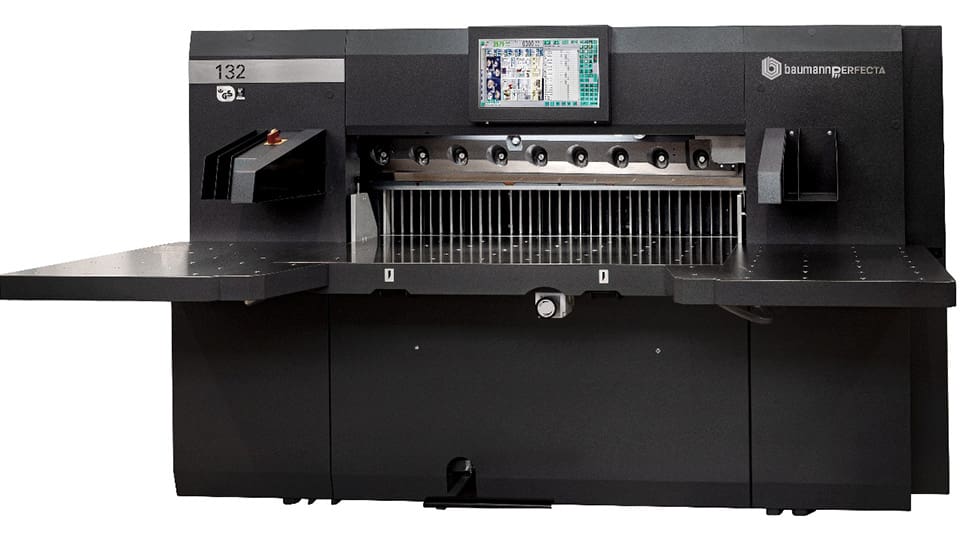
Friedheim International lists the BaumannPerfecta 132 as among the guillotine models most popular with its customers
Further to this, he advises printers to consider their automation options, again highlighting how BaumannPerfecta offers advantages as they offer entire workflow solutions such as handling, jogging, pile turning, and robotics that reduce the need for manual labour, and reduce the overall liability associated with Schedule One machinery types.
The most popular guillotines in this range are the 115 and 132 models, though Friedheim has seen an increase in the smaller 80 models from printers with a more focused product range.
“New guillotines are almost always supplied with the optional cutting assistance software applied, which use pre-programmes and barcoding to streamline cutting operations, and will of course run with JDF format instruction,” Cherry says, continuing: “Buyers are also keen to check that they’re able to add extra automation down the line when they are ready, such as extra processing tables and robotic units.”
Factoid:The word “guillotine” comes from the name of Dr. Joseph-Ignace Guillotin, an 18th-century French physician, who first proposed the use of a mechanical method for execution
Cherry concludes by issuing a warning against underinvesting in cutting technology within the print sector. He says the consequences can be “surprisingly serious”, with issues such as inaccurate or inconsistent trimming having the potential to spoil entire piles, forcing costly reprints and wasting valuable materials.
“Slow or unreliable machines often create production bottlenecks, meaning the finishing department ends up dictating turnaround times for the whole business – something that is an increasingly important metric when customers expect faster and faster turnarounds, meaning this is often a deciding factor in the choice of supplier,” Cherry says.
“The greatest risk, however, comes from outdated safety systems. Older guillotines lacking modern guarding, sensors, or compliant controls are still among the most hazardous items of equipment in the industry, exposing operators to unnecessary danger, and companies to significant liability. Little excuse is afforded to printers who don’t keep up to date with legislation and appropriate maintenance.”
The message is seemingly clear; do not skimp when it comes to investment in guillotines and cutting machinery. Underinvestment in this technology can leave your business short of print finishing quality, and lead to a lack of sharpness in printed work (no pun intended).
From advances in print quality and productivity to increasing demand for automation and sustainable solutions, the wide-format market continues to evolve. Rob Fletcher looks at the latest trends, challenges, and developments in this sector
Speaking to a range of print and signage professionals, we discover how a sustainable business model can drive growth, outlining actionable strategies to cut overhead costs, improve eco-efficiency, and boost your bottom line
As finishing continues to become a great way to add extra elements to your print and wow customers, we take a look at some of the creasers, folders, and collators on the market, and ask experts their advice on finding the right solutions
(this was inserted into the PHP of a code block)
Watch our latest video of the week
Print Monthly gives you the latest video coverage of companies, people, and events from within the print industry.