We speak to a range of humidification specialists about how to choose the right system for your print output, and how the changing industry landscape is evolving the solutions on offer
Jonathan Pert
April 8, 2026
While modern printers chase faster speeds and brighter colours, inconsistent humidity still remains a silent saboteur of profitability – causing all kinds of issues including registration errors, paper curls, and the build-up of static electricity.
For most print applications, maintaining relative humidity is essential to keeping substrate stocks stable. However, the ‘best’ way to achieve this can vary significantly depending on your facility's size, budget, and specific printing technology.
In this feature, we speak to four humidification specialists in the UK market to get their insights on the topic, while also discovering how to choose a system that can eliminate environmental variables and provide a consistent competitive edge.
Energy Conscious Solutions
Among the key UK providers of humidification solutions is Humideco, which has been providing systems to the trade since 2002. According to Gareth French, director of Humideco: “We were founded in response to a need for a more energy-conscious solution to the question of humidification.”
As French describes it, humidifier systems were historically either based on steam or compressed air, which can consume a lot of energy. Humideco, by contrast, offers two core product ranges for print applications, namely its Ultrasonic humidifiers and EcoMist nozzle systems.
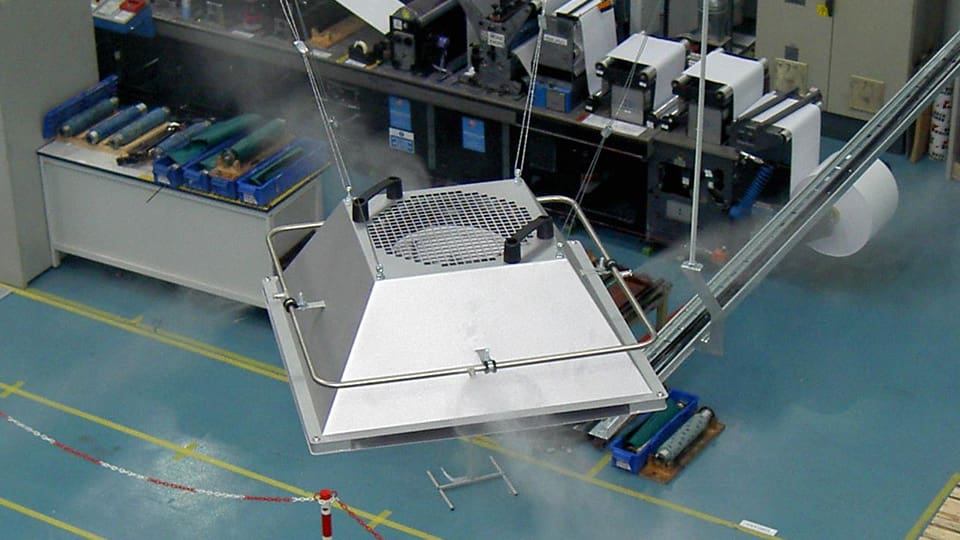
Describing the core features of the systems, French says: “Ultrasonic systems can achieve tight control of relative humidity, with minimal energy use, and virtually zero maintenance. They are perfect for local control in smaller areas, perhaps around a digital print machine or a proofing area. EcoMist systems are usually a bespoke solution suited to larger open areas, again with very low energy consumption.
“Both systems can be set up to control across multiple zones, allowing for optimal conditions where needed with the lowest water and energy consumption.”
Humideco’s systems can be set up to control multiple zones within a facility
Humideco’s systems are designed to provide full control over operational settings including water consumption and relative humidity. As French explains: “No two projects are the same, and with water chemistry such a variable across the country, this is always important.”
French also stresses the importance of additional expertise and support when working with clients. “We understand and have a wealth of experience in the print industry,” he comments, adding: “We take time to listen to our customers’ needs and requirements prior to discussing what a solution might look like.”
Among the potential issues Humideco can provide support for, French describes how customers can find problems not just with the control of relative humidity, but also with temperature. In these cases, Humideco is on hand to advise and assist with cooling or air conditioning requirements, again with energy consumption as a prime consideration.
With what French sees as a sustained and growing focus in digital printing, he believes that we will see “an increased demand for smaller, localised systems to control conditions around single machines.” With energy costs rising considerably in recent years, French also highlights that operating costs are “of paramount concern for any business,” which he says will increase the need for systems such as Ultrasonic or EcoMist.
Finally, he points out the impact of water-based inks like HP Latex on humidification, commenting: “The increase in water-based inks, driven by the need for sustainable, eco-friendly solutions and stricter environmental regulations, has increased the importance of relative humidity control to prevent premature drying and its associated problems.”
An Array of Solutions
Another expert in humidification systems is the aptly named Humidity Solutions, which was started in 2008 by managing director, John Barker. Explaining how the company came about, Barker says: “I had previously worked for a German humidifier business where the focus was selling high-pressure water humidifiers into the print sector in the UK. However, I wasn't happy with the level of technical support or customer service I was able to or allowed to offer.”
Humidity Solutions was therefore founded with the core focus of providing what Barker describes as “industry-leading products and customer service,” with installation teams covering the length and breadth of the UK.
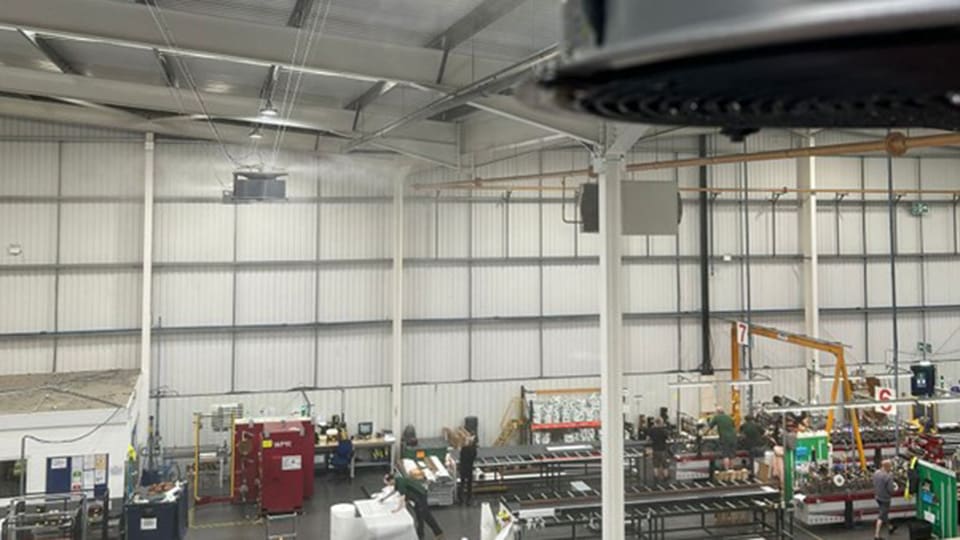
Barker asserts that a wide array of systems are required to cater for the entire print industry. As he says: “Large litho press halls would benefit from a high-pressure water system, as it offers really low running costs, adiabatic cooling to help with temperature control, and distributes the controlled humidity via zone control across the whole factory, without the need for ductwork.
“Small digital press rooms, however, would be better suited to wall-mounted steam humidifiers which provide precise control and ensure that the press is comfortably within the Q zone demanded by the press manufacturer.”
Humidity Solutions provides systems for a variety of print facilities
Humidity Solutions previously worked with commercial printer, Wilmot Budgen, where it supplied not only a high-pressure water system but also electric space heating and desertification fans. Humidity also installed the equipment and provided the controls and planned maintenance of the systems. As Barker describes: “From initial site visit to system calculations, selection of the equipment, supply, installation, and continued product support, we provide the expertise for a full turnkey project.”
While Barker does concur with French that energy efficiency is a key area of focus, he believes that “in some instances, a steam humidifier is more efficient than a low energy humidifier.”
He describes this by saying: “The low energy humidifier will cool the air through adiabatic cooling, which is great if you require cooler temperatures. If not, then you need to reheat the air, which can be energy hungry. In this case, an isothermal steam humidifier which doesn't affect the air temperature, alongside a reverse osmosis plant to eliminate scale build-up, becomes the best solution.”
Gone are the days where a maintenance engineer just turns up every six months to provide maintenance. Now we can remotely dial into the humidifier, see the hours run, any fault codes or concerns, and plan our visit accordingly
Barker describes the modern humidification landscape as being highly automated and intelligent. Automation capabilities can be provided both by Humidity Solutions’ own dedicated controllers or by providing the control equipment's information to a building management system. He asserts: “Gone are the days where a maintenance engineer just turns up every six months to provide maintenance. Now we can remotely dial into the humidifier, see the hours run, any fault codes or concerns, and plan our visit accordingly as well as ensuring that if components may be required, they are sent ahead or on the van.”
Describing the modern print ecosystem, Barker concludes: “With large press halls housing multi-million-pound presses, high tech finishing areas, and stores of high-value stock, the humidity control needs to be zoned – but in a straightforward way that means installation costs are kept to a minimum.
“This is possible with the latest in high pressure water humidifier technology, coupled with water treatment and excellent controls.”
New Systems to Come
Condair is a global specialist in humidification, with its roots stretching back to 1948 when the company was originally founded in Switzerland. Its early innovations in rotary atomisation technology laid some of the foundations for modern air humidification and the company has since developed systems across both cold water and steam humidification.
Today, the company has production sites in Europe, North America, and China, as well as its own sales and service organisations in 23 countries, and representatives in 50 other locations worldwide.
Condair’s UK organisation has been active in the print sector since 1980. The UK branch of the company introduced the JetSpray compressed air and water spray humidifier, designed to allow UK printers to overcome web breaks, misregister, and static issues with a hygienic humidification system.
Speaking about the benefits of spray humidifiers for larger print operations, Dave Marshall-George, UK and Ireland sales director at Condair, says: “As the waste heat produced by print machines is the main energy source for this type of humidification, the energy consumed by spray humidifiers is very low.
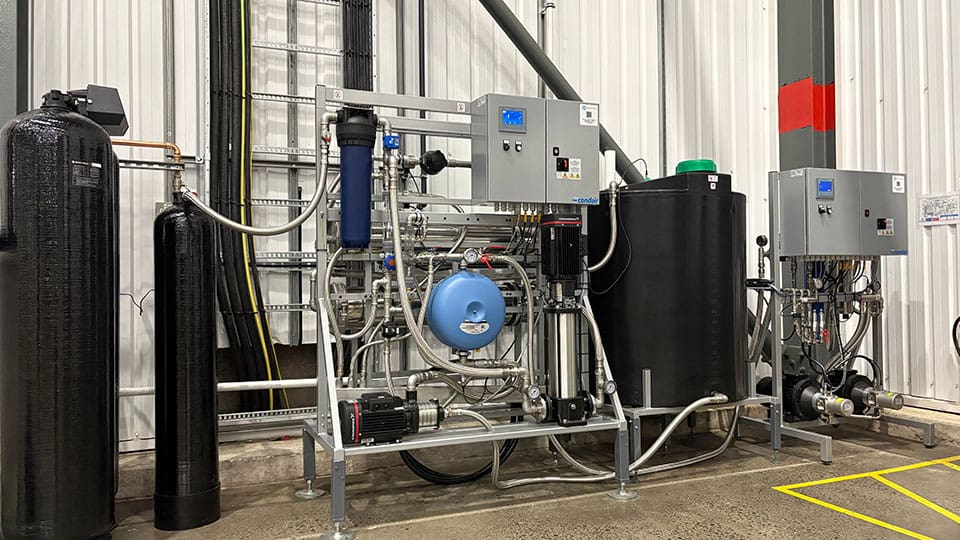
Condair’s latest humidifiers can be remotely monitored by the manufacturer
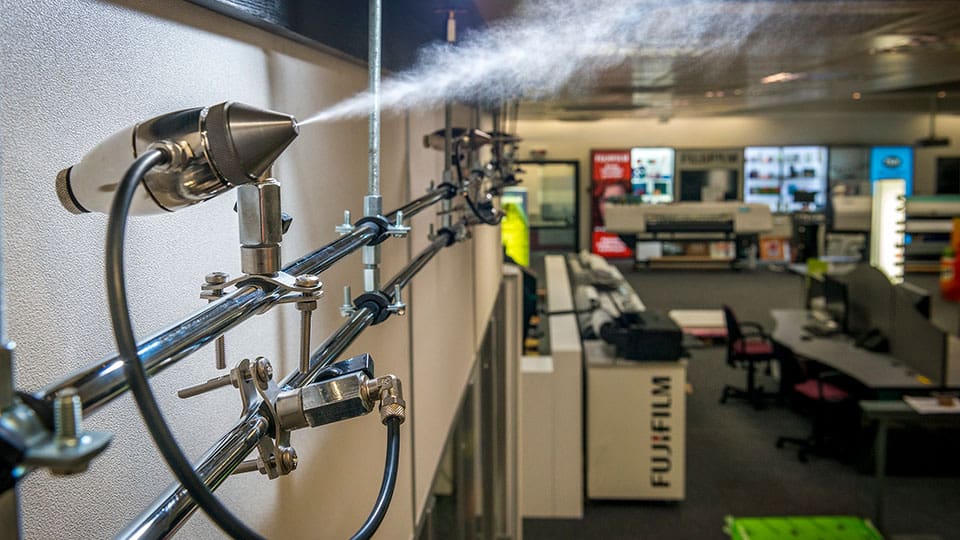
“The evaporative cooling effect enjoyed by printers who use spray humidifiers is an added benefit, alongside the productivity improvements from managing humidity. Condair manufactures both high pressure and compressed air, and water spray models, plus it can provide detailed analysis on the level of evaporative cooling that can be achieved.”
For smaller print facilities such as digital print rooms, Condair provides wall-mounted steam humidifier systems such as the Condair EL with a fan unit, which Marshall-George says can “provide from just a few kilos of steam per hour to around 40kg, with easy maintenance and good humidity control.”
Other steam humidifiers include the Condair RS, which incorporates a scale collection tank. This tank can be routinely emptied by on-site personnel, with the aim of extending the periods between necessary maintenance visits.
Marshall-George does point out that steam humidifiers use more energy than cold water systems, as they are boiling water to create humidity, commenting: “As the initial purchase and install costs are lower than a spray system,” he clarifies: “Financially steam units can make sense if the required output is relatively low.”
Before installation, Condair’s sales engineers visit the site to review what is the most appropriate solution for a client. This will take into account factors including the area’s size, heat gain, ventilation, and local water quality, alongside considerations such as budget, energy use, and on-going maintenance.
According to Marshall-George, a key change in recent years has been the diversifying range of substrates used by printers. As he describes: “The more sensitive stocks can be more hygroscopic, and therefore dimensionally unstable at varying humidity. Modern print machines are also faster and run with more precision. Both these factors result in a greater demand for tighter environmental controls to minimise defect rates, which includes an increased need for humidification.”
Condair’s latest humidifiers incorporate Internet of Things (IoT) connected control systems which enable operation and performance to be remotely monitored by the manufacturer, with maintenance identified and scheduled only when necessary. The aim of the system is to relieve on-site facility managers of worries connected to humidity control while ensuring optimal humidifier performance and the ideal printing environment.
The manufacturer is also shortly launching a new high pressure spray system designed for flexibility. While the full details of the machine are yet to be announced, Marshall-George says that it is “designed to be highly flexible in its configuration options,” allowing it to “precisely fit the needs of any printer, large or small.”
The new system will be available in capacities from 100 to 500 litres per hour, with several water treatment options and 12 different nozzle systems. Offered with a wide range of service and remote monitoring packages, the spray humidifier will be, as Marshall-George puts it, “precisely tailored by Condair engineers to suit any print room humidification need.”
From Creation to Installation
Condair works with a range of suppliers and installers which help companies integrate its humidification solutions within their facilities.
One of those suppliers is RGP Solutions, an independent sales and service company that provides humidity control, water treatment, reverse osmosis (RO) water treatment, and refrigeration services to industries including print and packaging.
Richard Guthrie, sales director at RGP Solutions, says: “We specialise within the print industry mainly with large high-pressure multi-zone cold water humidifiers. They are ideal for controlling multiple areas of large industrial sites as they use little energy, control the humidity accurately, and help to reduce temperatures in the summer months as well.”
RGP has installed systems at the facilities of leading UK carton and packaging manufacturers and suppliers including Graphic Packaging International, Minuteman Press (MMP), and Smurfit Westrock. The company also supplies high pressure and steam units for the small- and medium-sized digital press rooms of many of the UK’s commercial and specialist printers.
RGP offers maintenance support for the entire lifetime of its systems
When it comes to choosing the right humidification system for a print environment, Guthrie stresses the importance of fully understanding the print process of the space that is being humidified. As he explains: “Different processes require different project approaches and humidity levels, but in all cases consistency day-to-day and throughout the process from plain paper to packed product is key.
“It is vital that the systems are well-sized to cope with changing weather patterns and possible production expansions or changes. It is pointless to install an undersized system or system that doesn’t deliver humidity to the space that’s best for the printing process it is helping.”
Guthrie suggests that high-pressure cold-water humidifiers are often the ideal system for print plants, as they can cope with large air volumes and help with summer cooling. However, as he asserts: “It is vital that water treatment systems are correctly designed to avoid mineral dust, which is why we supply Condair devices which use state-of-the-art water treatment on all their units to eliminate this.”
RGP aims to offer a complete solution for the print providers they work with, including detailed analysis of the company’s facilities and output, full installation, and support with regular service contracts and call outs for the entire lifetime of the systems.
For Guthrie, the role of intelligent technology is key in modern humidifiers. As he puts it: “With margins squeezed and printers consistently being pushed for efficiency savings, it is vital that modern systems are not only efficient but show through data links to the customer’s building management system (BMS) or production computer systems how they are performing. This will allow for adjustments to maximise the positive effect on production output.”
Looking to the future, Guthrie believes that both environmental and industrial changes will have a significant impact to the kind of humidification needed in the coming years. He concludes: “I think the future for humidifiers will be very interesting with a changing climate and print processes rapidly evolving.
“I see that versatile modular systems are going to be key. Low energy consumption is going to be a deciding factor for many clients as well. As we believe that Condair make some of the most innovative low energy systems on the market, we feel very positive about the future.”
From advances in print quality and productivity to increasing demand for automation and sustainable solutions, the wide-format market continues to evolve. Rob Fletcher looks at the latest trends, challenges, and developments in this sector
Speaking to a range of print and signage professionals, we discover how a sustainable business model can drive growth, outlining actionable strategies to cut overhead costs, improve eco-efficiency, and boost your bottom line
As finishing continues to become a great way to add extra elements to your print and wow customers, we take a look at some of the creasers, folders, and collators on the market, and ask experts their advice on finding the right solutions
(this was inserted into the PHP of a code block)
Watch our latest video of the week
Print Monthly gives you the latest video coverage of companies, people, and events from within the print industry.