Humidification technology plays a key role for many print companies in terms of controlling production environments. Here, we speak with several specialist providers in this market to learn more about their latest solutions
Rob Fletcher
November 8, 2024
Condair has been supporting the humidity control requirement of printers for over 30 years
One of several unsung heroes within the print room, a humidification solution can be critically important for many print service providers (PSPs). Without this technology in place, print rooms would not only be a rather unpleasant place to work, but could also hinder the performance of machinery and negatively impact the quality of the final printed product.
The good news for PSPs is that there are plenty of solutions on the market to help them to improve their operating environment. For those print companies that already have some form of system already in place, it may be time to consider upgrading this to get the most out of your machinery.
Print Monthly catches up with several solutions providers in the humidification market to find out more about the latest technologies available to print companies and how investing in new systems could help improve both performance and output.
Long-Term Cost Savings
First up to offer advice and guidance is Dristeem. Stephen Finkel, Western European regional sales manager at the company, says maintaining optimal humidity levels is crucial in the printing industry to ensure high-quality output and operational efficiency.
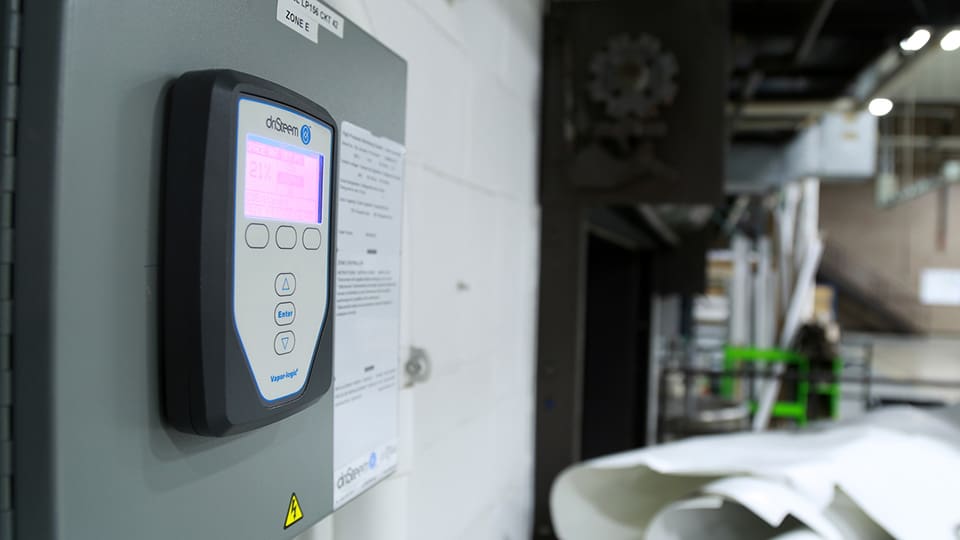
“Relative humidity levels (RH) directly impact materials like paper and ink, thus making it essential for printers to invest in a quality humidification system,” Finkel says, adding: “A good system should provide precise humidity control, stability, scalability, energy efficiency, reliability, and ease of maintenance to meet the unique demands of print environments.
Dristeem says maintaining optimal humidity levels is crucial to ensure high-quality output and operational efficiency
“This includes preventing paper distortion and ink drying issues. Additionally, the system should be scalable to accommodate changing production demands and energy efficient for long-term cost savings.”
Without investing in a proper humidification system, Finkel says printers can face a host of operational and product quality issues. He explains that the most immediate impact of poor humidity control is on the materials themselves, both paper and ink. If the humidity is too low, the paper can become brittle, which increases the chances of static electricity building-up and leading to sheets sticking together as well as feeding errors and jams. Additionally, ink can dry too quickly, leading to issues such as poor adhesion, inconsistent colours, and even printhead damage.
“Without humidity control, printers may experience equipment malfunctions beyond product quality,” Finkel explains, continuing: “Dry environments can lead to increased dust buildup, which affects machine performance and can cause frequent breakdowns. Maintaining consistent humidity levels ensures better product quality, printing equipment, and reduced downtime.”
Without humidity control, printers may experience equipment malfunctions beyond product quality
With this, Finkel draws attention to solutions available from Dristeem, primarily its Adiatec high-pressure system. This system provides high-capacity humidification across multiple zones with a single pump station, while its evaporative cooling effect helps offset the building’s cooling load.
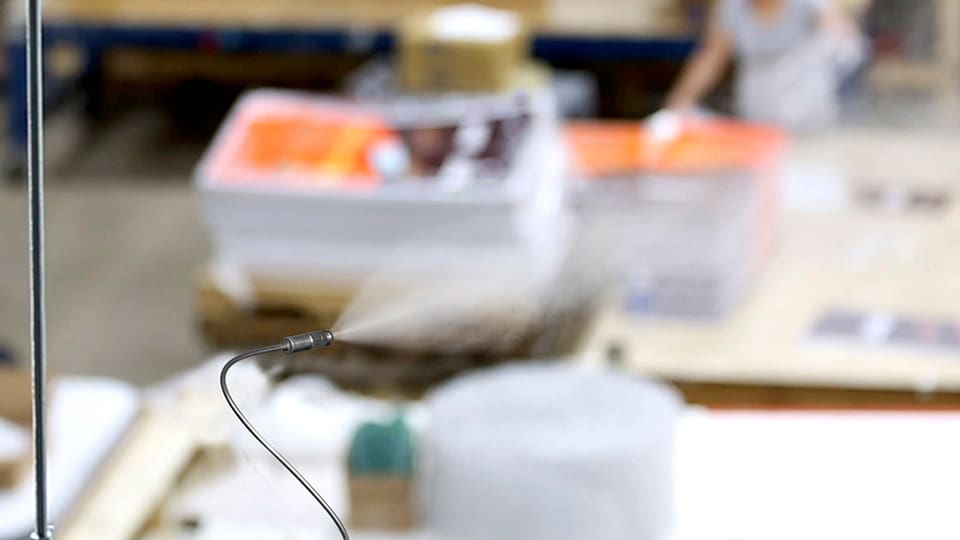
“The Adiatec system is designed for energy efficiency, using significantly less energy than traditional humidification methods by atomising water at high pressure into a fine mist, resulting in lower operating costs, which is critical for continuously operating print shops,” Finkel says.
According to Dristeem, a good system should provide precise humidity control, stability, scalability, energy efficiency, reliability, and ease of maintenance
In addition to precise humidity control, the Adiatec system offers dual functionality by cooling the air as it humidifies. This, Finkel says, is especially beneficial in print shops where heat from equipment can raise temperatures and impact the printing process.
“By creating a more stable environment for operators and equipment, the system improves working conditions and reduces the risk of equipment malfunctions,” Finkel adds.
Staying Efficient
Another specialist provider in this market is Condair. Dave Marshall-George, UK and Ireland sales director at Condair, says In order to achieve maximum return on investment in a humidification system, PSPs need to consider the operating costs and the ongoing support available from the supplier.
“Beyond the capital cost of a humidifier and its installation, the system will need energy to run and occasional expert servicing to remain efficient,” Marshall-George says, continuing: “So, decisions on which humidifier to install should factor-in efficiency of energy and water-consumption, necessary consumable parts, and available maintenance support.
Beyond the capital cost of a humidifier and its installation, the system will need energy to run and occasional expert servicing to remain efficient
“There are many types of humidifiers, including steam, spray, evaporative, and ultrasonic. The most appropriate solution will depend on the project’s requirements, but getting advice from a supplier with a comprehensive range removes the possibility of any technology bias. Hygienic operation must be top of the checklist, with built-in features to ensure water cannot remain in the humidifier or pipework during downtime. Ease-of-use is also important, as is the ability for routine service tasks to be carried out in-house, to minimise service costs.”
As we approach the colder winter months, Marshall-George reminds print companies that without proactively adding moisture to the indoor air, the relative humidity in a print hall will drop below 40%RH. At this level, paper will lose moisture from any exposed surface, resulting in dimensional changes. This can mean it will not run through a machine correctly, web breaks can occur from tight edges on a reel, or cracks can occur along folded edges. In addition, static electricity will build-up at lower humidity levels, possibly causing issues with paper not behaving properly, leading to machine downtime and production losses.
The Condair RS is a steam humidifier that incorporates a scale collection tank that can be routinely emptied by on-site personnel
“The impact on profitability from issues such as these, isn’t always easy to quantify,” he explains, adding: “A drop in product quality can result in a reduction in client confidence leading to lost projects. Clients don’t always highlight dissatisfaction or inform a supplier they are buying from elsewhere, so maintaining the highest quality production is always important.
“Being able to control humidity in a print hall avoids these issues and ensures successful print production is not subject to the weather.”
As to how Condair can help, Marshall-George explains the company has been supporting the humidity control requirement of printers across the UK for over 30 years. What has made the provider so successful (with its clients including Heidelberg and HP) is being able to provide expert application advice, alongside a comprehensive range of humidifiers.
Factoid:A humidifier turns liquid water into a gas in order to raise the air’s relative humidity to a desired level. To do this the humidifier will either boil water to create steam or evaporate cold water into the air by turning it into an aerosol or directly evaporating it from a wet surface – Condair
“Being the manufacturer, and not just a distributor, allows Condair to perfectly tailor a humidification system to the needs of a client, and deliver the manufacturer’s engineering knowledge on-site,” Marshall-George says.
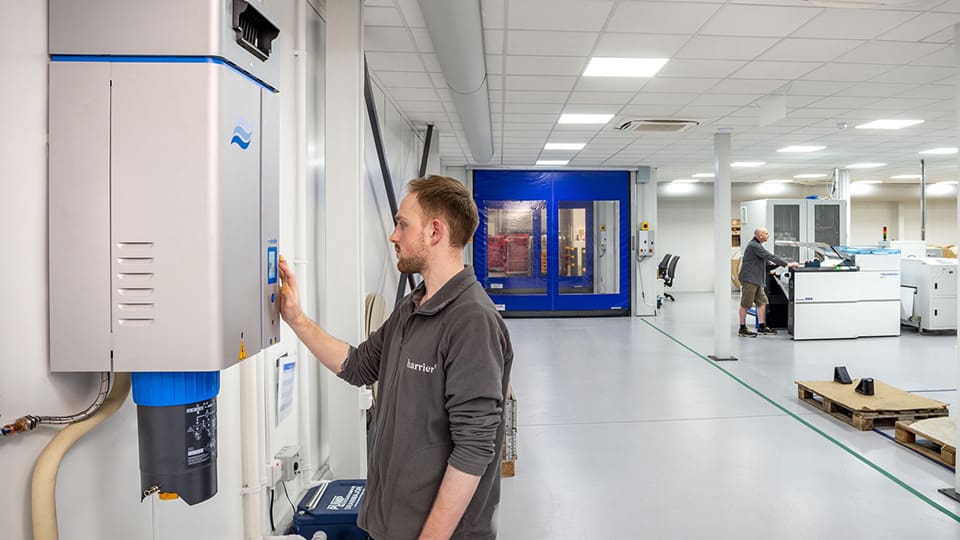
He offers the example of working in smaller rooms with a digital print machine, with these environments often only needing a wall-mounted steam humidifier with a fan unit, such as the Condair EL. These humidifiers can provide from just a few kilos of steam per hour to around 40kg. Other steam humidifiers include the Condair RS, which incorporates a scale collection tank that can be routinely emptied by on-site personnel, thus extending the periods between necessary maintenance visits.
Condair manufactures both high pressure and compressed air and water spray models
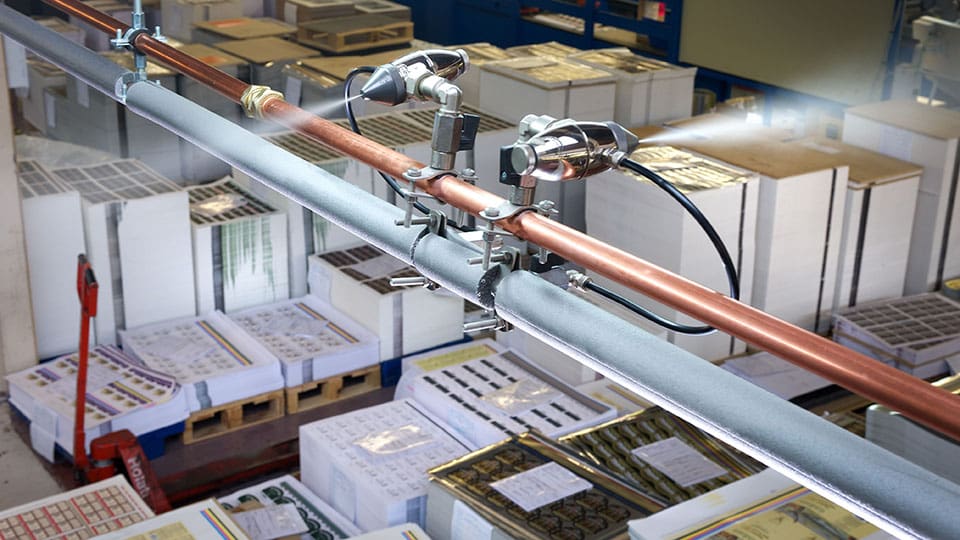
Larger print rooms, Marshall-George says, often benefit from spray humidifiers, as they not only provide humidity control but also free evaporative cooling, which can be advantageous, given the waste heat generated by print machines. Condair manufactures both high pressure and compressed air and water spray models and can provide detailed analysis on the level of cooling that can be achieved.
Finally, many older industrial buildings used by printers often suffer from poor ventilation, which can lead to excess air humidity causing condensation and mould on the building fabric, and excessive water absorption by the paper. Alongside humidifiers, Condair offers a complete range of dehumidifiers to help alleviate these types of environmental issues.
Counter Challenges
Also stepping forward to offer words of wisdom is John Barker, managing director at Humidity Solutions. Given the importance of paper in modern printing, and the more electrical nature of modern printers, Barker says adding water into a printing room might seem counter-productive or even harmful. While nobody is going to recommend spraying a hose onto the printing floor, Barker says the inclusion of a fine mist water dispersal counters many of the challenges that printers often face in this fast-paced industry.
“A quality humidification system allows for close climate control in the production area, meaning it can control relative humidity within a close range, preventing complications from high humidity such as paper jams or dimension distortion, and low humidity such as multi-sheet feeding, ink clogs, or static,” Barker says.
“The ideal humidity for printing and packaging is between 50-60%RH. This can differ depending on the type of printing, specialist equipment, ink type, or specific technique used as well as any substrates for printing on other materials such as fabric and canvas.”
Humidity solutions includes Airtec High Pressure Water Systems among its products
Barker goes on to say that low humidity can result in a ream of challenges, with static, web breaks, and paper jams causing manufacturing delays due to the combination of heat, low humidity, and friction present in the printing cycle. Uncontrolled humidity, Barker adds, can also cause warpage or shrinkage in product, creating further delays and misprints.
“Controlled humidity levels enable machinery to operate at peak efficiency, improving process times, increasing running speeds, and lengthening the serviceable lifespan of the machinery by reducing corrosion, heat, and friction damages,” he says, adding: “In those cases where glues or slower drying materials are required, controlled humidity can speed the drying process, allowing faster product development and lowering costs.
“High humidity is rare, but no less problematic. Too high a relative humidity can cause ink run and smearing, resulting in fuzzy prints and blurred edges. Printing also often involves hygroscopic materials which may wrinkle or bubble in the presence of too much water vapour in the air.”
The ideal humidity for printing and packaging is between 50-60%RH
As for how Humidity Solutions can help, Barker says the company recommends the Airtec High Pressure Water Systems. These humidifiers use cold water pumped at high speed and pressure, with the water dispersed into the target environment through stainless steel nozzles, forming a fine mist which merges into the surrounding air.
Another popular choice for printing applications is the Neptronic SKVF Evaporative Cooler. Within the model lies a honeycomb of water-coated media, encouraging evaporation and free cooling of any air stream channelled through it.
“As both of these solutions are cold-water based, we would then recommend a water treatment unit to ensure water safety and prevent mineral build-up in the humidification system,” Barker adds. The message here is clear: skimping on humidification systems could lead to a whole host of easily avoidable issues. Working with specialist providers in this market will help you pick out the most effective solution for your business and improve your production environment.
From advances in print quality and productivity to increasing demand for automation and sustainable solutions, the wide-format market continues to evolve. Rob Fletcher looks at the latest trends, challenges, and developments in this sector
Speaking to a range of print and signage professionals, we discover how a sustainable business model can drive growth, outlining actionable strategies to cut overhead costs, improve eco-efficiency, and boost your bottom line
As finishing continues to become a great way to add extra elements to your print and wow customers, we take a look at some of the creasers, folders, and collators on the market, and ask experts their advice on finding the right solutions
(this was inserted into the PHP of a code block)
Watch our latest video of the week
Print Monthly gives you the latest video coverage of companies, people, and events from within the print industry.