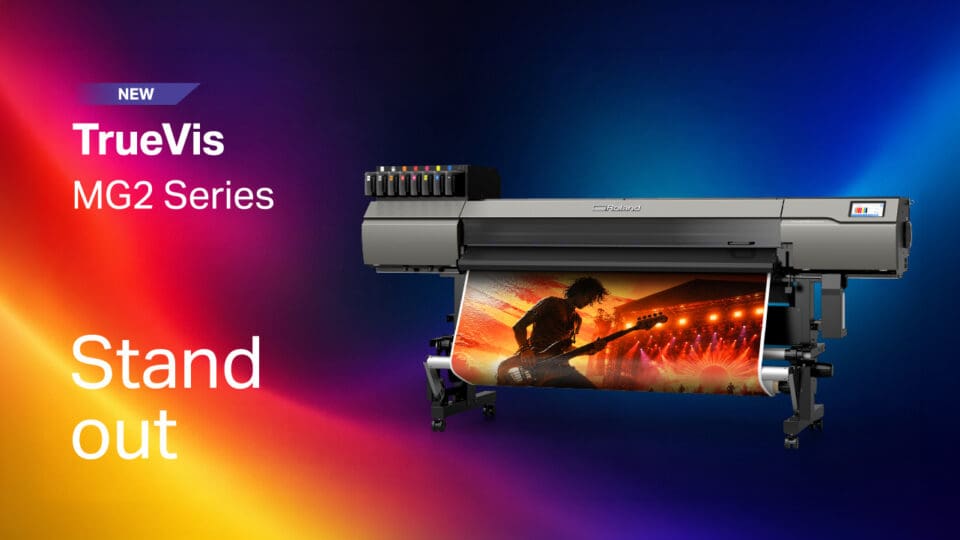
Roland DG launches TrueVis MG2 series
Roland DG has announced the launch of the TrueVis MG2 UV printer series, which offers integrated print and cut technology, a newly developed printhead, and expanded automation capabilities



From advances in print quality and productivity to increasing demand for automation and sustainable solutions, the wide-format market continues to evolve. Rob Fletcher looks at the latest trends, challenges, and developments in this sector

As evident through the many releases and events in the industry, wide-format print has been one of the most exciting areas in recent years in terms of innovations and development. Evolving customer expectations have driven manufacturers to release improved machines that present print service providers (PSPs) with more opportunities to diversify and add value.
However, technological advancement is only one part of the story. Rising operating costs, increasing sustainability demands, and ongoing labour shortages are changing how PSPs invest in equipment. Businesses are now seeking solutions that deliver not only outstanding print quality but greater efficiency, automation, and long-term profitability.
Against this backdrop, manufacturers are continuing to push the boundaries of what wide-format print can achieve. From productivity-enhancing features and workflow automation to environmentally conscious inks and media compatibility, suppliers are helping shape the next chapter of the market.
Up first is Colin Easton, UK and Ireland large-format country lead at HP, who says today’s wide-format print customers are looking for solutions that help them do more with less. As such, while productivity remains a priority, buyers are increasingly evaluating printers based on their ability to automate workflows, reduce operator intervention, and deliver consistent output.
In addition to this is sustainability, which he says has moved from a “nice to have” to a key purchasing factor. Easton explains how customers want technologies that help them reduce waste, lower energy consumption, and meet their environmental commitments without compromising print quality or versatility.
Finally, Easton highlights flexibility as being critical, saying PSPs are diversifying into new applications and that they need equipment that can support multiple media types and jobs efficiently. For technical and AEC customers, he says accuracy, reliability, and seamless digital workflows are equally as important as they increasingly digitise project delivery.
With HP, Easton says its latest generation of wide-format printers are designed around these three key pillars.
“For example, with our HP Latex portfolio, customers can produce a broad range of high-value applications using water-based HP Latex Inks while achieving vibrant colours, durable output, and consistent image quality,” he says, adding: “Recent innovations have focused on helping PSPs increase throughput, simplify operations, and expand into new markets without adding complexity to their business.
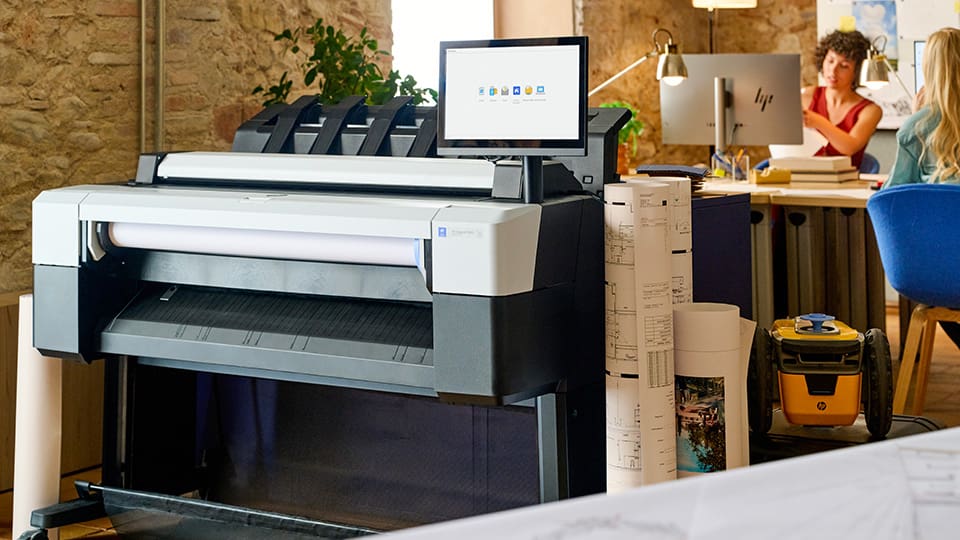
“Within the DesignJet portfolio, we continue to focus on delivering precise, reliable output for architecture, engineering, construction, GIS, and design professionals. Features such as intuitive workflows, enhanced security, and seamless integration with design software help professionals work more efficiently from project creation through to final output.
“What truly differentiates HP is our ability to combine industry-leading print technologies with workflow software, services, and sustainability initiatives. Customers are increasingly looking for complete solutions rather than standalone devices, and that is where HP’s broad ecosystem provides significant value.”
These developments greatly reduce cycle times and free PSPs to focus more on winning profitable new customers
But where can we expect the market to go from here? Easton picks out several core focus areas including automation and workflow digitisation, with labour shortages and increasing production demands encouraging businesses to adopt technologies that reduce manual processes and improve operational efficiency.
A second trend is application diversification, with Easton highlighting how PSPs are looking for new revenue opportunities beyond traditional signage such as wallcoverings, décor, personalised graphics, retail experiences, and short-run packaging applications. On top of this is sustainability-driven innovation due to brands, print providers, and end-use customers all demanding more environmentally responsible solutions.
Finally, Easton says the industry is seeing increased demand for connected, intelligent printing environments, where devices, software, and workflows work together seamlessly. He adds: “HP is responding by combining hardware, software, and services into integrated ecosystems that help customers increase efficiency and maximise uptime.”
Next, Phil McMullin, head of sales for the UK and Ireland at Epson, sets out how wide-format print covers many applications, with requirements in signage clearly differing from areas like textile production. However, despite this, McMullin says Epson has identified that all PSPs are looking for maximum uptime through improved reliability, automated maintenance, and first-class support.
“Delivering this ensures prints are produced right first time, reducing waste and minimising human interaction,” he says, adding: “Epson has recently focused on new, more productive printheads that can detect blocked nozzles and compensate on the fly. This technology is known as nozzle verification (NVT), and it ensures productivity and print quality is not impacted on long print runs.
“The other area Epson has developed recently is the whole colour ecosystem around our printers which includes the SD10 handheld spectrometer. The Epson colour ecosystem enables PSPs to easily match existing spot colours and reproduce them accurately in print with very little trial and error. Together, these developments greatly reduce cycle times and free PSPs to focus more on winning profitable new customers.”
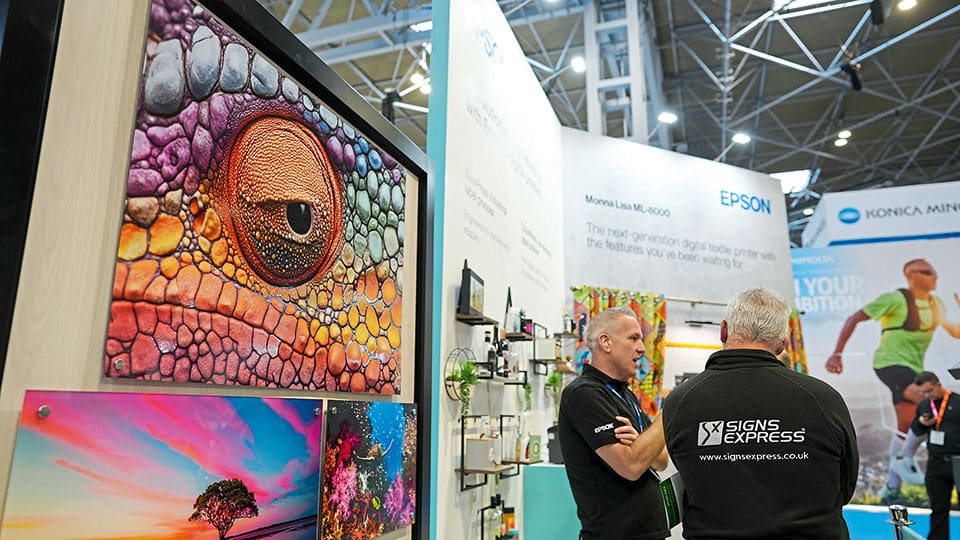
Going into more detail on Epson’s innovation focus, McMullin says the key selling points of its wide-format printers are that they are built with reliability and consistent performance in mind.
“Epson designs and manufactures its own printheads, ink, and main printer components,” he says, adding: “Like a Formula 1 car, everything is designed and tuned to get the best out of the complete unit. This may sound a simple idea, but it translates into maximum possible uptime and therefore improved profitability.”
Also weighing in is Andrew Edwards, partner sales manager for sign and graphics at Hybrid Services, the exclusive distributor for Mimaki in the UK and Ireland. According to Edwards, today’s customers are looking beyond headline print speeds and focusing on the total cost of ownership. This means low running costs, efficient ink consumption, and reduced power requirements all play a significant role in purchasing decisions, particularly for businesses looking to maximise profitability.
“Printers that run from a standard electrical supply also help avoid unnecessary installation costs,” Edwards says, continuing:
“Reliability is equally important, with businesses wanting equipment that will deliver consistent performance for many years. Finally, a comprehensive warranty that provides added confidence, ensuring their investment is protected also gives operators peace of mind.”
Factoid: The latest FESPA Print Census found automation, AI, and sustainability are now the three biggest strategic priorities for speciality print businesses worldwide
With this, Edwards highlights how the industry is moving towards greater simplicity and automation. He explains how many print businesses are operating with smaller teams, which in turn makes it important for printers to be straightforward to use.
“Rather than requiring constant supervision, modern printers should keep production running with minimal operator intervention,” Edwards says, adding: “Mimaki has developed multiple intelligent Core Technologies to achieve this, including the Nozzle Check Unit (NCU), which automatically detects blocked nozzles, and the Nozzle Recovery System (NRS), which remaps output using functioning nozzles to maintain print quality without stopping production.
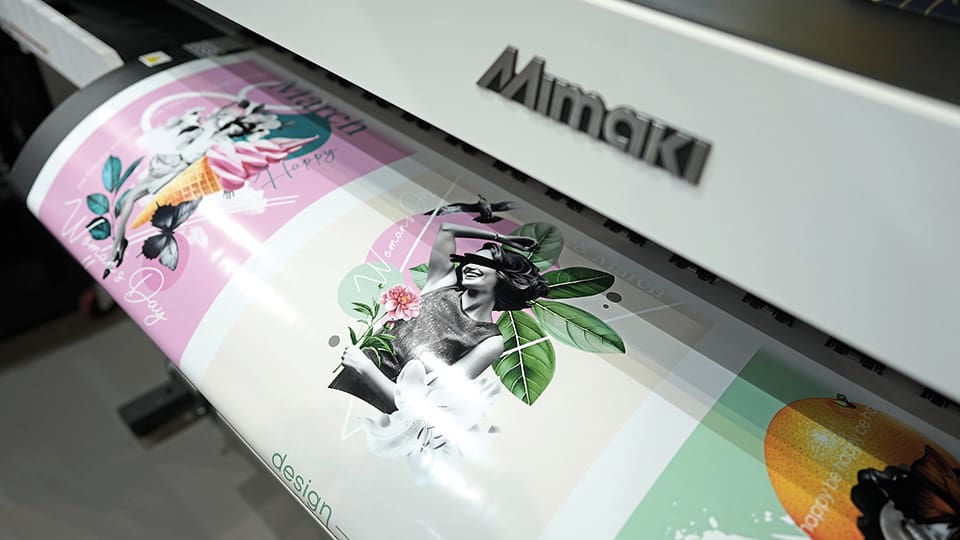
“Combined with automatic maintenance routines and the Mimaki Advanced Pass System (MAPS), which reduces visible banding, these technologies maximise uptime and help operators spend less time troubleshooting.”
Going into more detail on Mimaki’s approach to new innovations, Edwards sets out how one area where the manufacturer differentiates is by solving practical challenges for PSPs. He offers up future-proof ink technology as an example, with GBL-free solvent inks and UV inks formulated without SVHCs or CMR substances, helping users prepare for evolving environmental regulations.
Mimaki also recently introduced BS4 solvent ink to address a demand for lower operating costs. Rather than risking machine performance or warranty by switching to non-original inks, Edwards says Mimaki BS4 offers a genuine lower-cost alternative that maintains print quality, colour consistency, and full manufacturer support.
Rather than requiring constant supervision, modern printers should keep production running with minimal operator intervention
As for machinery, Edwards says the 200 Series – including the CJV200 and JV200 solvent printers, UJV200 UV printer, and TS200 dye sublimation printer – has been designed to make professional printing easier to get to grips with.
“The Mimaki 200 Series demonstrates how considered engineering can benefit both new and experienced users,” Edwards says, continuing: “Built on a single chassis across solvent, UV, and dye sublimation models, the range offers a consistent interface, familiar operation, and shared design philosophy. For businesses, this means a shorter learning curve, easier staff training, and a simpler path to expanding into new applications without starting from scratch.”
Elsewhere, Rob Goleniowski, regional general manager for the UK, Ireland, Scandinavia, and Baltics at Roland DG, says PSPs are looking for more than a printer; they want a complete production solution that helps them increase output, strengthen profitability, and respond quickly to new opportunities.
“Versatility is central to that,” Goleniowski says, continuing: “A printer that can handle a range of applications allows businesses to serve more customers, enter new markets, and generate greater value from a single investment.
“Reliability is just as critical. Every hour of productive printing contributes to the bottom line, so customers need equipment they can trust to perform consistently, day after day. On top of this, print quality and colour accuracy are increasingly important, particularly as end users demand sharper results and consistent brand reproduction across multiple applications.
“Ease of use brings all these elements together. Intuitive tools such as remote monitoring, Roland DG Connect and VersaWorks Backup help streamline production, reduce disruption, and give operators more time to focus on profitable, value-added work.”
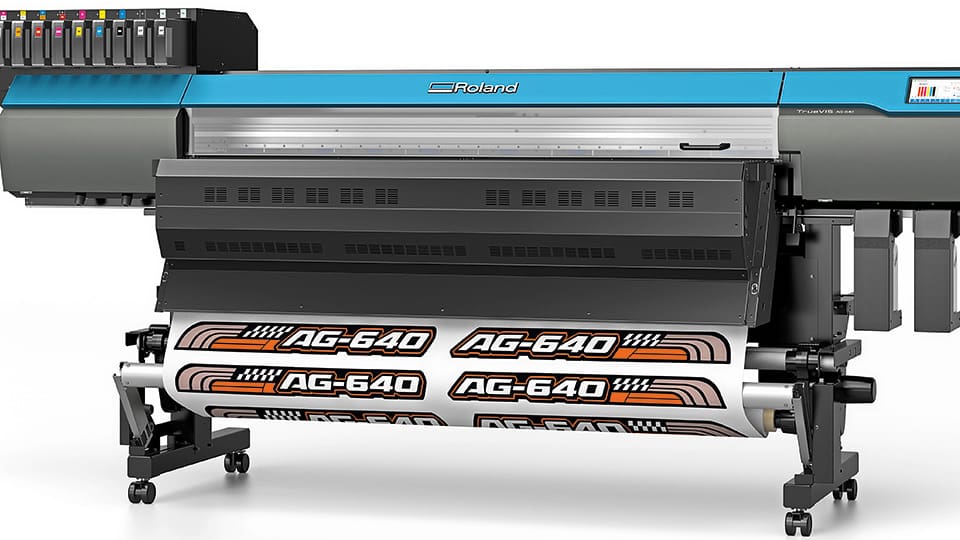
Goleniowski continues with this, saying that what differentiates Roland DG from other wide-format manufacturers in the market is the complete package surrounding the printer. He says customers are not simply purchasing a piece of hardware but rather investing in an integrated solution that includes powerful workflow software, connected business tools, training, service, and ongoing support.
“Our focus is on delivering long-term value rather than competing solely on the initial purchase price,” he says, adding: “Roland DG solutions are designed to deliver outstanding output and long-term value, combining reliability, versatility, ease of use, and exceptional print quality with comprehensive support throughout the machine’s lifetime – all at a competitive overall cost of ownership. For customers, that means greater confidence in their investment and a solution designed to support both their immediate production needs and their future growth.”
These developments greatly reduce cycle times and free PSPs to focus more on winning profitable new customers
Rounding off the discussion, Goleniowski offers an apt conclusion by saying that the market is moving towards greater speed, simplicity, and efficiency. He sets out how customers now want to maximise output and return on investment without adding complexity to their workflows.
“There is also a growing ‘today, not tomorrow’ expectation, with PSPs required to deliver high-quality work quickly and often at short notice,” he says, adding: “The TrueVis AG-640 is a strong example of how Roland DG is responding to this demand. Its fast-drying latex ink technology allows prints to move more quickly into finishing or installation, helping users meet tight deadlines and maintain a responsive service for their customers.”