Canon unites its full product portfolio
Launched at its first Leadership Summit, Canon UK & Ireland has launched Canon United, a new campaign to bring together all of the company’s portfolio



At its recent annual conference, the IPIA revealed further findings from its New Narrative for Print initiative, which aims to permanently shift the perception of print by end-users

The Independent Print Industries Association (IPIA) used its annual networking event to promote its latest research programme, which aims to effect positive change in the perception of print through utilising in-depth research of online conversations.
The event, held last week at the Manufacturing Technology Centre in Coventry, asked its delegates to look ‘beyond the margin’ – reflecting what the IPIA sees as a pressing need for the print industry to look past the immediate pressures of day‑to‑day operation and consider where future growth will come from.
The conference was kicked off by a talk from IPIA general manager, Brendan Perring, and Carey Trevill, co-founder of Mission Element, revealing the findings and impact of the IPIA’s flagship advocacy and research programme, A New Narrative for Print.
The programme, launched at the 2024 edition of the conference and with its initial findings published in a white paper in December of that year, calls on the industry to permanently shift the perception of print by end-users, consumer audiences, and related sectors.
Developed in collaboration with global insight agency, Madano, and a coalition of industry partners, this project has analysed more than 12,000 online conversations to uncover how print is perceived across key buying markets – and how those perceptions can be positively transformed.
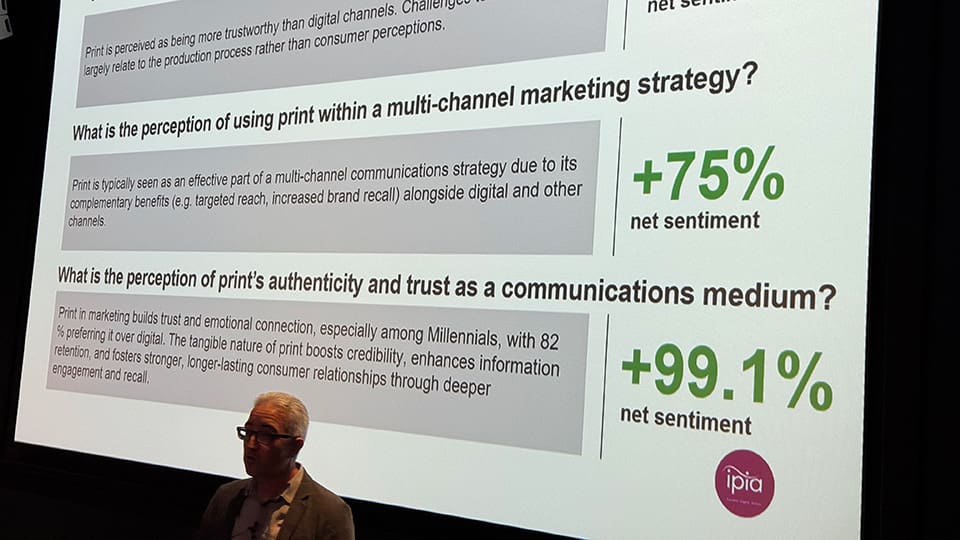
As discussed in the talk, the research found promising results in the general sentiment of print in the online world, with 73% of those conversations analysed suggesting that print is seen as more trustworthy that digital channels.
According to the data, challenges to this view largely relate to the production process of print, rather than consumer perceptions.
A particularly promising finding of the programme was that a reported 99.1% of net sentiment suggests that print in marketing builds trust and emotional connection, especially among millennials, with 82% preferring it over digital.
According to Perring, in contrast to a generally perceived sentiment that younger generations are increasingly moving away from print and towards digital, the research suggests that Gen Z individuals value print's tangible qualities, authenticity, and credibility, and experience a sense of relief from digital overload when interacting with physical media.
However, part of the perception problem in this regard is that those outside of the core industry do not always perceive these products as ‘print’, with the term mainly only being associated with print media rather than instances such as specialist packaging, labels, signage, and graphics.
In response to the findings, the IPIA launched a social media campaign with the slogan “Print Made This”, demonstrating a range of instances of print positively effecting people’s lives as well as its ability to make lasting memories and increase consumer engagement.
The talk then discussed how the IPIA engaged with a range of influential professionals, identified through the research programme, that could become pivotal advocates for the UK print industry.
The focus when choosing these ‘thought leaders’ was not simply to go for those with the most followers, but instead target respected individuals who, according to the gathered data, were looked to as informed and inspirational voices, and whose thoughts were widely adopted as perceived wisdom.
These included advertising executive, Rory Sutherland, marketing professor, Byron Sharp, and fashion designer, Holly Fulton, among others.
According to Trevill, many of those in the media and advertising space were already advocates of print for uses such as direct mail and out-of-home (OOH) campaigns, but had received push-back from clients and media buyers about misconceptions of its impact, cost, and sustainability.
Trevill then worked with these individuals to give a toolkit of data and case studies that could change that perception, as well as encouraging them to promote these positive perceptions on their influential social media accounts.
In addition, the IPIA hosted a debate at the House of Commons, with four speakers both proposing and opposing the motion: ‘Campaigns that include print are more effective.’
Aside from gaining valuable insight on the topic, the event was designed to create traction on social media. At the conference talk, it was revealed that a large number of social posts had resulted from the event, with engagement from outside the core print industry increasing.
As with all the talks at the conference, which included insights on the power of direct mail, the financial outlook of the UK, and the role of AI in 2025, Perring and Trevill’s address aimed to present data and findings which can help print professionals’ better market their own products and articulate its value to their customers.
As well as an expansive line-up of talks that gave a range of insights to the over 150 gathered delegates, the event included networking sessions designed to foster new conversations and connections.
Overall, the conference succeeded in its goal to provide delegates with fresh thinking and actionable data, challenging them to think about how their businesses can evolve and thrive, rather than simply survive.
More information about the New Narrative for Print initiative, its findings, and how to get involved in the project are available on the IPIA website.