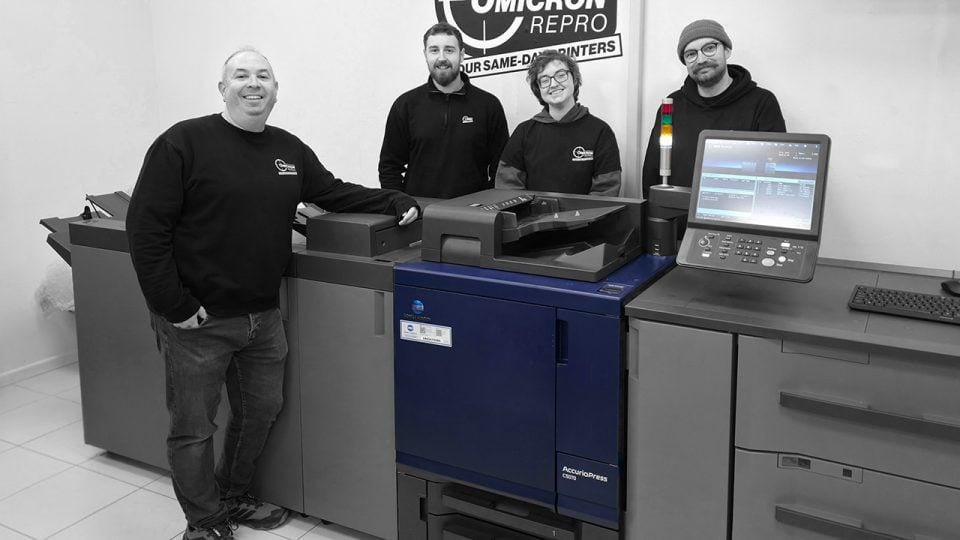
Print Show visit leads to AccurioPress C5070 investment for Omicron Repro
Omicron Repro says the new AccurioPress C5070 from Konica Minolta will deliver premium colour consistency, advanced media handling, and reliable automation

New research from Epson Europe has found that while there is a strong appetite for robotics in manufacturing, integration with existing production and a shortage of specialist expertise remain major barriers to adoption

New research from Epson Europe has highlighted the issues that manufacturers still face when integrating robotics into their production lines.
In a survey of over 200 businesses conducted at the recent PPMA trade show in September 2026, Epson found that manufacturers are actively exploring robotics to improve productivity and overcome labour pressures, but that integrating robots into existing production environments remains a challenge.
According to the survey, 44% of manufacturers with European operations are already using, implementing, or considering selective compliance articulated robot arm (SCARA) robots, indicating strong interest in the technology.
Epson believes that repetitive handling tasks present a clear opportunity for automation, with SCARA robots offering the speed, precision, and consistency these applications demand.
Pick-and-place was the leading potential application for robotics cited in the survey at 31%, followed by packaging at 24%.
However, integration with existing production was found to be one of the biggest barriers to robot adoption, cited by 21% of respondents.
At the same time, 31% said that simpler integration is the clearest way to encourage adoption, with intuitive or low-code programming ranking second with 13%.
Recruiting automation or engineering specialists was found to be the greatest workforce challenge for 43% of respondents. Skills shortages are delaying projects for 22%, while 18% say they make integration harder.
Only 14% of those surveyed are very confident their business has the skills needed to implement and support industrial robots, while 45% are not very or not at all confident.
More than two-thirds (69%) of respondents expect AI-enabled automation to increase or change the skills their workforce needs over the next three years, with 26% saying it will widen the existing skills gap and only 13% thinking it will reduce the need for specialist skills.
Volker Spanier, head of robotics solutions at Epson EMEAR, says: “SCARA robots represent a significant opportunity for manufacturers to improve productivity and efficiency across established production processes.
“However, integration challenges and skills shortages continue to hold back investment in industrial automation. Making automation more accessible and demonstrating how SCARA robots can deliver value within existing operations will be key to helping manufacturers move forward with confidence, accelerate adoption, and unlock further opportunities for factory floor innovation."
Spanier points to simplified integration as the key to allowing more manufacturers to benefit from robotic automation, adding: “Simpler integration and programming will empower manufacturers to apply that capability where it will deliver the clearest operational benefit. In the current economic environment, these are essential capabilities for any manufacturer focused on maximising efficiency.”