Publishers develop new “sustainable” typefaces to save paper
Publisher HarperCollins and typesetting company 2K/Denmark have both developed new typefaces to reduce the pages needed for their books
Jonathan Pert
September 30, 2024
2K/Denmark's Sustainable Serif font aims to deliver reduced CO2 emissions and financial savings
Innovations in typeface, font choice, and page layout have apparently led to significant savings in emissions for publishers, according to a report recently published by the BBC.
Typesetting company 2K/Denmark developed its Sustainable Typesetting project with the goal of efficiency in mind. The aim is to subtly change the typeface and more efficiently distribute space between letters and lines in order to, in its own words, “save a significant amount of pages and reduce the size of data files, delivering reduced CO2 emissions and considerable financial savings.”
The news has already caught the attention of print and paper advocacy group, Two Sides, which was made aware of the claims following a BBC breakfast news piece.
The perceived wisdom within font makers is that legibility of text is primarily determined by “x-height”, the height of the majority of lowercase letters in the Latin alphabet.
The x-height of a typeface can therefore be increased without enlarging the whole text, allowing for more letters per line of an equivalent sized typeface.
With this in mind, 2K/DENMARK has designed its Sustainable Serif font. This has a larger x-height than many equivalent popular typefaces, such as Garamond. These space savings can have a knock-on effect on the number of pages needed, which can therefore reduce paper usage. Over time these savings are believed to substantially reduce emissions.
But for Andreas Stobberup, project lead at 2K/DENMARK, it is important to also focus on the financial savings that these reductions will allow for. “We need to make sustainability cheaper,” he says. “We simply need to show that we do not think it is a compromise. We think it is a better product.”
David Miller, president and publisher at non-profit Island Press, reported a 19% reduction in pages and a subsequent 10% cost saving by working with Sustainable Typesetting.
Speaking to the BBC, Miller explains: “It is a sort of revolution in thinking about what typography can be and how it can be put to use in a very productive way.”
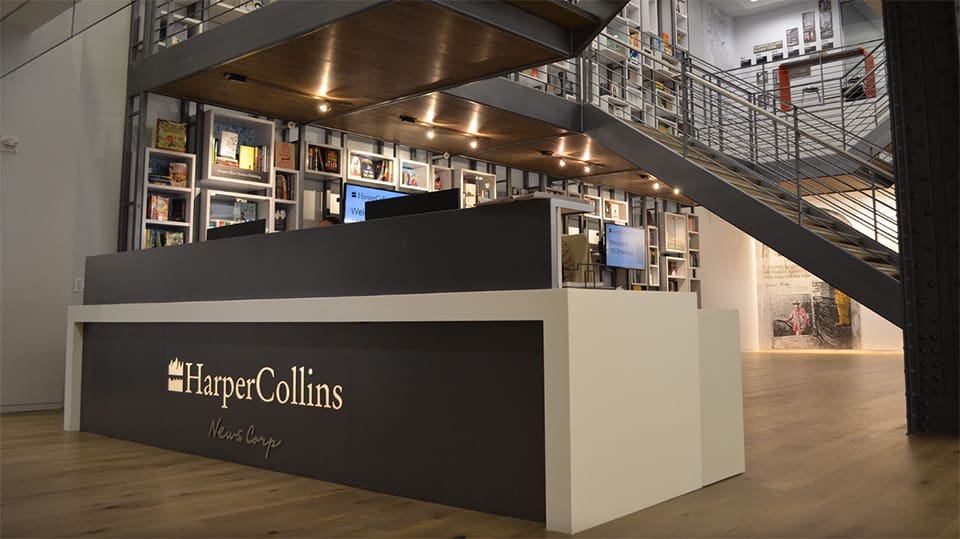
For HarperCollins, the push for typeface innovation originally came from its Christian publishing division, Zondervan Bibles.
A typical bible will use thousands of pages, but through experimenting with different fonts and adjusting page layouts, Zondervan was able to significantly reduce the number of sheets used. This reduced the amount of paper required per book and cut printing costs.
According to HarperCollins, the font and layout changes have so far saved 245.6 million pages
Building upon these findings, Zondervan and HarperCollins worked with 2K/Denmark to develop a font called the NIV Comfort Print. The new font ultimately saved more than 350 pages per bible, resulting in a total savings of 100 million pages in 2017 alone.
HarperCollins conducted further research, creating versions of books in its catalogue using a wide range of typefaces, to figure out which was most compact while still remaining readable and visually appealing. Based on these findings, it curated a list of 15 fonts that were determined to be the most “eco-friendly”. These are now the preferred fonts of HarperCollins.
According to the publisher, subtle changes to typeface, layout, and even ink choice have so far saved 245.6 million pages, equivalent to 5,618 trees. Further savings on emissions have been made by subtly reducing paper thickness.
Print Monthly approached Two Sides for comment on the original BBC article, and the claims of emissions savings quoted by the companies involved.
Jonathan Tame, managing director of Two Sides, comments: “Sustainable innovation for using fewer materials must be applauded, and no industry can argue with using less. However, the fact remains that paper physical books are a natural, renewable, and sustainable way of reading.
“We shouldn’t forget that paper books store carbon, are kept, shared, and when they have finished their life, can easily be recycled and made into new products.”
Speaking about the cost-saving measures, Tame adds: “As an industry we should applaud sustainable innovation which uses less resource. New type faces and light weighting paper may lead to less material.
“However, past the sales headlines of these companies promoting their own sales innovations we should also consider; Physical books are a choice for that haptic experience. Publishers should not overlook this when they are choosing cover or text materials.”
James Cropper has revealed a transformation in results for its Paper & Packaging division, despite highlighting a range of ongoing issues including rising energy costs and supply chain issues
Antalis has acquired the trade and assets of UK paper merchant, Ovenden Papers, after the family-owned business entered administration due to cashflow pressures
UPM and Sappi have nominated members of its senior staff as the chief executive officer and chief financial officer of its new Joint Venture, conditional on receipt of all regulatory approvals
(this was inserted into the PHP of a code block)
Watch our latest video of the week
Print Monthly gives you the latest video coverage of companies, people, and events from within the print industry.