Micropress invests in new Horizon iCE folder
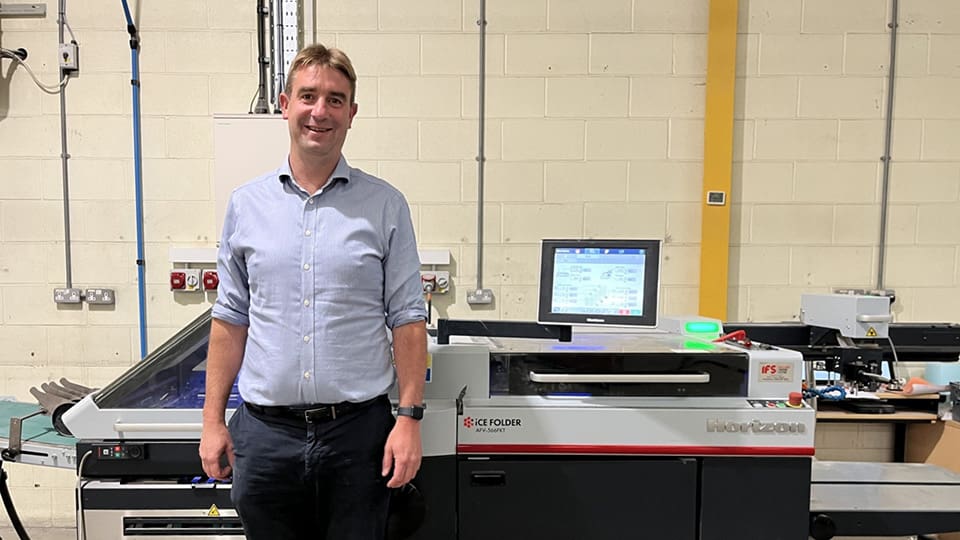
Micropress has continued its recent kit investments with the purchase of a new Horizon AFV-566FKT iCE folder, as part of goals to enhance its leaflet production capabilities



The IPIA is calling on the UK print industry to respond to a new government consultation regarding the control of the chemical GBL, which is present in a range of inks, coatings, and solvents

The Independent Print Industries Association (IPIA) has raised attention to a new UK Home Office consultation about controlled substances, which could have implications for thousands of companies in the print, signage, graphics, packaging, and associated manufacturing supply chain.
The Government is proposing tighter controls on Gamma-Butyrolactone (GBL) and 1,4-Butanediol (1,4-BD). These substances are classed as controlled drugs because of the potential for their criminal misuse, but they also have legitimate industrial applications including within inks, coatings, solvents, adhesives, polymers, and other chemical products.
While many modern water-based and latex inks do not include GBL, the chemical is still a component in a range of solvent, flexo, packaging, and direct-to-object (DTO) applications, among others.
The Government is now considering exemptions for mixtures containing 70% or less GBL/1,4-BD under Option 1, or a substantially broader 99% or less threshold under Option 2. The intention is for many legitimate finished products to remain outside licensing requirements, while businesses handling higher-purity substances would require controlled-drug licences.
According to the IPIA, affected businesses could incur licensing fees, DBS checks, additional administration, record keeping, storage, and compliance requirements. The Government estimates initial licensing costs could reach £4,700 per business, not including the wider compliance costs.
The public consultation regarding GBL and 1,4-BD (linked here) is open to responses until November 11th, with the IPIA calling on the UK print industry to respond en masse.
The association is also strongly encouraging members to check their ink, coating, solvent, and chemical supply chains and speak to their suppliers if they are unsure whether GBL or 1,4-BD is present.
Brendan Perring, general manager of the IPIA, says: “If your business manufactures, imports, supplies, stores, or uses affected products, please respond to the consultation. This is an important opportunity for the print industry to provide evidence of legitimate industrial uses and ensure that any new controls are proportionate and workable.”
The issue began with a UK government reclassification under the Misuse of Drugs regulations in 2022, which made possession of GBL illegal without a strict, expensive narcotics licence, directly threatening thousands of printing businesses.
The IPIA played a key role in spearheading the UK printing industry’s response to government restrictions on GBL when these restrictions were first proposed.
This included working with ink and printer manufacturers to calculate the potential economic fallout and outlining why standard printing inks could not realistically be reverse-engineered to harvest GBL for drug misuse.
The new consultation officially closes on November 11th, 2026. The full Home Office consultation document and the Home Office Options Assessment regarding the potential GBL restrictions are available online.