In this exclusive interview, Jonathan Pert speaks to Joan Perez Pericot, vice president and general manager of HP Industrial, about the launch of HP Nio and the role of AI in print
Jonathan Pert
August 1, 2025
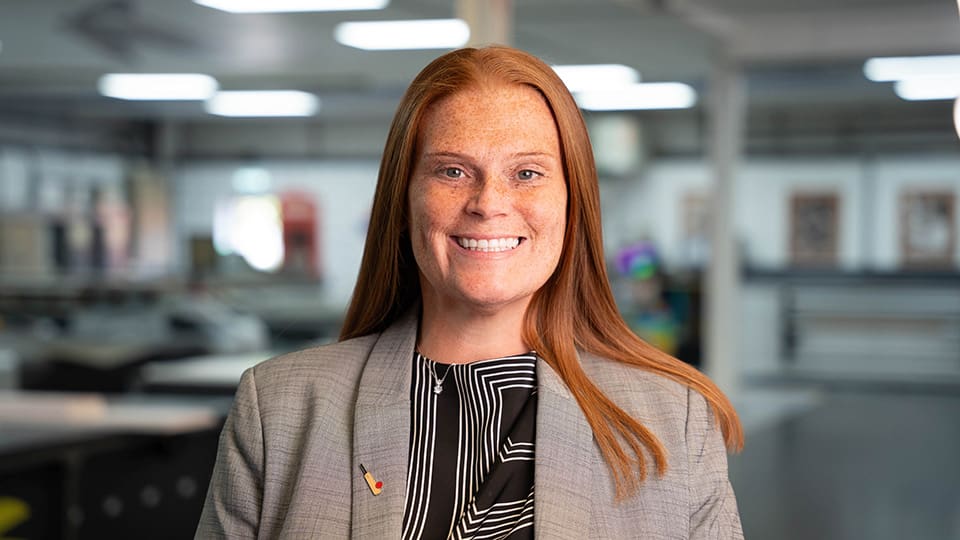
[Pictured] Joan Perez Pericot, vice president and general manager of HP Industrial
Can you talk through what underpins the innovations in AI and tech that HP Industrial has brought to the market?
Before talking about the innovations we have released, let me start as we always do at HP with the customer – understanding what the customer’s challenges are and what we can do to help them.
After the many interviews and visits we have done since we formed the new software and solutions team, it became very clear that many customers are really struggling to scale up growth efficiently. The core problem is not just in the presses – in fact, a common theme we hear is that the printing part is mostly solved, but where they are struggling is everywhere else.
There are three big themes we have been hearing loud and clear. One is the challenge of growth –the challenge of connecting with brands and streamlining this connection. This includes a lack of standardisation, long and complex integrations, and the complexity that these digitalised workflows are bringing between brands and print service providers (PSPs).
The second is all the complexity of all the different workflows they have inside of the production floor that are disconnected and different. It requires a lot of manual work to integrate them, to figure out capacity, to manage reprints, and to manage situations that are not really planned – especially in peak seasons.
The final issue is the lack of data that production managers and PSPs have in general, which means that they cannot make intelligent decisions, and cannot often make the most out of every piece of equipment. This lack of data ends up with the kind of errors, mistakes, and inefficiencies that stop them from maximising their capacity.
And how do your solutions aim to tackle these issues?
Our solutions try to solve all of these core issues with the concept of what we call an intelligent automation platform. We want to demonstrate how we can help our customers grow by streamlining their connection with their clients, and help them to run their production more efficiently with automation solutions that are dynamic, intelligent, and efficient.
We also want to show how we can help them maximise the capacity of their equipment and have more control by providing fleet management solutions that are smart – applying AI to maximise the output of the equipment, make the most out of every operator, and make them more productive.
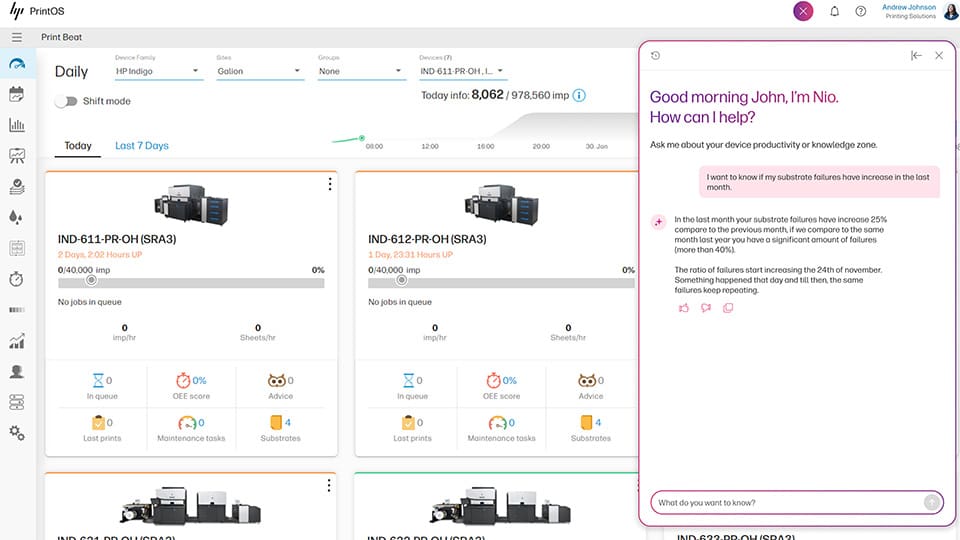
Nio is an AI companion which works on top of HP’s existing PrintOS system
Was that the core thinking behind the launch of HP Nio?
We released many technology enhancements built from customer feedback that we continuously invest in and develop. Among these solutions is HP Nio, which we recently announced at this year’s DSCOOP.
HP Nio feels like our first giant leap into artificial intelligence. We see Nio as a kind of AI companion for the production manager and for the operator. This companion can convert complex data and a lot of information that we have from the press into insights that can drive much more production, can boost the capacity and efficiency of the equipment, and also maximise the productivity of the operator.
Through Nio we can generate insights, we can do troubleshooting, and we can help the operator learn things and respond to questions in a natural language, a very casual manner, and an easy kind of interface. We believe this is going to be a real revolution on how operators and production managers interface with and make the most out of their equipment, and we are very happy with the innovation.
Traditionally the print sector can be a little bit hesitant to take on board new technologies, so what's the response been to HP Nio so far? And do you see much wider adoption happening in the near future?
So far the response has been great. We are now in the alpha and beta phase, and we expect the solution to be live in the market by the beginning of October.
The good thing about Nio is that it’s not a brand-new software or a new application that customers need to adopt – Nio runs on top of all of our existing PrintOS applications. This means it is embedded in the solutions that our customers have subscribed to already, providing an added layer of intelligence, insight, and interaction. For that reason, we expect a high adoption rate because it really adds a lot of value to the current applications that our customers have.
The way we have designed Nio is not just as a chatbot. It is not just a kind of ChatGPT-like interface that can answer questions and do some troubleshooting. Instead, Nio is what we call an agentic system. Nio is an orchestrator, and the way it works is that it truly understands the question of the user. We have a lot of privacy, security, and a lot of guardrails that we have put on top, leveraging a lot of the infrastructure and technology we have developed throughout HP, not just in the industrial space. When you talk to Nio, it understands the question, makes a decision based on proper reasoning, and then looks for the right agent in the right database that has the answer.
What is Nio connected to now and what are the plans for developing HP Nio further?
Today we have Nio connected with Indigo’s PrintOS Knowledge Zone, which basically contains all the product information, service notes, and all the documentation needed to maintain, troubleshoot, and fix the press. We also have Nio connected to the PrintOS Print Beat application that has all the information about the press telemetry, the overall equipment efficiency, and information about the jobs – therefore, all the information required to maximise press productivity and efficiency. Nio can talk with these two virtual experts on everything around the press and everything about the productivity, to answer any type of question.
Nio is not dependent on which application you are in. It can be in the Knowledge Zone and answer questions about productivity. You can be in the Print Beat application and ask questions about the Knowledge Zone. So, Nio is really ubiquitous to all the print applications on PrintOS. And the good news is that we can keep adding new databases – we can add information on the coloured binary ink developer (BID) units, we can add our large-format equipment, we can add Pagewide equipment, and we can add third party data. We can keep expanding the platform and the knowledge, allowing Nio to orchestrate answers across our entire fleet.
One of the next things we want to do for instance is add Nio within Site Flow. Site Flow is a workflow automation system that optimises and automates print production from order intake to shipping. If we are able to not just have information on the press, but also have information on the workflow, we really can have an end-to-end perspective which can correlate information and provide production managers with much more insightful information.
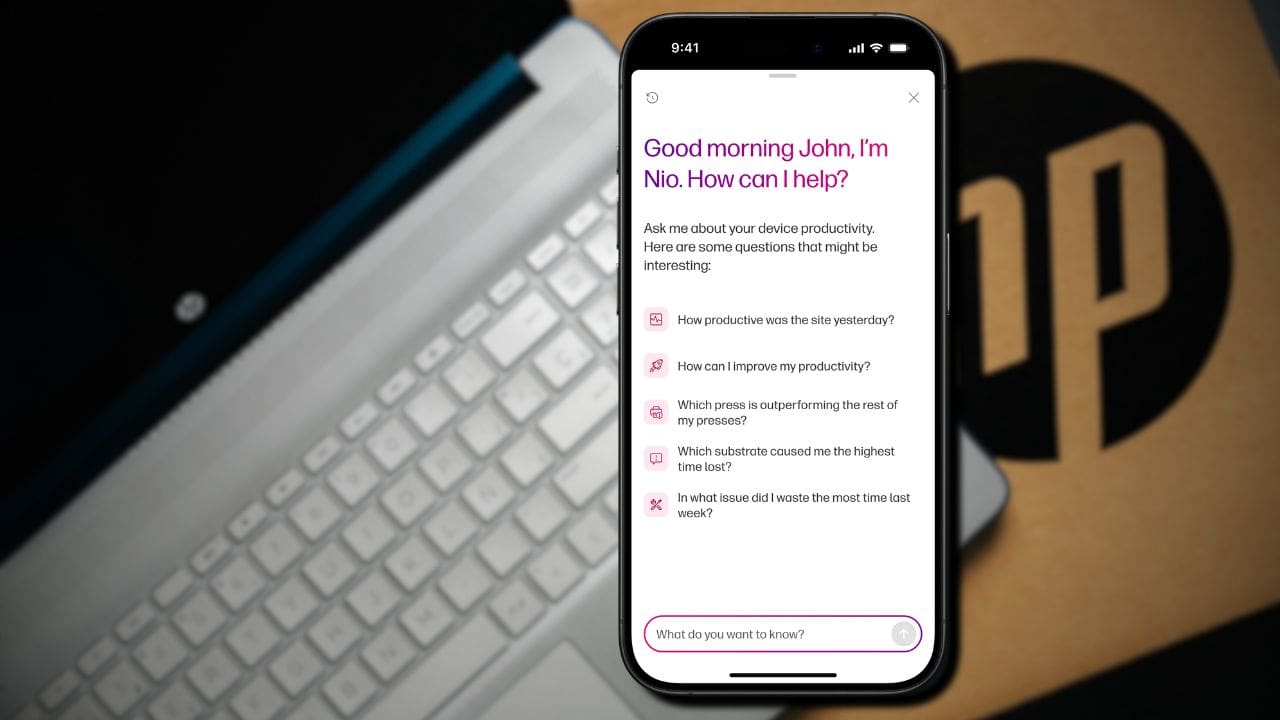
Nio is designed to work on desktop and mobile, allowing for information gathering even while off site
With print automation seemingly ever increasing, how important is it for the data behind this automation to be accessible and transparent?
I think it's critical. The need for automation is really increasing, driven by labour challenges and driven by all the modern complexities that PSPs encounter. Automation really is a must-have to scale up the business and to grow. In fact, we have demonstrated that customers that are adopting our automation solutions are growing around 27% faster than the rest of our customers. This is because they are able to respond faster and more efficiently to the changing needs of the market. So automation is crucial, and data is the source of all this automation.
This is not just about automating repetitive tasks – this is about truly understanding the data, connecting the dots, and making dynamic decisions in real time. Data management is going to be increasingly crucial and that's why we are putting a lot of focus on not only creating the data, but protecting it and making the data able to connect the different systems and all the different areas of HP. Accessibility to that data is fundamental – it is what is feeding all the intelligence of the automation solutions.
How much would you say that innovations like AI can help to create the next growth period in print?
I think it can be a big part of that, but I don’t think it will be one particular thing or another that will create the next growth period. It's not that the innovation is only in software, or it's only in AI – you’re seeing innovations across the whole industry.
I think the key here is to be able to have end-to-end innovation and be able to connect all the dots. We want to have innovation in the print process, which we can connect with the wider workflow, and also help our customers to connect and get more jobs, with everything working in synchronicity together. That's why we are trying to become more of an overall solutions provider, not just a machine vendor or a hardware vendor.
In what ways do you therefore think that AI can transform the industry?
There are three big pillars of transformation that I see as part of the AI revolution: autonomous automation, orchestration, and becoming the new user interface. Let’s go through these one by one.
The first is that AI is going to transform automation. Today automation is basically about automating repetitive tasks – it is rule-based and very, very static. AI is going to change that, generating a whole new era of automation that is autonomous, that is dynamic, and that is making decisions in real time.
The second transformation that we believe in is the concept of orchestration. You can have autonomous agents or autonomous elements working in silos, but this can be very inefficient. If you have different agents from different areas and you are not able to connect the dots, this can be very problematic, and can drive you to a big failure. So we believe that the AI revolution is going to come not just from having more autonomous automation, but having a layer of orchestration that can make all these agents work together in sync and make decisions that are dynamic all across the workflow – not just in different silos or different isolated areas. What you want is a central brain that is looking at all the workflows end-to-end and really triggering decisions across the whole system in an intelligent way.
The third element is that I believe AI is going to become the new interface, transforming how PSPs interact with systems. Today, PSPs may be using 20-30 different software programmes with different interfaces, with different UX and UIs. AI is going to create a revolution in the way we interact with these various software applications, becoming the new central interface from which we work. AI will be your new landing page every morning, connecting you with other solutions, generating the information you want to see, and responding dynamically to the questions you have.
This is why we are being very bold about AI, and why we really want to lead the intelligent automation revolution. I believe AI, if harnessed properly, can be truly transformational.
Following the launch of AI Adoption in Manufacturing: A Practical Toolkit from Made Smarter, we speak to Kevin Smith, lead technology specialist at Made Smarter North West, about how print and packaging companies can benefit from the new practical toolkit
Following her award win at the Welsh National Wedding Awards, we speak to Grace Hussey, owner of Print On Me, a print and stationery company based in Caldicot, Monmouthshire, which come together with the help of her father, Peter Flynn, owner of International Graphics Supplies (IGS)
We speak to Samantha Overton, managing director of Zebra Print Group, about the volatility of the modern print market and navigating supply chain disruption
(this was inserted into the PHP of a code block)
Watch our latest video of the week
Print Monthly gives you the latest video coverage of companies, people, and events from within the print industry.