What’s the Difference Between a True Flatbed and a Belt-Fed Hybrid Printer?
A true flatbed printer can enable greater accuracy and positional placement of media. However, that's not to say that belt-fed hybrid solutions don't have their place. But what are the differences between the two technologies? SwissQprint gives its insight
Guest Writer
June 15, 2026
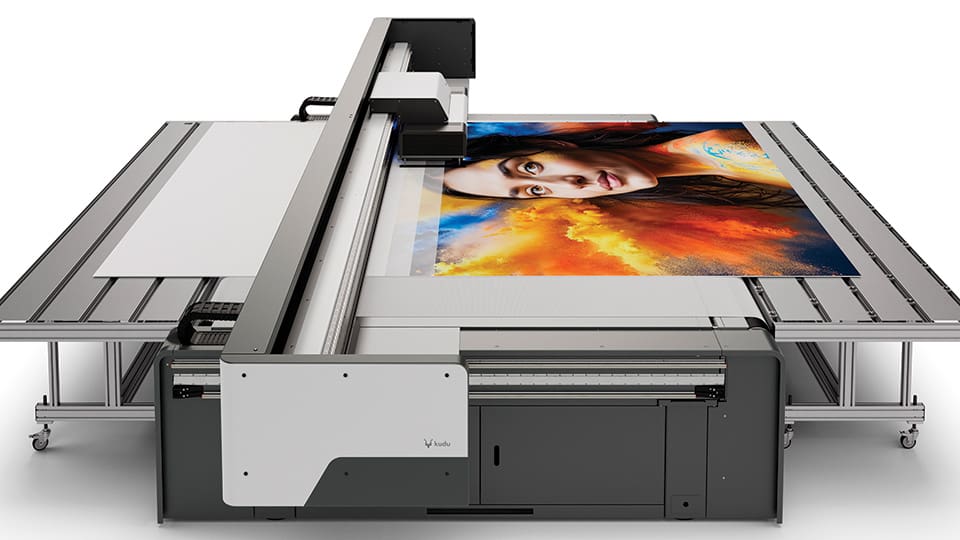
The swissQprint Nyala 5 flatbed printer
There is much to weigh-up when buying any piece of printing equipment, and in the large-format market considering the technology that drives the machine is a factor. It can make the difference to your return on investment, print quality, and operational efficiency. In short, you need to be sure.
There are two technologies at play if you want to print onto rigid materials: flatbed and belt-fed hybrid. UV inkjet technology has helped these two formats, with the ability to enable high-speed and high-resolution printing on a diverse range of media. Both have their pros and cons but it's worth examining the two approaches; why opt for one over the other and what's the best route to maximum quality and efficiency?
Variety of Choice
To help understand the approach, it’s worth looking at belt-driven machines and compare them to true a flatbed design. A conveyor system on the belt-fed hybrid machine is used to move materials under a stationary print gantry and are often considered if a larger share of the work is on roll material. There is a wide variety of machines to choose from, with different manufacturers offering systems at varying speeds and prices.
These systems – from 1.6m to 5m-wide – are best suited for continuous large runs using collapsible roller feed tables, allowing operators to easily handle oversized boards. Feeding the material through is straightforward; as a job is being printed, the next one is already being lined up, ready to slide into position.
Improved Access
The roller feed tables don't just offer loading advantages. They can be detached when not in use helping to reduce the footprint of the machine, improving access for operators on the shop floor. Without the tables, the machines themselves can have a comparatively smaller footprint providing easier access into buildings without wide access.
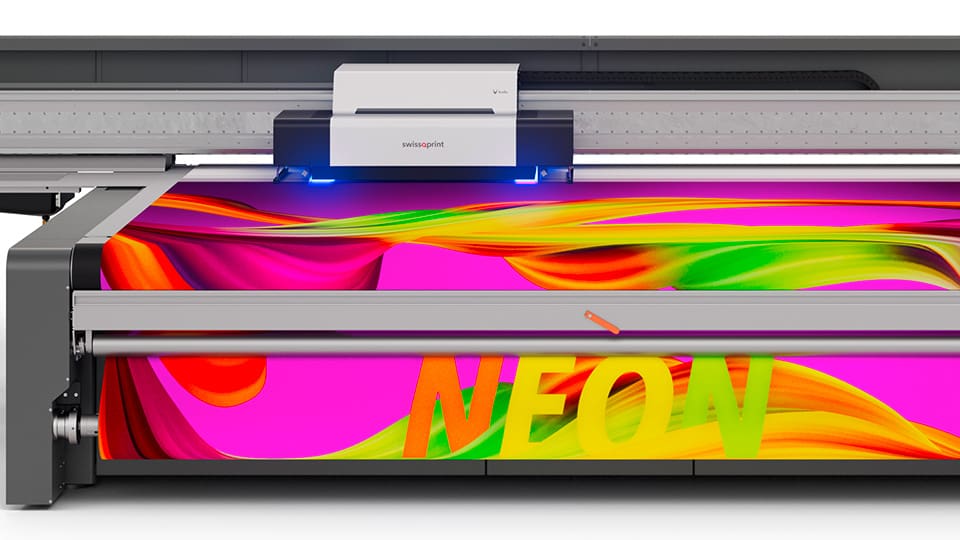
The swissQprint Kudu printing with its signature neon inks
Belt-fed hybrids can handle oversized boards; an advantage compared to most flatbeds. However, while this may be the case many hybrids are not able to print anything less than A3 size.
Print Quality
Print quality tends to be good enough for many applications that do not require up close viewing. However, when it comes to printing fine text and high-quality, for example, a true flatbed is the better bet. That's because with belt-fed systems, there is less control of dot placement due to the moving belt, and they tend to run with a higher distance between the print head and the material. Hybrid machines will struggle with accurate double-sided printing, whereas this is a simple, very precise process on a true flatbed. If neither is an issue, then a print service provider (PSP) can find a low-cost hybrid solution.
Risk of Errors
Hybrid systems can encounter alignment issues – the belt needs to be fully in sync with pulleys and idlers or there can be issues with the quality of the finished job. With the material moving, the risk of errors in the finished job is great. Servicing and cleaning belts can also be costly and time-consuming, with full-bleed printing.
Roll-to-roll material printing on belt-fed systems work well on higher end machines, but lower end alternatives create issues if left unattended as they won't track straight when printing.
A flatbed allows the user to get a better visibility on checking the quality of prints while the machine is operating. On a belt-fed hybrid, the material is printed on an enclosed system restricting what you can see. That said, these systems often incorporate a hinge door allowing the operator to open the engine and lean in to inspect the progress of a job.
Flatbed Accuracy
For a true flatbed, the drift and registration issues that come with belt-fed applications aren’t a factor as the media is fixed onto the bed. The material can be positioned precisely on the vacuum table and printed with complete accuracy. The roll-to-roll option is better than most belt-fed hybrid machines because the tracking is straight.
The Kudu in the oversize board option
Edge-to-edge printing and accurate double-sided printing also works in favour of a flatbed system using the precise registration pins. It means that PSPs buy the material at the size required with no need to cut or trim. It’s another sustainability win as it reduces the waste created by discarded material.
A true flatbed is more efficient than a belt-fed hybrid because it uses five-times less energy to drive the media, thanks, in part to the role the vacuum plays on the bed. This doesn't just give it a sustainable advantage but also a financial one.
Special Effects
Art reproductions or any print requiring tactile effects – raised print, optics, relief, or braille – are well suited to flatbed technology. Multi-pass printing for high build layers is not possible on a belt fed hybrid.
It’s also worth noting that flatbed printers can become a hybrid system. For example, there is the option of roll-to-roll for single rolls up to 3.20m wide or dual rolls up to 1.55m each. Because the roll is guided across the print table, it provides the user greater flexibility when printing films or banners. There are two approaches here: fixed beam where continuous images are printed with the beam in a stationary position; and picture wise for images smaller than the flatbed table and where the machine operates in flatbed mode.
The scope of available media is also wide. Varying formats, such as pre-cut or large sheets for further processing, and heavy or difficult to handle substrates are ideally suited to flatbed printing. For example, glass can be accommodated without difficulty thanks to the blow function of the vacuum. The material effectively floats on the bed, making it easy to move around. A flatbed system can efficiently handle large panels of up to 3.2 × 2m. The true flatbed's main strength is that it can pretty much print anything including applications such as pens or notebooks – anything intricate at any size.
Ease of Use
Simplicity means that an operator can easily set up a job (taking less than two minutes), hit the print button, and walk away. The open design and architecture of the flatbed printer give the operator visibility of the job. In addition, the operator can intervene and take corrective action, if necessary, with no loss of material.
That user-friendly approach gives flatbed machines an advantage, enabling them to be the efficient, productive workforce that a large-format print business needs. Of course, it’s often dependent on applications but a true flatbed solution ticks many boxes that belt-fed hybrids struggle to compete with.
Weighing up the Choices
In summary, belt-fed hybrids are the preferred option for continuous printing and for handling oversized materials. It targets applications that don't require fine print quality and is ideal for PSPs where space is a bit of a premium.
Quality and printing on a versatile range of materials and applications, true flatbed has the edge while also being highly productive. Energy efficiency and waste reduction are further pluses for those weighing up the two technologies.
Pros and Cons at a Glance
Belt-Fed Hybrid
Pros: Suited to continuous large runs; smaller footprint with collapsible roller tables; and can handle oversized boards.
Cons: Alignment issues with the belt; unable to print sizes less than A3; costly servicing and cleaning; and potentially inferior print quality.
True Flatbed
Pros: Ideal for fine text and high-quality; energy-efficient; highly productive; and wide scope of media and applications.
Cons: Wider footprint requiring more space; and narrower variety of machines to choose from.
For more information
To discover more about the swissQprint range of high-quality true flatbed printers visit https://www.swissqprint.com/ch/en/flatbed-printer/
Marketing manager and freelance marketing consultant, Rachael Hunt, talks about the impact a social media ban could have on print and the wider trend of disconnecting from digital technology to interact with tactile experiences for both practical and marketing purposes
Advercado was set up in 2020 by Joe Reid and Will Booth as a way for small businesses to find affordable advertising. Six years later the company is reaching out to printers to help local businesses utilise PSPs. In this article, Reid tells about the thinking behind this venture
In this guest article from The T-Shirt Bakery, we find out first hand how AI is being used to improve workflow and the value it adds to a business looking to grow in 2026
(this was inserted into the PHP of a code block)
Watch our latest video of the week
Print Monthly gives you the latest video coverage of companies, people, and events from within the print industry.