Creating Effective Sales Channels on Print Webshops
As online print offerings continue to evolve, including the use of AI, automation and customisation, David Osgar speaks to several players in web-to-print to find out how businesses can best utilise various different platforms
David Osgar
July 25, 2025
How do customers purchase print in 2025? This is a question constantly asked by members of the print industry as they grapple with changing landscapes and the habits of Gen Z consumers.
While the need to be online has been evident for the past twenty plus years, the question now is how print service providers (PSPs) can navigate different online channels to reach consumers and buyers? Ways that businesses can now sell to customers include e-commerce websites, marketplaces like Amazon, Etsy, and eBay, as well as mobile apps and sales channels such as Shoptify.
So, what is the best way to access these platforms and how can PSPs effectively use webshops and online portals to increase profits and visibility?
Transitioning from the 'Industrial Era of Print'
A big player within software in the past few years has been Gelato, a global print on demand platform which offers a catalogue of custom products made to order locally across 32 countries.
Speaking about the company’s production print platform, Marcus Boijemyr, chief product officer at GelatoConnect, says: “Gelato's vision is to redefine global manufacturing for the benefit of people and the planet […] GelatoConnect is our AI-powered operating system for PSPs, which helps them across 30 plus countries optimise procurement, workflow, and logistics to drive growth and enhance efficiency.
“Unlike traditional MIS/ERP systems, GelatoConnect is purpose-built for modern PSPs. It unlocks new digital demand while replacing manual work with real-time, intelligent automation – helping printers grow faster, operate leaner, and deliver consistently higher quality.”
Marcus Boijemyr, chief product officer at GelatoConnect
When discussing the need for PSPs to use webshops in 2025, Boijemyr says that transitioning from legacy systems is crucial when looking to unlock “significant revenue”. “Beyond just providing a sales channel, webstores enable B2C and B2B customers to purchase from PSPs in a way that's consistent with how today's consumers and businesses purchase what they need and run their operations,” adds Boijemyr.
Describing what GelatoConnect offers, Boijemyr says the software gives PSPs a way to connect, manage, and grow their order volume by leveraging flexible integrations and intelligent automation. “This is vital for the ongoing evolution of print businesses,” Boijemyr emphasises, adding: “Enabling them [PSPs] to expand on their traditional quote-based approaches by integrating efficient and automated SKU-based production, where a webshop combined with software like GelatoConnect can significantly enable growth and allow PSPs to capitalise on the rising demand for customised, made-to-order products.”
A common mistake that Boijemyr highlights is for businesses to treat webstore orders like manually processed quote-based jobs, which creates inefficiencies and “limits scale”. GelatoConnect is an example of a platform which integrates with webstores like Shopify, Infigo, and Pressero in order to automate production, shipping, and inventory replenishment end to end.
Boijemyr also highlights the importance of understanding the target audience, emphasising that B2C customers will be dependent on effective marketing, therefore meaning PSPs need a clear strategy to create demand generation from their customers.
Beyond direct webstores, Boijemyr points to ecommerce platforms like Amazon and Shopify as well as specialised volume aggregators like Printerpix and Cloudprinter which can all help to aggregate volume and produce vast amounts of micro-orders.
Boijemyr highlights that the biggest consideration for PSPs today is not the capacity or ability to produce the print, but largely how quick and efficient the work can be produced.
We are seeing a significant shift in the print industry. The average print run has decreased from over 3,000 units to fewer than 30, leading to a rise in micro-orders and increasing complexity in production
“We are seeing a significant shift in the print industry,” says Boijemyr, adding: “The average print run has decreased from over 3,000 units to fewer than 30, leading to a rise in micro-orders and increasing complexity in production. This transformation marks the end of industrial era print economics. The winners will be those who embrace software, automation, and agility at the core of their operations. That’s what GelatoConnect was built for.”
Making Print Hassle-Free
Another company which has weighed in on the relevancy of webshops is Four Pees, an international consultancy and services organisation. The company helps businesses with “hassle-free” automation by providing web-to-print, job onboarding, packaging creation, and pre-press automation.
Tom Peire, chief executive officer for Four Pees and chief evangelist of Atomyx, says: “The web-to-print picture has become increasingly complex in recent years with new channels emerging such as consumer and B2B marketplaces, print-on-demand services integrated with Shopify, and APIs connecting to enterprise ERP systems, meaning print shops can now manage their own production whilst outsourcing work to other print companies.”
Tom Peire, chief executive officer for Four Pees and chief evangelist of Atomyx
Piere points out that many printers are now faced with rising raw material costs, energy prices, and demand from customers for lower prices, meaning many are turning to web-to-print as a solution. When it comes to the considerations a company should have when implementing a webstore, Piere says:
“The simple fact is that without all systems of a webstore communicating automatically, a printer’s webstore will be rife with inefficiencies. PSPs should choose a web-to-print solution that can integrate smoothly with their existing website and connect to third-party software such as MIS, ERP, or automation platforms. This ensures that the print webstore doesn’t just sit in a silo but becomes a fully functioning part of their wider production and sales ecosystem.
“With connected automation, inefficiencies are eliminated with connectors linking the website, ERP, and carrier system, forming a continuous flow of information, removing the need for manual intervention and avoiding human error.”
The simple fact is that without all systems of a webstore communicating automatically, a printer’s webstore will be rife with inefficiencies
Piere points to Solopress as an example of a commercial printer utilising connected automation to increase its efficiency. Compared to 2019 the business is now operating at a 99.85% time dispatch rate, after automating its processes, with around 500 out of 2000 orders a day being manual compared to automated.
On top of offering print portals to manage future orders, Piere also suggests PSPs should work with large companies or brands in order to act as a print partner whenever an order comes in from an employee or user. “A software provider and integrator like Four Pees would facilitate the implementation of the portal itself,” says Piere.
“Another benefit of offering print portals is increased loyalty through offering repeat customers their own dedicated portal where they can easily reorder branding materials. Printers could market this as an extra service, and they have themselves another revenue stream,” explains Piere, concluding: “There’s no one size fits all and it’s the role of software integrators to facilitate a solution that works best for each printer’s individual need.”
Building a User-Friendly Experience
Another company that specialises with web-to-print and ecommerce platforms is VB Media, which works with print companies to establish an online presence and sell products and services.
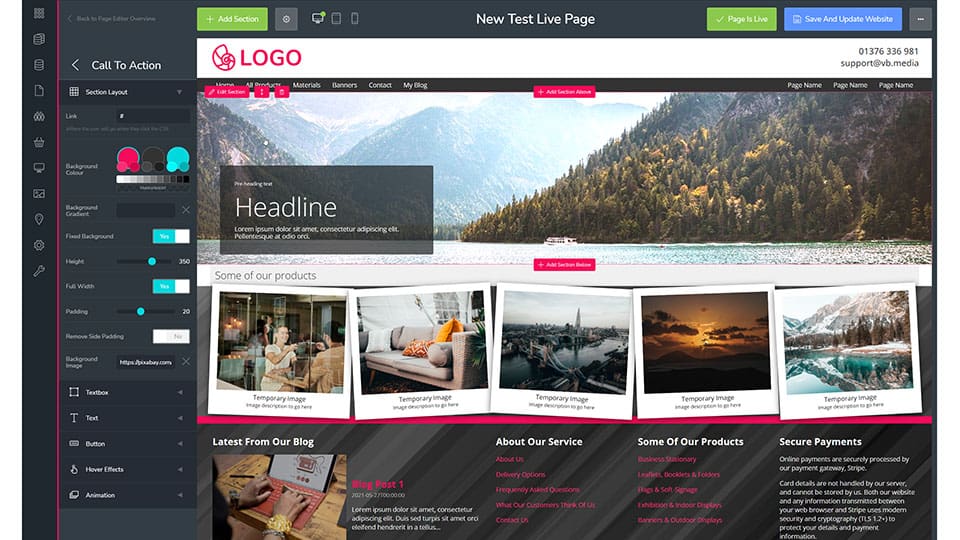
Wayne Bodimeade, director of VB Media, says: “Our ecommerce websites enable printers to provide web-to-print services to their customers, and are flexible enough to operate as stand-alone e-commerce sites, or to set up private storefronts, merchandise stores, or even trade websites. We enable printers to ‘dip their toe’ into ecommerce without any web design knowledge or any need to make large investments.”
Speaking about modern consumers, Bodimeade notes that ecommerce is an essential part of how the public research and buy products, regardless of whether it is B2C or B2B. VB Media highlights research from Sana Commerce from 2024 that shows that more than two thirds of global B2B buyers prefer to place orders via supplier websites.
VB Media users are able to add their own products and ranges from integrated trade suppliers
Bodimeade says: “Even if not all your orders come through your website, having the ability to sell print online can decrease ‘sales friction’ by making the process easier for your customers. Being able to offer prospective customers the option of a private storefront through which to place orders from a pre-approved product range can give your business the edge when tendering for work from large corporate clients and franchises, without the need for hefty investment. It’s not just about having your product range available to buy online, either. If you are able to generate a quote that you can send to your customer, which they can then easily accept and pay for online, that is a massive benefit, especially for those smaller print businesses which rely more heavily on a positive cash-flow.”
When it comes to the considerations to have when implementing a webstore, Bodimeade suggests making a website more than just a ‘digital version of the company brochure’ and emphasises giving the buyer a user experience that makes the tasks they are doing as easy as possible. Bodimeade also highlights how print providers can offer vastly different products, this means creating a system that can flexibly cater to not just different variants of products, but also customised characteristics of attribute-based products.
“Beyond how your system accommodates products, some other considerations are universal, such as speed and performance, data security, and usability when it comes to editing your website and managing your online product catalogue,” says Bodimeade, who adds: “At VB Media, our platform also offers a way for users to process and manage the orders placed on their websites, as well as integrating with PitchPrint to enable our customers to allow buyers to customise designs online and create products using pre-built templates.”
Factoid: According to a 2023 report by Smithers, the market for web-to-print totalled around $25.1bn (£18.7bn), which was up from $21.4bn (£15.9bn) in 2018
As evident by the way people interact with the modern world, and the answers to many of those questioned in this article, it’s evident a webstore of some level is important to a print business. Piet De Pauw, head of marketing and ecommerce at Enfocus, likens not having a webshop to saying "no" to the question – “do you want to do business?”
As a provider of automation software for the industry, Enfocus has seen many of the challenges and changes that have happened online in recent years. De Pauw points out the 20% spike in ecommerce that happened during the pandemic, which has now made online shopping the norm for many.
De Pauw’s advice for having a smooth running operation is to make sure equipment and processes can be integrated successfully into a web-to-print platform. “A webshop is redundant if you have to download files and manually input jobs specs as if you received them in an email. Data should freely flow from a webshop into the MIS system and out to production.”
De Pauw also highlights marketplaces and websites like Amazon and Etsy as useful places to sell bespoke products, demonstrating the many options available to PSPs and SMEs.
Whether it’s providing a sophisticated online store, or a simple app integration, the world of web-to-print is far more extensive and complex than ever before. Taking the advice of the businesses and individuals in this article, along with effective marketing strategies and research, will mean you can be well prepared for taking your business to the next level.
Known for its premium stationery, envelopes, and packaging, we take the chance to find out more about this 167-year-old company by speaking to the directors of the business
Marketing manager and freelance marketing consultant, Rachael Hunt, talks about the impact a social media ban could have on print and the wider trend of disconnecting from digital technology to interact with tactile experiences for both practical and marketing purposes
(this was inserted into the PHP of a code block)
Watch our latest video of the week
Print Monthly gives you the latest video coverage of companies, people, and events from within the print industry.