Fresh Perspectives: Why Businesses That Ignore the Circular Economy Will Lose Out
In this edition of Fresh Perspectives, we hear from Jack Good, founder of Reuseabox, and recent speaker at The Print Show, who talked about the importance of creating a circular economy in print and all industries around the world
Guest Writer
December 12, 2025
Jack Good, founder of Reuseabox
If you’d told me over ten years ago that I’d one day build a company out of someone else’s waste, I’d have laughed. Yet here we are.
Reuseabox began more than a decade ago, not as some grand environmental mission, but to help my parents keep their small business afloat. Things were tough, and I was hustling and selling whatever I could online through eBay or Gumtree, trying to bring in some extra money. Then came the turning point.
A local wedding dress wholesaler had thousands of perfectly good cardboard boxes stacked up in his warehouse. Barney, the warehouse manager, was furious because recycling fees had just gone up. Imagine being told you had to pay to throw away something that looked brand new.
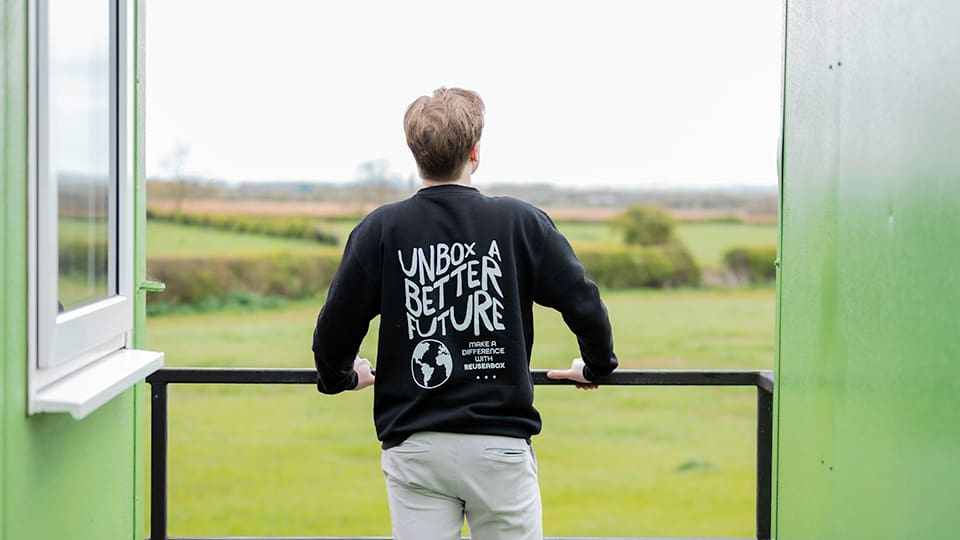
Reuseabox was founded in 2012
That frustration sparked an idea. What if we found another business that wanted the boxes? If it worked, the wholesaler wouldn’t just save money; they’d stop paying for waste altogether.
Within days, we had a buyer, literally a few doors down. That single deal turned into £12,000 a year in profit. More importantly, it revealed a bigger truth: across the UK, millions of boxes and materials weren’t worthless; they were just overlooked. Nobody was thinking about keeping them in use. That’s how Reuseabox was born.
From Side Hustle to Sustainability Movement
A couple of years later, I was still running Reuseabox out of my parents’ garden when my phone rang. On the other end was someone from the environmental team from one of the UK’s largest distribution companies. They wanted to reach net zero and wanted to help achieve that by reusing millions of boxes each month. The only catch? We’d need to prove the environmental savings of reuse over recycling.
We had no idea how to do that, but we said yes. That decision led to a partnership with the University of Lincoln, where we carried out the first environmental studies on cardboard reuse in the UK. The findings were clear: something as simple as reusing a box saved trees, carbon, energy, and water on a scale that nobody could ignore.
From then on, Reuseabox wasn’t just about selling boxes, it was about showing businesses that profit and purpose could go hand in hand.
Why Linear Thinking is no Longer Fit for Purpose
Most companies still run on a linear model: take, make, use, and dispose. It’s simple, it’s familiar, and for decades it has powered growth. But it’s a model that’s collapsing under its own weight.
Here’s why:
Resource scarcity – We’re consuming natural resources faster than the planet can regenerate them. Paper, timber, and water, all critical to the print and packaging industries, are under unprecedented pressure.
Waste and landfill – In the UK alone, we generate approximately 200 million tonnes of waste each year. Much of it could be reused, but instead it ends up buried or burned. That’s lost value.
Carbon costs. The production of materials like cardboard and paper is energy intensive. Creating something new from scratch almost always requires more energy than reusing what already exists.
Regulation. Policies like Extended Producer Responsibility (EPR) and the Plastic Packaging Tax are shifting costs back onto businesses. If you create waste, you’ll pay for it.
Customer expectations. Five years ago, sustainability might have been a differentiator. Today, it’s a baseline expectation. Fail to demonstrate progress, and customers will take their business elsewhere.
In short, the linear economy is broken. It wastes resources, it wastes money, and it wastes opportunity.
B Corp was awarded to Reuseabox in 2023
What the circular economy really means
The circular economy offers a different approach. Instead of the take-make-dispose model, it focuses on designing waste out of the system and keeping resources in use for as long as possible.
It’s often misunderstood as ‘just recycling,’ but recycling is only one small part of the puzzle, and often the least efficient part. True circularity prioritises:
Reuse – Extending the life of products and materials in their current form
Repair – Fixing and maintaining instead of discarding
Remanufacture – Refurbishing and upgrading materials or products
Recycle – Recovering materials at the end of their life
Each stage adds value and reduces the demand for virgin resources. For businesses, circularity isn’t just about environmental responsibility. It’s about resilience. By rethinking supply chains, you reduce exposure to volatile material prices, carbon taxes, and reputational risks, as well as open up new revenue streams by turning waste into value.
What This Means for the Print Industry
The print sector is uniquely placed to benefit from circularity, but it’s also under pressure. Paper and ink costs are rising, clients are asking about sustainability credentials, and regulations are becoming stricter.
So, what does embracing the circular economy look like for print businesses?
Materials – partner with suppliers who can guarantee traceability and sustainability.
Design for reuse – create packaging and printed products that can be repurposed or reused by customers, not just thrown away.
Rethink waste streams – offcuts, misprints, and used materials don’t have to be waste. Could they be sold, repurposed, or donated?
Collaboration – work with customers on take-back schemes, or partner with local charities and community groups to give unused materials a second life.
Transparency – measure and publish your environmental impact. Customers increasingly want hard data, not vague promises.
Some of the biggest success stories in recent years have been built on circular thinking:
Patagonia repairs, buys back, and remanufactures clothing, turning repair into a profit centre.
Lush has pioneered reusable and refillable packaging, building loyalty through sustainability.
Wild created a refillable deodorant that was eventually sold to Unilever for £100m.
These aren’t niche experiments. They’re proof that circularity is commercially viable, scalable, and attractive to investors.
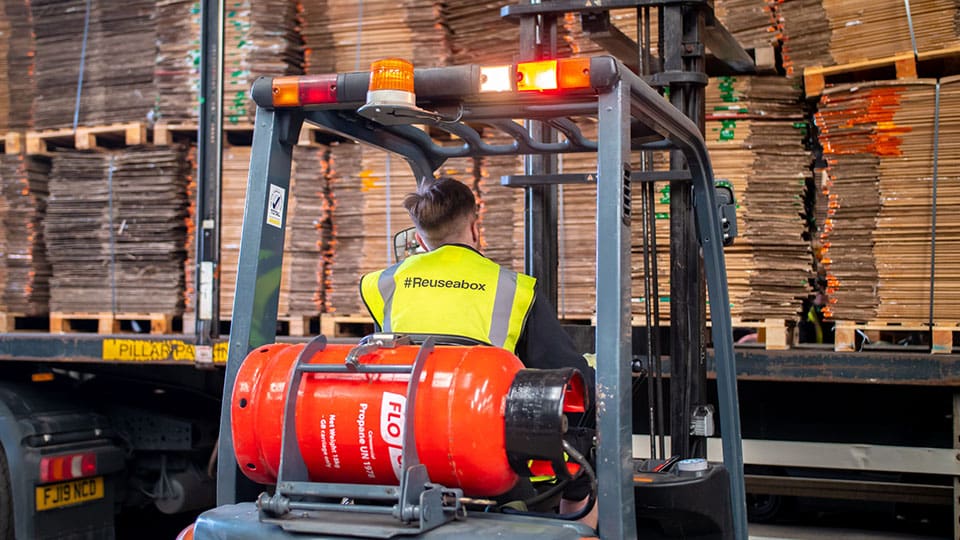
At Reuseabox, our model is simple – keep boxes in use for longer. The impact, however, is anything but small. Tens of millions of boxes reused, thousands of tonnes of CO₂ prevented, and profits are reinvested into reforestation in Tanzania through the Eden Rubeho Mountains Carbon Project.
What we’ve learned is that circularity isn’t just about being ‘green’, it’s about building more efficient, resilient businesses that can thrive in a changing economy.
Collaboration is Key
If there’s one thing I’ve learnt, it’s that collaboration is everything.
Talk to your suppliers. Talk to your customers. Even talk to your competitors. Keeping materials in use for longer requires rethinking processes, redesigning products, and challenging business-as-usual. But no one can do it alone. The more businesses work together across the value chain, the more impact we can have. The choice for businesses, in print and beyond, is clear.
The more businesses work together across the value chain, the more impact we can have. The choice for businesses, in print and beyond, is clear
Stick with the linear model, and you’ll face rising costs, regulatory penalties, and declining customer trust. Embrace the circular economy, and you’ll unlock new efficiencies, new opportunities, and new ways to stand out in a crowded market.
At Reuseabox, we didn’t just build a company; we started a movement. That’s what the circular economy is all about – reimagining what business can be.
In this Fresh Perspective, we hear from Joe Moon, marketing and social media executive at CFH Docmail, about his introduction to the print industry and his perception when entering it
After winning the Young Leader Award at last year’s IPIA Recognising Excellence awards, Rebekah Hughes from Latcham gives her thoughts on opportunities available in print, and how to approach the print versus digital marketing argument
For this edition of Fresh Perspectives, we hear from someone on the other side of the pond – Carly O’Neill, communications coordinator at PRINTING United Alliance, who speaks about her experience in the print industry, following a successful PRINTING United Expo in 2025
(this was inserted into the PHP of a code block)
Watch our latest video of the week
Print Monthly gives you the latest video coverage of companies, people, and events from within the print industry.