As printers balance quality, speed, and cost, the relationship between litho and digital print continues to evolve. Rather than competing technologies, many are now finding the two can work side by side, if deployed in the right way. Rob Fletcher finds out more
Rob Fletcher
June 15, 2026
For years, lithographic and digital print have often been positioned at opposite ends of the production spectrum, with litho associated with long runs and consistent quality, and digital offering flexibility and short-run efficiency. However, as market demands shift and customer expectations continue to evolve, this once clear divide is becoming increasingly blurred.
Advances in digital print technology have seen improvements in quality, substrate range, and productivity, enabling it to take on work that would traditionally have been the domain of litho. At the same time, litho remains a highly efficient and cost-effective solution for longer runs, with many printers continuing to rely on it for high-volume, repeat work.
As a result, many print service providers (PSPs) are adopting a hybrid approach, using litho and digital alongside each other to maximise efficiency and expand their service offerings. The challenge lies not in choosing one over the other, but in understanding where each technology delivers the greatest value – and how the two can be combined to best meet the needs of the modern print buyer.
Efficiency and Flexibility
Eirini Spanou, B2B SaaS and AI strategy leader at HEIDELBERG Graphic Equipment, says while digital print continues to grow rapidly, litho has not disappeared. Instead, she says that both are being integrated into hybrid, automated, and workflow driven environments, with hybrid production systems and ‘Smart Print Shop’ models increasingly positioning the two technologies as complementary tools within the same ecosystem.
“Litho and digital operate as complementary technologies, each contributing to operational flexibility and production optimisation,” Spanou says, continuing: “Today, the strengths of litho and digital align naturally with the diverse needs of modern print customers. The result is a production environment where each technology strengthens the other, creating opportunities for greater efficiency and flexibility.”
Today, the strengths of litho and digital align naturally with the diverse needs of modern print customers
“Offset remains unmatched in delivering premium, consistent colour quality, high efficiency for medium to long run production, excellent reliability for catalogues, brochures, and packaging continues to be a stronghold especially for labels.
“Meanwhile, digital excels where agility is key along with short runs and rapid turnaround, lower setup times, and on demand capability reduce inventory and waste. Digital volumes are rising steadily due to its speed, flexibility, and the ability to support print on demand models in books, transactional print, and advertising.”
However, Spanou goes on to say that while litho and digital overlap more than ever, clear dividing lines still guide job allocation. She explains run length is usually the key and that industry research confirms run lengths globally are declining, which intensifies the need for a mixed approach.
On this, she says hybrid workflows are central to HEIDELBERG’s Smart Print Shop and digital ecosystem vision, an integrated, automated and adaptable production environment. Spanou sets out how many printers now operate hybrid environments, pairing offset and digital presses within a shared workflow, with this model offering significant operational and commercial benefits.
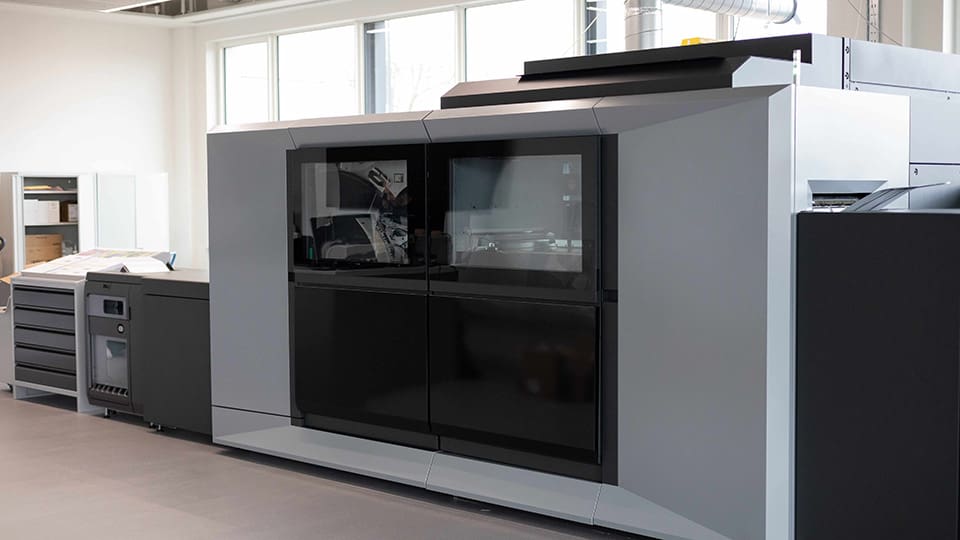
HEIDELBERG’s recent ‘Beyond The Machine’ event showcased its Jetfire 50 B3 inkjet digital press in live production at Stockley Park
Operational benefits include optimal job routing, with automated workflows directing each job to the most efficient press; either litho, toner, or inkjet, based on run length, substrate, and complexity. Spanou also flags reduced bottlenecks, with digital absorbing the shorter, on demand jobs, keeping litho presses fully productive on longer runs, as well as end to-end automation, noting how HEIDELBERG Prinect Production workflow enables autonomous job handling.
As for commercial benefits, these include broader service capabilities across both short run and variable and long run or static segments. Spanou highlighted faster turnaround and enhanced customer responsiveness with greater capacity to serve digital native models such as web to print and on demand fulfilment, in addition to improved cost control and higher profitability.
“At HEIDELBERG, our innovations from the Speedmaster platforms to Prinect’s autonomous production capabilities alongside our Digital Eco System are designed to harmonise offset and digital into one coherent workflow,” Spanou says, adding: “The future is not about choosing between litho or digital, but about leveraging both strategically to deliver maximum efficiency, quality, and commercial advantage.”
Shifting Relationship
Also weighing in is Chuck Slingerland, vice president of Barberan Corrugated, part of Barberan S.A., a specialist manufacturer of single‑pass digital printing solutions for retail packaging and displays, flooring, and metal applications. On the subject of using both litho and digital print within the same workflow, Slingerland says the relationship is shifting – and quite decisively.
“Backed by Barberán S.A’s 18 years of single pass production expertise, we see the market moving toward a truly hybrid print model in which litho and digital are complementary rather than competing technologies,” Slingerland says, adding: “Printers now intelligently route each job to the most suitable process: offset for long, stable runs at the lowest unit cost, and digital for short runs, variable data, quick turnaround, and on demand reprints.
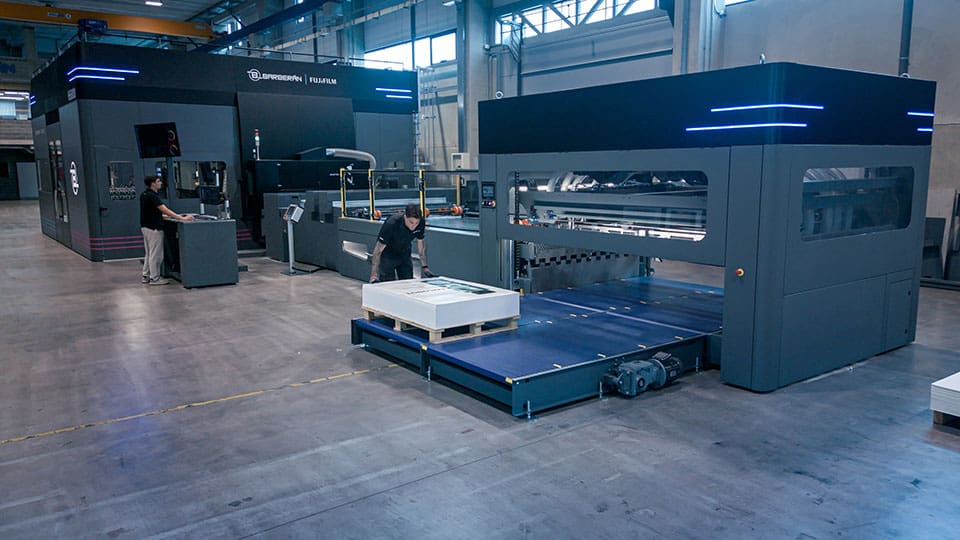
Barberán partnered with Fujifilm to develop the HS6000, a single-pass digital inkjet printer
“Because workflows, colour management, substrates, and finishing are increasingly unified, it’s becoming seamless to combine both processes within the same workflow or even the same campaign. As print buyers focus more on speed, flexibility, and consistent quality than on the underlying print method, Barberán’s single pass solutions enable digital to enhance and support offset instead of displacing it; maximising efficiency, responsiveness, and profitability across the entire operation.”
Because workflows, colour management, substrates, and finishing are increasingly unified, it’s becoming seamless to combine both processes within the same workflow or even the same campaign
While Slingerland says litho and digital are genuinely complementary, especially in mid to large commercial operations where they share prepress, workflows, and finishing, this may not be the case in smaller or traditional shops. He explains that digital is used more as a secondary device for proofs, micro runs, and rush jobs, and while the complementarity is real, it is not fully optimised due to limited automation, colour or stock constraints, and cultural resistance.
However, Slingerland maintains Hybrid workflows that combine offset and digital give printers leverage on both the production and commercial sides. He says: “Operationally, they allow you to route each job to the most efficient process – offset for long, stable runs, and digital for short, variable, or rush work – while relying on shared prepress/MIS and common finishing. That integration cuts touchpoints, waste, and inventory, and helps smooth out capacity peaks across the plant.
“Commercially, you can offer a much broader range of options: from large, multi-wave campaigns to tiny test batches and highly personalised or last-minute components. It lets you position your business as a campaign and problem-solving partner rather than just a “press owner,” improve margins by steering work to the most profitable process, and build loyalty by handling all of your customers’ needs under one consistent, colour managed roof.”
Both technologies offer their own, individual benefits, though printers can benefit from running both machine types
On this, Slingerland notes how Barberán S.A.’s engineering forward culture is “very much aligned with this future”. He explains how the manufacturer designs its single pass solutions so they can live alongside offset, not replace it, giving printers a coherent, integrated environment rather than forcing an either-or choice. In this model, he explains how offset handles long, stable, cost driven runs, while digital takes care of variable, fast changing, and risk sensitive work, with jobs automatically steered to whichever process best fits the campaign, schedule, and supply chain needs.
“Lithographic and digital printing will continue to compete at the edges, especially as faster, more cost effective digital systems push into volumes once dominated by offset, but the overall direction is toward tighter integration in shared workflows,” Slingerland says, concluding: “Common prepress, MIS, colour standards, substrates, and finishing increasingly let printers treat both processes as interchangeable tools inside one hybrid production platform.”
Mature and Realistic Approach
Away from manufacturers, Jean Lloyd, a specialist print consultant and a global ambassador for Print Island, says the relationship between litho and digital is complementary. She says most successful PSPs are combining both within a single workflow to maximise efficiency, flexibility, and profitability.
“For a long time, the industry positioned digital and litho print as competitors, with digital expected to replace conventional processes,” Lloyd says, adding: “Having been in the market during those early days, I can say that simply didn’t happen, and it was never going to.
“What we’re seeing now is a far more mature, realistic approach. Digital print, particularly inkjet printing, has evolved significantly in terms of quality, speed, and volume capacity. At the same time, litho hasn’t stood still. Press manufacturers have improved makeready times, reduced waste, and made short-run litho far more viable.”
Lloyd goes on to set out how each technology has its own advantages. With digital print, she says it delivers its strongest value where flexibility and responsiveness are critical, pointing out how short runs, versioning, variable data, and fast turnaround times are where inkjet really excels.
Specialist print consultant, Jean Lloyd, says PSPs that try to force digital into long-run work, or litho into highly versioned
“However, the real value isn’t just in the technology itself; it’s in how it’s used,” Lloyd says, expanding: “The most successful PSPs are those who understand how to leverage digital to unlock new applications and revenue streams, rather than simply replacing existing analogue work.”
On the other hand, Lloyd says conventional processes such as litho and flexo remain the most economical choice for longer runs, particularly for static content. She sets out how the lower cost of inks, combined with high production speeds, means that for large volumes, analogue still delivers the best cost per unit – with this especially true in packaging, where long-run jobs with consistent artwork are common.
Factoid: British Printing Industries Federation (BPIF) research shows digital print was responsible for an estimated 37% of all printed media in the UK in 2025
“It’s important to recognise that digital hasn’t replaced these processes; nor should it,” she says, adding: “Instead, it has reshaped where they are most effective. The real opportunity lies in understanding the crossover points and deploying each technology where it makes the most commercial sense. Printers who try to force digital into long-run work, or litho into highly versioned work, often struggle to remain competitive.
“The most effective and future-proof production model today is hybrid. This means using conventional processes for the fixed, high-volume elements of a job, and digital, particularly inkjet, for variable content, shorter runs, or late-stage customisation. This approach allows printers to optimise cost, reduce waste, and significantly improve turnaround times. It also opens the door to new business models such as producing closer to demand rather than holding large amounts of inventory.”
The most effective and future-proof production model today is hybrid
Lloyd will go into further detail on the subject during her session on the Knowledge Zone at The Print Show 2026. Her presentation – ‘Inkjet & Hybrid Printing for Print & Packaging’ – will take place at 11am on September 30th, the middle day of this year’s event at the NEC.
While some print companies may continue to favour one technology over the other, one thing is abundantly clear: there are benefits to each type of machine, as well as advantages to using both within the same production workflow. Print companies must look at the type of work they produce and weigh up how a combined approach could help them improve their service offering in the long-term.
From advances in print quality and productivity to increasing demand for automation and sustainable solutions, the wide-format market continues to evolve. Rob Fletcher looks at the latest trends, challenges, and developments in this sector
Speaking to a range of print and signage professionals, we discover how a sustainable business model can drive growth, outlining actionable strategies to cut overhead costs, improve eco-efficiency, and boost your bottom line
As finishing continues to become a great way to add extra elements to your print and wow customers, we take a look at some of the creasers, folders, and collators on the market, and ask experts their advice on finding the right solutions
(this was inserted into the PHP of a code block)
Watch our latest video of the week
Print Monthly gives you the latest video coverage of companies, people, and events from within the print industry.