Widely regarded as one of print’s stand-out areas of growth for several years, Rob Fletcher takes a closer look at label printing, examining the opportunities in this market and how businesses can succeed
Rob Fletcher
July 29, 2026
Label print has long been regarded as one of the industry’s strongest growth markets, with demand continuing to rise in sectors including food and drink, cosmetics, pharmaceuticals, and retail. Advances in digital technology, shorter run work, and the growing demand for personalisation have all helped drive investment and innovation in the sector.
However, as customer expectations evolve, printers are under increasing pressure to deliver greater flexibility, faster turnaround times, and more sustainable solutions. For many businesses, investing in label production offers the opportunity to diversify services, unlock new revenue streams, and secure higher-margin work in an increasingly competitive market.
With all this in mind, we spoke with some of the leading manufacturers with interests in the label print market to find out more about the current level of demand and how investment can help print companies secure profitable work.
Strong Branding
Up first, Jon Pritchard, label and inkjet consultant at Konica Minolta Business Solutions UK, says label printing can still be classed as a growth market. He explains that as the buying habits for printed items changes, it is a logical process for commercial printers to change their approach to make them more robust to fluctuations in print demand.
“Today, you will find most commercial printers offering wide-format, a print process that is different to, say, the production of a business card, but still a printing process that has been absorbed into the normal production life of a printer today,” he says, adding: “Labelling as with wide-format is a different print process but ultimately still a form or print, and one that can utilise existing skills within a commercial printer to enable its adoption.
“Labelling is one of the print sectors that continues to grow with forecasts continuing to show growth, especially compared to conventional print. Where commercial print is impacted by electronic communication methods, food, and products still need labels with no sign of this changing in the near term. The need for manufacturers to deliver product safety information, food nutrition, and branding is stronger than ever. Combine this with general population growth requiring more products and services, and digital labelling is seen to be growing at a rate of 10.8% per year in volume at an average.”
As to where printers should be looking for labelling work, Pritchard says food and beverages remain the biggest sector. However, he adds that this can be high volume production, which can lead to lower margins, and at times specialised equipment to optimise speed and costs further.
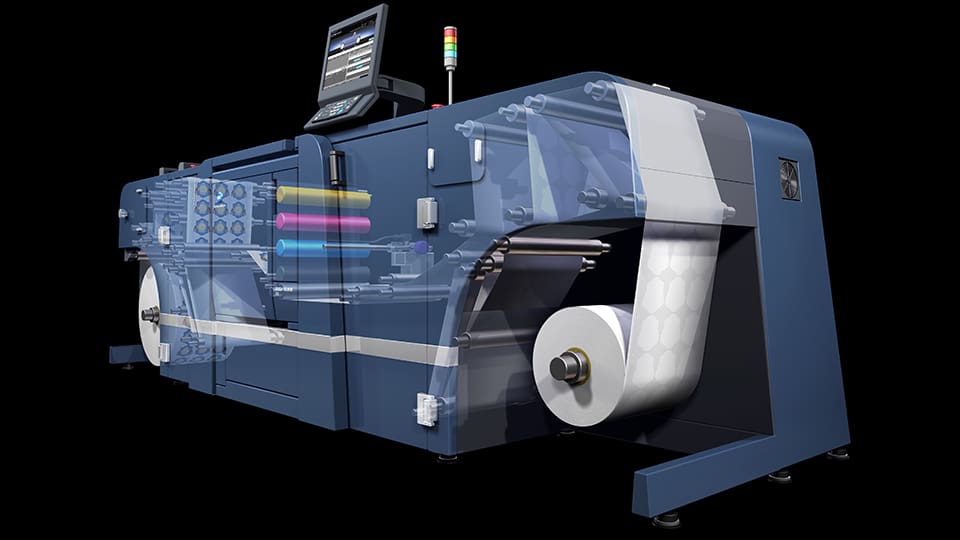
Konica Minolta says its AccurioLabel AL230 is one of the best-selling digital label presses in the world
“While Konica Minolta customers do produce food and beverage labels due to the toner being suitable for indirect food labelling, we do find that customers are adding more variable content into their labels. A typical application is the transition of work from thermal transfer printers that would normally apply single colour variable content on to a preprinted colour label.”
Pritchard adds: “As the volume of this work expands, more thermal transfer printers are acquired, and before you know it the job to manage all of the data and individual printers becomes a mammoth task.”
On this, he says customers have found using the variable data function on the AccurioLabel presses enables the entire label to be printed in a single process, reducing time and errors due to the reduced touch points in production. He picks out logistic labels, PAT electronics labels, and engineer shipment labels as examples that can be moved from a multi-step to a single step process on an AccurioLabel press.
Factoid: According to Future Market Insights, the global digital label printing market is expected to grow to $20.6bn (£15.3bn) by 2035
The AccurioLabel AL400 and the AccurioLabel AL230 are the primary label presses from Konica Minolta, with Pritchard describing the latter as ‘one of the best-selling digital label presses in the world’.
“This is not because it’s the fastest press in the market, or as cheap as some desk top entry level presses, but rather the all-round performance it can offer versus investment and running costs,” he says, adding: “A simple-to-use press that can match the print quality of presses three times its price, without the need for monthly fixed service costs. Pound for pound, this is the best digital label press in the market.”
Compliment Other Services
Also active in this market is HEIDELBERG. Ross Holloway, label specialist at the manufacturer, says there is still potential to succeed and grow in this sector. He explains that while there is a healthy level of competition, those not already offering label printing should still consider a move into the sector as a way of diversifying their business.
“It may be that labels can complement the services already supplied by a printer,” he says, adding: “In some cases, labels may already be outsourced but they can be brought in-house to give the company greater control and an improved margin.
In some cases, labels may already be outsourced but they can be brought in-house to give the company greater control and an improved margin
“With our print heritage and strong digital experience, added to that the experienced team at HEIDELBERG Graphic Equipment, we are able to work closely with customers to guide them as they move into label printing with Gallus label technology.”
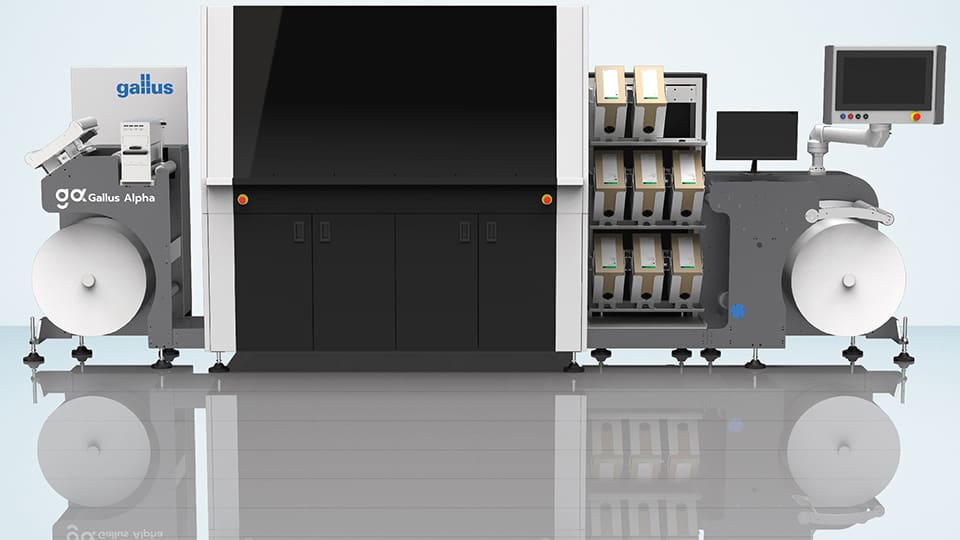
Setting out some of the options on offer within the Gallus range, Holloway picks out the Gallus Alpha, which he says is competitively priced and offers a range of functional strengths in terms of running speed, print quality, and a small footprint amongst others.
HEIDELBERG says its Gallus Alpha is competitively priced compared to other label printing solutions on the market
The Gallus Alpha is a compact roll-to-roll inkjet press designed to help printers move into digital label printing. Available in a 340mm print width configuration, the press runs at speeds of up to 65m/min and features UV inkjet technology with CMYK and white as standard, alongside optional orange and violet inks. Operating at a native resolution of 1200 x 1200dpi, the machine also offers automated features such as nozzle compensation, inline quality control, and variable data printing to improve efficiency and reduce waste.
Natural Extension
Also weighing in is Andy Gregory, sales director at Hybrid Services, the exclusive UK and Irish distributor of Mimaki. Gregory says while label print can “definitely” be considered a growth market, growth is not confined to traditional high-volume label production.
“We’re seeing increasing demand for shorter runs, faster turnaround, and more personalised output, particularly from businesses wanting to produce multiple variants, seasonal packaging, promotional labels, or highly targeted campaigns, without committing to large print volumes.
“Typically, those requirements are creating opportunities beyond the conventional label press environment and bringing wide-format offerings into consideration. We’re also seeing that many print businesses are now looking at labels as part of a broader diversification strategy, producing them alongside applications such as signage, packaging prototypes, promotional graphics, and branded materials on the same device.”
With this, Gregory says printers should consider adding labels to their offering, particularly those looking for accessible routes into new revenue streams without the investment associated with dedicated label production equipment. He explains label production can be a natural extension of existing capabilities across areas such as graphics, decals, or packaging-related work – and investment in a single Mimaki machine allows users to take on work in all these markets.
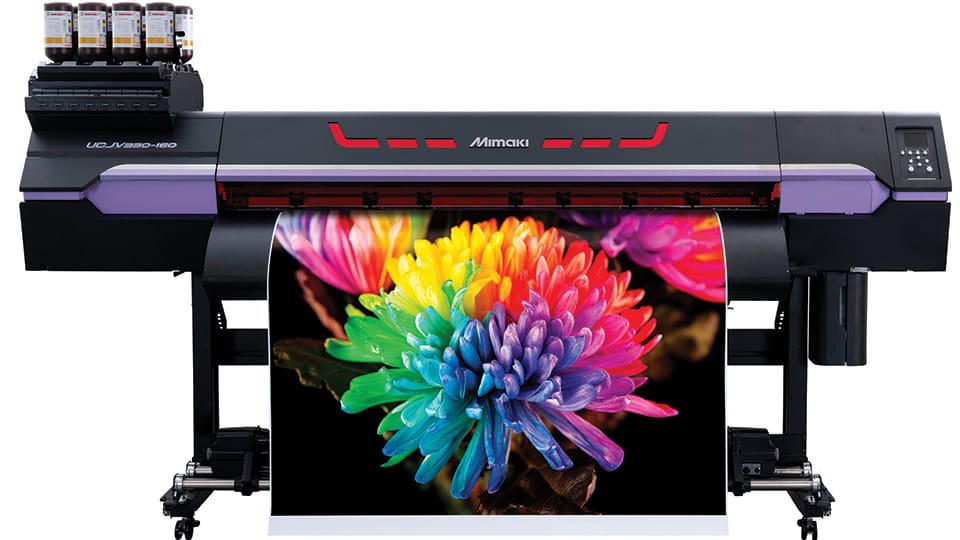
Hybrid Services picked out the Mimaki CJV330-160 for use in higher production environments
“The Mimaki UCJV330-160 UV printer and cutter is well suited to creative label and sticker production,” he says, continuing: “Its LED UV curing allows prints to be finished immediately, while white ink, layered printing, and textured effects generate opportunities for premium applications on clear and coloured media.”
On the solvent side, Gregory recommends the Mimaki CJV200 Series, saying it continues to be popular because it provides an accessible route into integrated print and cut production. As for higher production environments, he says the Mimaki CJV330-160 offers increased productivity and quality while retaining the flexibility that many businesses now prioritise.
Rather than competing directly in commodity label production, many print businesses are successfully targeting applications where responsiveness and creativity matter most
“Importantly, the market for labels is no longer solely about volume,” Gregory says, adding: “There is strong demand for prototype work, short-run packaging labels, product stickers, window decals, and promotional applications where creativity, flexibility, and turnaround times are key considerations. This then enters the sweet spot for integrated print and cut technology.
“Rather than competing directly in commodity label production, many print businesses are successfully targeting applications where responsiveness and creativity matter most. The ability to produce short runs, samples, one-offs, limited editions, or multi-version campaigns quickly can become a real advantage.
“For existing sign and graphics providers, labels can also complement wider customer projects, allowing them to offer more complete branding packages from a single production platform.”
Empowering Customers
The final manufacturer to weigh in is HP. Andy Pike, EMEA industrial marketing lead at HP, says while overall industry growth remains steady at mid-single digits, the real acceleration is happening in digital label production, where brands increasingly require shorter runs, faster turnaround, and greater customisation.
“Digital label printing is emerging as the fastest-growing segment, enabling converters to unlock new applications, improve sustainability, and respond to rapidly changing consumer and market needs,” Pike explains, adding: “HP Indigo stands at the forefront of this transformation, empowering customers to capture high-value growth opportunities, and drive profitable expansion in an evolving labels and packaging landscape.”
In terms of the work on offer, Pike says while food and beverage labels are one significant foundation, the fastest-growing segment right now is flexible packaging, pushed by brands needing agility, shorter product lifecycles, and cleaner sustainability numbers.
Going further, he says pharma labels, premium cosmetics, and craft products are attracting interest as well, but really it is “anywhere short runs, variable data, and brand protection carry weight”.
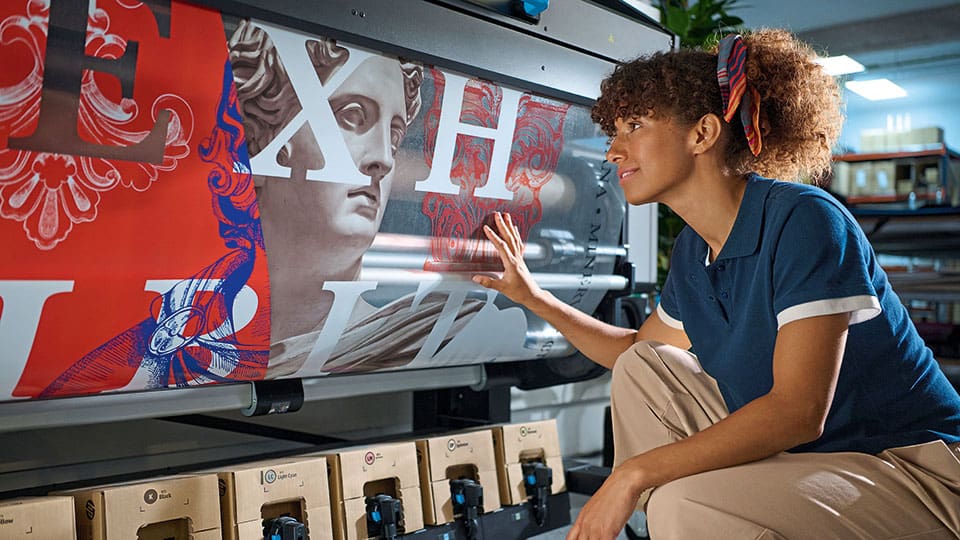
Andy Pike, EMEA industrial marketing lead at HP, says the real acceleration in the sector is happening in digital label production
“Smart labels with QR, NFC, and AR integration are generating new demand, giving brands tools for authentication and consumer engagement they didn’t have before,” he adds.
As to how HP can help, Pike picks out the HP Indigo V12, its flagship machine in this area and the manufacturer’s first press that uses LEPx technology. Printing at 120 metres per minute on narrow web, Pike says the machine is capable of replacing multiple flexo lines and the overhead that goes with them.
For converters who need broader application range, he recommends the HP Indigo 6K+, which runs a new SmartControlSystem with AI-powered automation, built around demand for multiple SKUs and faster turnarounds. Meanwhile, for flexible packaging, he says the HP Indigo 200K bridges label and packaging workflows, with an optional slitter for converters expanding into that space.
“We recently hit 3,000 global HP Indigo installations for labels and packaging at Labelexpo Europe 2025, which gives a sense of the platform’s reach,” he adds.
Label printing continues to offer print businesses a valuable route to growth, with demand being driven by shorter runs, personalisation, and smarter packaging. For companies looking to diversify, improve margins, and future-proof their offering, labels remain one of the most compelling opportunities in the market.
From advances in print quality and productivity to increasing demand for automation and sustainable solutions, the wide-format market continues to evolve. Rob Fletcher looks at the latest trends, challenges, and developments in this sector
Speaking to a range of print and signage professionals, we discover how a sustainable business model can drive growth, outlining actionable strategies to cut overhead costs, improve eco-efficiency, and boost your bottom line
As finishing continues to become a great way to add extra elements to your print and wow customers, we take a look at some of the creasers, folders, and collators on the market, and ask experts their advice on finding the right solutions
(this was inserted into the PHP of a code block)
Watch our latest video of the week
Print Monthly gives you the latest video coverage of companies, people, and events from within the print industry.