As finishing continues to become a great way to add extra elements to your print and wow customers, we take a look at some of the creasers, folders, and collators on the market, and ask experts their advice on finding the right solutions
David Osgar
September 23, 2026
As print continues to output both traditional products and growing verticals like packaging, personalised print, bespoke publications, and short-run orders, creasing, folding, and collating continues to be a crucial part of the finishing process.
With a myriad of new advancements now available, and constant changes and innovations helping print service providers (PSPs) bring automation and customisation forward, we take a look at some of the options available on the market, and speak to providers of creasers, folders, and collators to see what they have to say about this market.
A Relevant Technology?
When speaking about the relevancy of creasers and folders, Jörg Scheffler, chief executive officer at Motioncutter, says: “Creasers and folders are still very relevant, but as run lengths get shorter and demand shifts toward shorter runs, more personalisation, and faster turnaround times, this technology has needed to evolve. Traditional analogue finishing methods can be time-consuming, with single-function machines taking up space on print room floors and keeping operators away from other skilled areas of production where their time would be more valuable.”
Motioncutter, a division of Themediahouse, is a manufacturer and supplier of digital finishing systems which operates under the ethos of: “designed by printers, for printers”. The company looks to solve challenges within automated laser finishing such as cutting, engraving, creasing, micro-perforation, and variable data finishing.
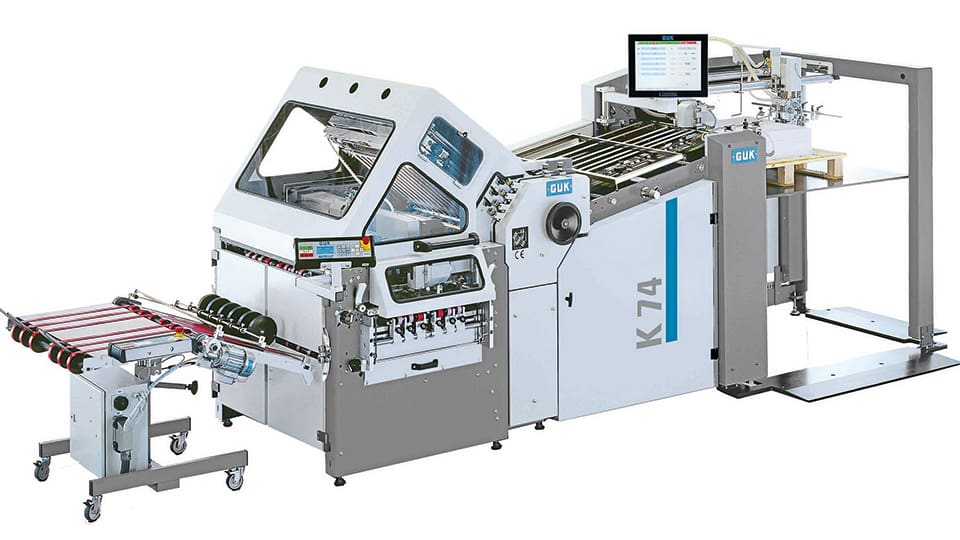
Encore Machinery’s options include the GUK K74 cross-fold machine with pallet-feeder
Scheffler says that creasing in particular remains essential for applications such as greetings cards, packaging, and direct mail, but the process no longer needs to rely on conventional tool-based processes. “That’s why we developed our Motioncutter laser digital finishing systems in the first place,” says Scheffler, adding: “Having been printers ourselves, we understood the need for a platform that makes it possible to perform multiple finishing processes, including creasing, at the same time, with the option of job-to-job variability.
“Digital finishing complements existing workflows by reducing the number of separate finishing stages required and making them better suited to today’s digital production environment. For example, with Motioncutter it’s possible to cut, crease, and personalise a greetings card or piece of packaging, all in one step, with custom-shaped labels able to be kiss cut on the same machine in one automated workflow.”
Regarding relevancy, Paul Davidson, managing director of Encore Machinery agrees with Scheffler: “Creasing, folding, and collating equipment remains as relevant as ever in today’s print environment. While digital printing technology has advanced significantly, the need for high-quality finishing has become even more important. Customers expect professionally finished products, shorter turnaround times, and greater flexibility, which places increased demands on finishing departments.”
Customers expect professionally finished products, shorter turnaround times, and greater flexibility, which places increased demands on finishing departments
When it comes to recommendations, Davidson says: “The Bacciottini Pitstop creasing and folding machines are particularly relevant because they address one of the biggest challenges in digital print – cracking on digitally printed and heavier stocks. They enable printers to produce high-quality brochures, booklets, leaflets, and folded products quickly and efficiently, making them ideal for short-run and on-demand production.”
Davidson also points to the GUK folding systems, which he says continue to play a vital role across the commercial print, direct mail, and pharmaceutical sectors. “Their precision, reliability, and ability to handle complex folding applications make them indispensable for businesses that require consistent accuracy and high production speeds,” says Davidson.
Established in 2001, Encore Machinery is an independent supplier of printing and packaging equipment in the UK. “We specialise in providing reliable, high-performance solutions that help commercial printers, digital print providers, mailing houses, and packaging companies enhance productivity and improve finishing quality,” adds Davidson.
What to Consider
When it comes to what to consider when purchasing a creaser, folder, or collator, Jack Harris, managing director of Tech-ni-Fold, a designer, manufacturer, and supplier of print finishing equipment, says these solutions are extremely important. “For any printer that needs to add a finishing capability it’s important that they can do so at a cost level that suits the amount of work they will be taking on so they can grow with that work. Without the availability of stand-alone finishing equipment there is no opportunity for smaller companies to grow.”
As mentioned above, Harris stresses that printers should only consider equipment if it provides a solution that enables them to take on a bigger quantity or wider range of work. Tech-ni-Fold says it can provide businesses with a variety of options such as folding machines, saddle stitchers, and perfect binders. “We also have our own range of entry level print finishing machines that crease, micro-perforate, and cut up to 8,000 sheets per hour,” says Harris.
Factoid: Eindhoven University of Technology says creasing is a process which indents a section of corrugated board along fold lines to facilitate a neat fold. The most common failure site in a box made from corrugated board is at the folds, where the stiffness is reduced by the creasing operation
When it comes to the biggest pitfalls a customer can fall into when looking to invest in this technology, Harris says that customers often assume that all finishing equipment is too expensive or too niche for the range of work they are undertaking.
Seth Morgan, marketing executive at Freidheim International, agrees with Harris, adding that many businesses end up investing in poor quality solutions. “A well-designed creaser, folder, or collator should have high-performance characteristics, intuitive easy usage, and will be efficient across a range of runs and formats without any pitfalls – all in a small footprint. It will be capable enough to grow with you.”
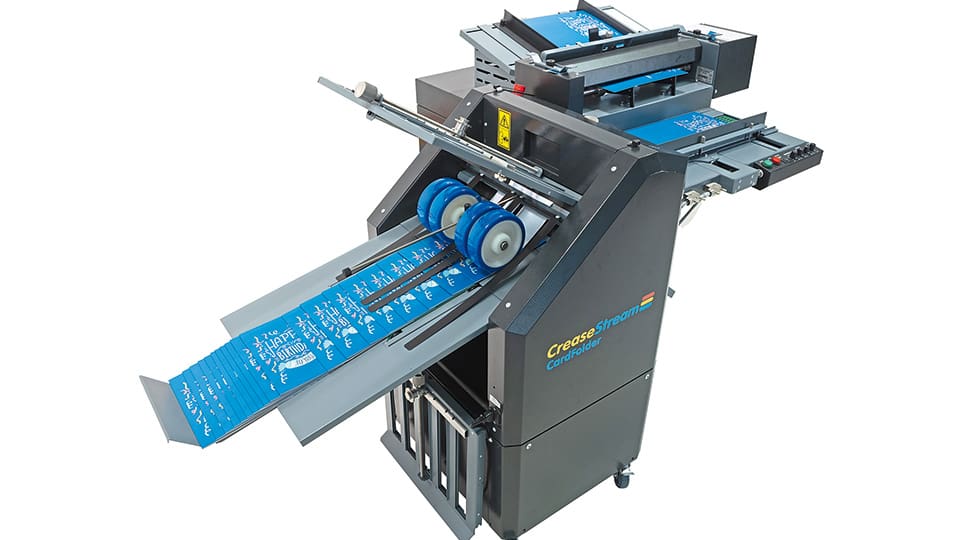
Tech-ni-Fold sells a variety of options including the CreaseStream CardFolder
Like Tech-ni-Fold discussed, Morgan also talks about the concept of a solution growing with the customer, a benefit of finishing solutions that is often not talked about. Morgan adds: “For a medium sized or growing printing outfit, higher levels of automation are the difference between how an operator can maximise their output, and if jobs are delivered on time, in budget, in good quality, and without waste, giving busy staff the opportunity to stay proactive.
“In order for larger firms to maintain their competitive edge, technology is finally optimised for today’s challenges with shorter run lengths, costs per job, and flexibility across work types.” Morgan also says that if an investment is recognised as being necessary, it’s worth doing properly and capitalising on.
“It’s why we have multiple training course options, comparison features on our website, vetted and quality assured products, and a selection of workflow analytics packages so you always know you’re fixing the right problem. We hate to see good machinery not in good use,” adds Morgan.
Friedheim International says it provides a wide range of finishing equipment in the UK which includes a full spectrum of upstream and downstream converting, packaging, and automation systems.
Future Prospects
When it comes to recent changes and advancements, Davidson from Encore Machinery highlights the continued trend of automation, productivity, and application versatility. “Print providers are under increasing pressure to deliver shorter runs, faster turnaround times, and a wider range of finished products, so manufacturers have responded by developing faster and more flexible finishing solutions. Within the Bacciottini PITSTOP range, we’ve seen significant speed improvements with the latest FM series machines now running at up to 16K per hour, allowing customers to process more work with fewer operator interventions and achieve higher daily throughput.
“Another exciting advancement has been the introduction of specialist folding modules, including the new OXO MULTISKILL creaser and folder as well as the PITSTOP BUTTERFLY 3 Fold Unit. These systems enable print providers to produce more complex folding applications in-house, opening opportunities in areas such as marketing collateral, direct mail, and innovative folded formats that were previously difficult or time-consuming to produce.”
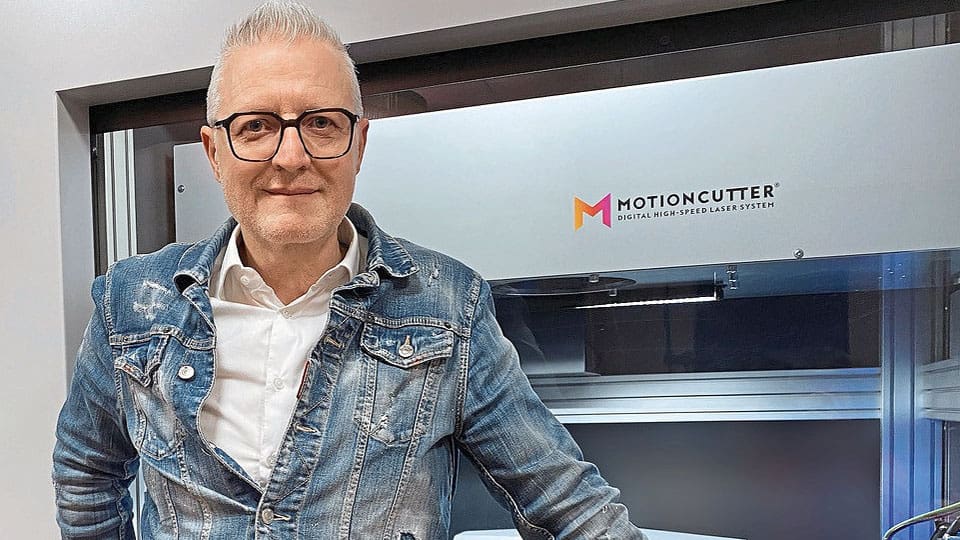
Jörg Scheffler, chief executive officer at Motioncutter, with one of the company’s laser systems
Harris from Tech-ni-Fold, has also seen a variety of recent changes, adding: “We are continuously adapting our retro-fit tooling to fit a much wider range of machinery, I would say for anyone that is looking at adding creasing, micro-perforation, or cutting to their set up consider that you might have some older equipment that you no longer use that Tech-ni-Fold could retro-fit and transform into a high speed finishing machine – thus fully removing the need to invest in new machinery. For anybody else our entry level CreaseStream machines provide access to high-speed, top quality, consistent finishing that isn’t possible from any other machine.”
A company looking to the future with a variety of different products is Intelligent Finishing Systems (IFS) which is the UK and Ireland distributor for Horizon finishing solutions alongside an extensive portfolio of creasing, folding, and collating options.
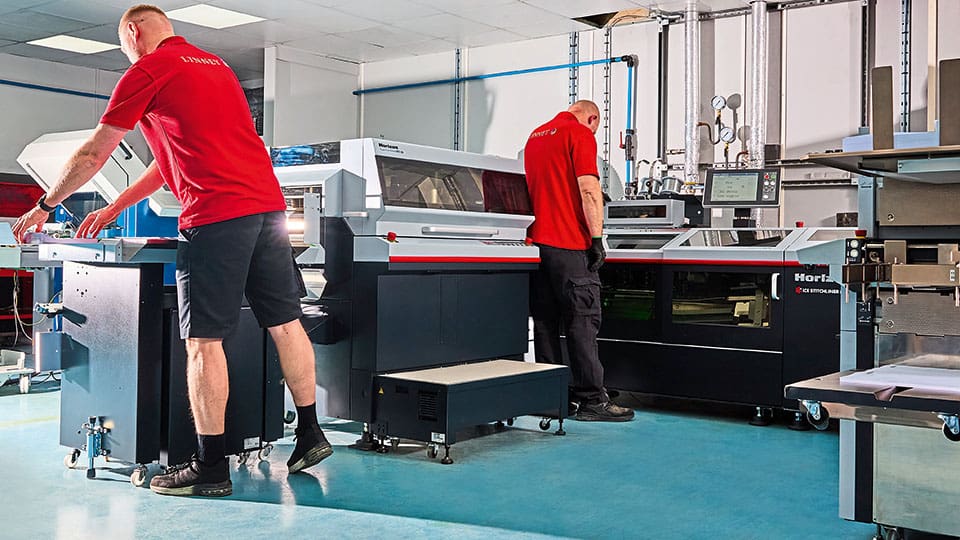
Eric Keane, managing director of IFS, says many PSPs will have some kind of solution already, but this is where the SitchLiner “comes into its own” as it combines processes for faster completion, faster production, and a smoother transition from one job to another. “For some operations their use is defined by the workload – for example collating towers where a lot of sets may have previously been hand collated.
“But when looking at updating existing capabilities operations should consider how much the latest automation can elevate their production speed, capacity, and support greater application versatility. The latest Horizon systems are equipped with iCE LiNK, a cloud-based platform that can provide device monitoring, KPI analysis, PM schedule/alerts, JDF/JMF Workflow, scheduling, job creation, editing, and more. We are also having a lot of conversations about the role of robotics and how they can support faster, more efficient, and round the clock production for operations of varying sizes.”
IFS supplied a Horizon iCE StitchLiner to print and marketing business, Linney
For Keane, the latest generation of automated solutions have been designed to remove production bottlenecks, improve workflow efficiency, and enable operators to move seamlessly between systems.
“Ultimately, the right automation strategy can make a substantial difference in creating a more streamlined, efficient, and profitable workflow,” says Keane, adding: “Horizon has introduced the Horizon iCE StitchLiner Mark V saddle stitching system for inline and offline configuration with both the Canon varioPRINT iX3200, and HEIDELBERG JetFire 50 B3 sheetfed inkjet presses. This new solution provides true print and finishing on demand with just one operator thus reducing labour costs and job turnaround times with increased profit margins and happy customers. This is just one example of how automation is changing finishing operations.”
The Final Line
When it comes to concluding thoughts, Davidson says: “One point I’d emphasise is that finishing is often the final stage in the production process, yet it’s one of the most important factors in how the customer judges the quality of the finished product. Even the best print can be let down by poor creasing or inaccurate folding. We’re seeing an increasing number of printers looking for ways to diversify their services and bring more work in-house. Modern creasing and folding equipment gives businesses the flexibility to produce a wider range of applications, improve turnaround times, and create new revenue opportunities without significantly increasing labour costs.”
Without the availability of stand-alone finishing equipment there is no opportunity for smaller companies to grow
Davidson’s final points emphasise that investing in finishing equipment isn’t just about specification. Scheffler from Motioncutter echoes this mentality, vouching for a change in attitude towards the process: “Finishing shouldn’t be thought of as just another step in production. It should be thought of as part of the design concept itself. Digital creasing, structural cutting, engraving, and personalised finishing all enable businesses to create applications that would have been impractical or not commercially viable using analogue methods. As digital print continues to evolve, I believe digital finishing will play a key role in helping printers to produce work that stands out.”
Scheffler’s final thoughts, encapsulate what the future of finishing and the print industry will be, adding: “For years, we’ve talked about variable data printing but I think the next step should be variable data finishing, where every job can contain a different printed sheet, and a different cut path, crease pattern, or structural finishing. This is where digital finishing really starts to unlock the full potential of print.”
From advances in print quality and productivity to increasing demand for automation and sustainable solutions, the wide-format market continues to evolve. Rob Fletcher looks at the latest trends, challenges, and developments in this sector
Speaking to a range of print and signage professionals, we discover how a sustainable business model can drive growth, outlining actionable strategies to cut overhead costs, improve eco-efficiency, and boost your bottom line
With The Print Show upon us once again, anticipation has been building for the UK’s leading industry event. From product launches and live demos to expert advice and networking opportunities, here’s what to expect at the NEC this September
(this was inserted into the PHP of a code block)
Watch our latest video of the week
Print Monthly gives you the latest video coverage of companies, people, and events from within the print industry.