The ROI of Sustainability: From Compliance to Capital
Speaking to a range of print and signage professionals, we discover how a sustainable business model can drive growth, outlining actionable strategies to cut overhead costs, improve eco-efficiency, and boost your bottom line
Jonathan Pert
September 23, 2026
Your average commercial printer or sign-maker doesn’t need a lecture on how lower-energy machinery or local sourcing can save money as well as the planet; reducing energy, overheads, and material waste has been a standard part of operational survival for years.
The commercial pressure facing businesses today is far more complex than a simple numbers game – it is driven by tightening supply chain regulations, corporate clients demanding granular carbon footprint tracking, and public sector tenders strictly enforcing carbon reduction plans.
However, far from being a regulatory burden, meeting sustainability mandates can actually unlock deeper financial returns. Forward-thinking print service providers (PSPs) and sign-makers are finding that pushing past basic energy efficiency into deeper sustainable practices can reveal overlooked revenue streams – and lower overheads in previously unforeseen ways.
We spoke to a wide cross-section of professionals from print, signage, and their associated industries, in order to understand how you can transform the challenge of sustainability into an actively beneficial business strategy.
Consistent Focus
Achieving sustainable goals in a way that actively benefits your business takes patience, experimentation, and a clear set of goals. One company particularly aware of that is Yorkshire-based commercial print provider, Zebra Print Group. The company’s managing director, Samantha Overton, has been with the business for more than 15 years, overseeing its growth into one of Yorkshire’s leading independent print companies – and she highlights its sustainable practices as a key part of its success.
Speaking about this focus, Overton says: “Sustainability has become a key part of our long-term strategy, helping us reduce our environmental impact while continuing to deliver the high-quality service our customers expect. For us, sustainability isn’t a one-off initiative – it’s something we consider in the everyday decisions we make across the business.”
It’s about continually looking for ways to operate more efficiently. We believe environmental responsibility and commercial success should go hand in hand
This focus has lead Zebra Print Group to invest in more energy-efficient equipment, generate its own renewable electricity through solar power, reduce material waste, and choose responsible suppliers wherever possible, with the mindset of benefitting both the business and the planet. As Overton explains: “It’s about continually looking for ways to operate more efficiently. We believe environmental responsibility and commercial success should go hand in hand.”
Overton highlights that sustainability has become an increasingly important consideration for many of its customers, particularly larger organisations looking at the environmental impact of their supply chains who want a print partner that shares their values. By aligning its operations with these values, Zebra Print Group has strengthened long-term client relationships and opened the door for lucrative partnerships in the future.
Samantha Overton [pictured] has overseen a transformation of Zebra Print Group’s sustainable practices
Overton admits that balancing environmental ambition with the financial reality of running a manufacturing business can be challenging. As she says: “Many sustainable technologies require significant upfront investment, and smaller businesses don’t always have access to the same level of support as larger organisations.”
To combat this, she recommends that businesses take a long-term view and make steady improvements rather than expecting overnight change. She advises: “Start with the changes that are within your control and don’t feel you have to do everything at once. Measure where you are today, set realistic goals, and build on each success over time. Sustainability is a continuous journey, and even small improvements can have a meaningful impact when they’re embedded into the way your business operates every day.”
Greener Tech
In order to reap the rewards of energy-efficient equipment and renewable materials, it is important to understand some of the latest solutions available to the market. One of the hardware companies looking to offer a raft of sustainable solutions is Mimaki, which provides a range of equipment to UK businesses through its official distributor for the UK and Ireland, Hybrid Services.
Andy Gregory, sales director at Hybrid Services, asserts that: “One of the biggest commercial gains any print business can make is reducing the amount of energy and consumables it uses every day, and that’s something Mimaki has focused on for a number of years.”
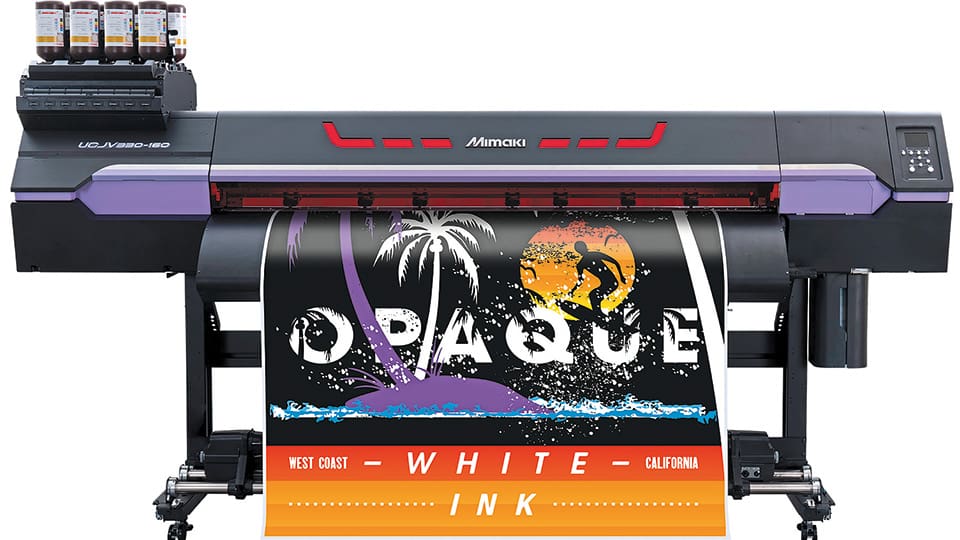
This focus dates back to the early 2000s, when Mimaki was one of the pioneers of LED UV printing, delivering the productivity benefits of instant curing while significantly reducing energy consumption compared with conventional UV systems. In the company’s newest solutions, features such as an built-in ink saving function available within Mimaki’s RasterLink RIP software can allow users to reduce ink consumption without compromising the quality expected for many applications. Mimaki has also invested heavily in onboard systems to help avoid production errors before they happen, reducing the likelihood of spoiled prints and unnecessary material consumption.
Mimaki has utilised UV-LED print into its solutions, which reduces energy consumption in comparison to standard UV systems
Alongside advances in Mimaki technology, Hybrid’s own ‘Let’s Do More’ solvent cartridge recycling scheme has been helping UK customers recycle solvent ink cartridges for almost two decades. Gregory explains: “Our Let’s Do More cartridge recycling scheme removes much of the administration by providing a simple, established route for customers to recycle used solvent ink cartridges.”
Gregory believes that while print and signage professionals now have a greater awareness of the impact of sustainable and low-impact print solutions, the wider conversation is still evolving. As he explains: “Customers are no longer looking solely for environmental credentials; they want equipment that reduces energy use, minimises waste, and lowers operating costs without affecting productivity or print quality.” In Gregory’s view, Mimaki’s approach to the development of its solutions means that “in a lot of cases, sustainability and commercial performance now go hand in hand, which makes investment decisions much easier to justify.”
However, even the most energy-efficient printer can fall short of true sustainability if the materials it prints on cannot be recycled. Enter Kavalan, a manufacturer of PVC-free sustainable banner materials developed for the wide-format printing industry, which boasts a product range that is certified by life cycle assessments (LCAs) and designed to meet stringent international standards and certifications.
In a lot of cases, sustainability and commercial performance now go hand in hand, which makes investment decisions much easier to justify
The PVC-free Kavalan range was launched back in 2017 to challenge the wide-format industry’s overreliance on materials that can’t be recycled by traditional processing plants. Nova Abbott, head of marketing at Kavalan, declares: “For decades, the industry has largely overlooked the environmental concerns surrounding PVC, including the toxicity generated during its production, as well as the excessive freshwater and energy required to manufacture conventional textiles. Many of these impacts occur long before a banner is ever printed, shipped, or installed.”
By contrast, independently conducted LCAs demonstrate that Kavalan’s PVC-free materials are 100% sustainable, weigh up to 45% less than their PVC and textile-based counterparts, and are designed for responsible end-of-life disposal. As Abbott says: “They are engineered with sustainability in mind, right from the start. Using sustainable materials like this can protect the bottom line of UK print and signage businesses, by avoiding both direct and indirect regulatory costs.”
Abbott believes that the biggest challenge when switching to PVC-free banner materials is often mindset. She explains: “Many of the misconceptions around making the transition relate to durability and performance. Having relied on PVC banner materials for decades, much of the industry is reluctant to make the move into the unknown.
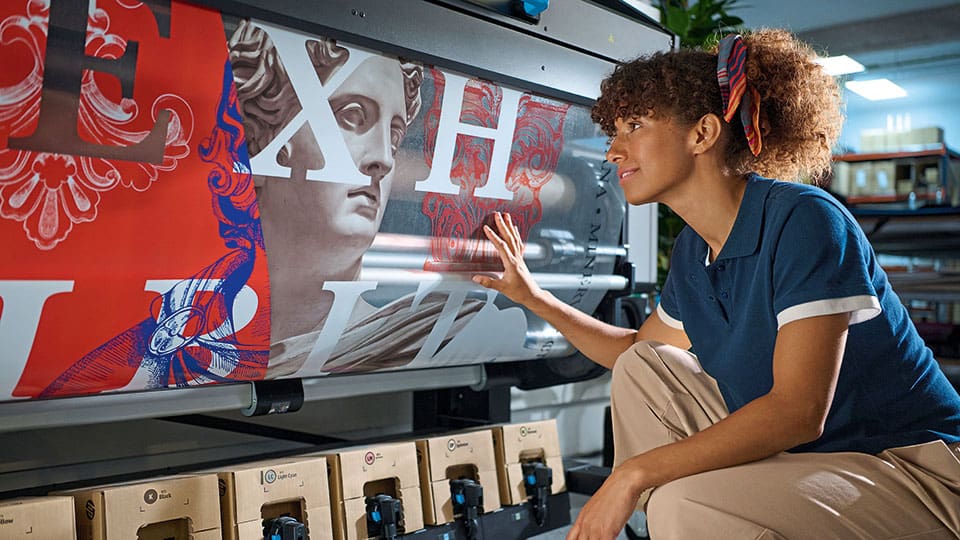
Kavalan materials are designed to meet stringent sustainability standards
“However, advances in PVC-free banner materials mean that they now offer the same durability and image quality as PVC and traditional textile materials without leaching toxic chemicals into the environment – both at the point of creation and at end of life when materials are sent to landfill or incinerated for waste-to-energy. Kavalan materials also retain the flexibility, durability, print quality, and flame retardancy required for demanding large-format applications while remaining REACH and RoHS compliant.”
The materials manufacturer is also aware that as sustainability becomes an increasingly important consideration for brands, agencies, and print buyers, being able to demonstrate environmental performance with independently verified data is now a competitive advantage. For this reason, the company launched the Kavalan Eco Calculator, which can quantify reductions in carbon emissions, freshwater consumption, and other environmental impacts, providing evidence to support customer conversations, strengthen tender applications, or meet growing sustainability reporting requirements.
Abbott believes that achieving true environmental sustainability will require the print and signage industries to look beyond incremental improvements and start addressing impact at the source. She concludes: “If we want to make meaningful progress, the industry needs to place far greater emphasis on material selection and understanding the full lifecycle impact of the products being used.”
Sustainable from the Start
To best understand how sustainability can impact a business, it is worth looking at businesses that were shaped by these practices from the beginning as a core part of their identity. One company that fits the bill is Teemill, a UK-based, tech-driven print-on-demand (POD) platform that operates a fully circular open-access supply chain.
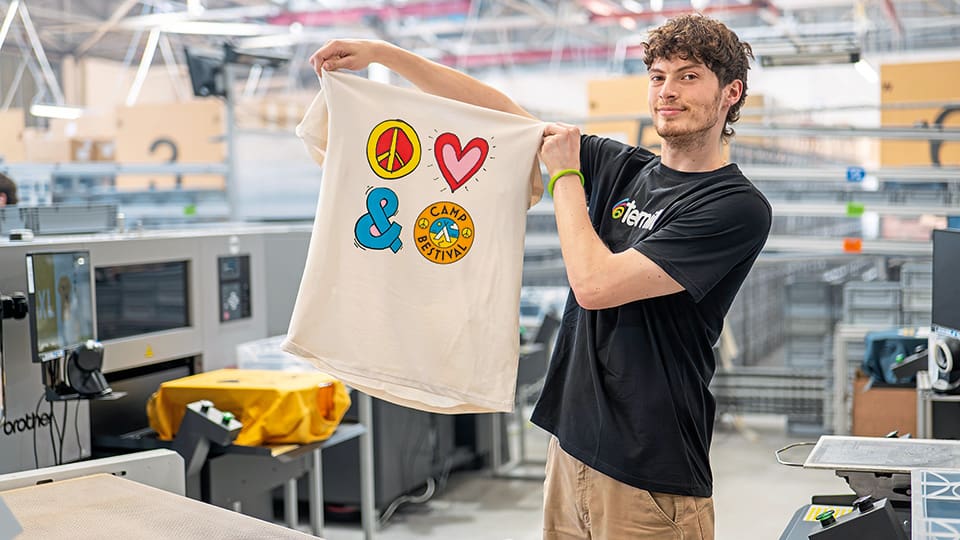
Teemill was never conceived as a traditional commercial print business that decided to ‘go green’ later on. Instead, it was born entirely out of frustration with global manufacturing waste, and that focus has shaped its future successes. As Sára Debreceni, content marketing manager for Teemill, outlines: “Building the supply chain behind our products ourselves gave us the power to make decisions on small details that make a big difference.
“Using organic cotton rather than conventionally farmed cotton can reduce water usage by up to 91%. Using renewable energy enables you to employ processes that might be more energy-intensive. Introducing automation into your fulfilment system means more efficiency and big savings. But the biggest thing is waste – if you hunt waste within your operations, you will become more sustainable and save money.”
Teemill’s mission is to help brands end waste through POD production, using organic materials and renewable energy. All of its products are designed to return to the company when they’re worn out, to be remade into new products. This system, which they have dubbed Remill, has so far recovered over 100,000kg of material.
Teemill operates a fully circular supply chain, with its products designed to return and be remade into new products
As Debreceni comments: “Our long-term strategy is to create a world without waste, and our platform helps to displace clothing made from fossil fuels as part of a take-make-waste economy, with sustainable alternatives designed for circularity.” Linking this to financial savings and business growth, she adds: “By offering a circular system to recover products at the end of their life and utilising recycled material to make new products – massive savings can be made whilst protecting the planet.”
However, Teemill is not content for those financial rewards and good practices to stay within the company. Instead, they offer Teemill as an open-access online platform currently used by thousands of charities, creators, and companies. Debreceni explains this approach, saying: “By sharing our workflow software with other printers and fulfilment providers, we hope to help them accelerate their growth and influence the direction of the market at industrial scale.”
Factoid: Nearly half (48%) of UK businesses say that energy makes up 25% or more of their total business costs, according to a 2026 report from Energy UK
Highlighting the breadth of Teemill’s ambitions, Debreceni declares: “We are aiming to be the primary operating system for print companies within five years, helping incentivise transition to an online-driven, low-waste-on-demand model.”
Another company with sustainability in its DNA is The Recycling Factory, which began its journey in 2004 by initially focusing on the collection and recycling of inkjet and toner cartridges. Since then, it has significantly expanded its offerings to include comprehensive IT asset disposal (ITAD) services, as well as collecting used printers and IT equipment for renewal, refurbishment, remanufacturing, and recycling.
According to Shakila Miah, ecommerce sales and marketing manager at The Recycling Factory, the organisation’s biggest breakthrough has been expanding into IT equipment refurbishment. As he explains: “This included securing key partnerships with major corporations, providing us with a consistent stream of high-quality used devices.” He continues: “This, combined with investing in advanced diagnostic and repair technologies, allowed us to scale our operations efficiently and meet the growing demand for refurbished IT assets.”
If we want to make meaningful progress, the industry needs to place far greater emphasis on material selection and understanding the full lifecycle impact of the products being used
Miah suggests that taking advantage of this type of recycling refurbishment initiative can boost both the environmental standing of a company and provide significant savings, both when discarding old equipment and replacing it. He comments: “The Recycling Factory advises businesses to embrace sustainability by integrating refurbished IT equipment into their operations, which can significantly reduce environmental footprint and offer cost-savings.
“We encourage companies to partner with us for their IT recycling needs, ensuring their old equipment is responsibly processed, refurbished, or recycled in alignment with circular economy principles. This approach not only champions eco-friendliness but also streamlines IT asset management for businesses.”
The Recycling Factory’s focus on these initiatives has allowed it to grow beyond the scope of its initial brief, with its ITAD services fostering new relationships with organisations and businesses interested in supporting sustainable IT solutions. In turn, these strategic partnerships have secured an increasingly dependable supply chain for the business, allowing them to scale operations and meet growing demand for refurbished IT assets.
The Bottom Line
Ultimately, the evidence from industry professionals shows how sustainability can be more than a passive defensive shield against compliance – in fact, it can be an active growth engine that brings in direct profit. Many of the businesses currently thriving in the UK print and signage markets are using sustainable practices to streamline production, capture high-margin corporate tenders, and secure their long-term position in a changing market. By investing in these practices at a deeper level, your business can be the next to find new, greener avenues of success.
From advances in print quality and productivity to increasing demand for automation and sustainable solutions, the wide-format market continues to evolve. Rob Fletcher looks at the latest trends, challenges, and developments in this sector
As finishing continues to become a great way to add extra elements to your print and wow customers, we take a look at some of the creasers, folders, and collators on the market, and ask experts their advice on finding the right solutions
With The Print Show upon us once again, anticipation has been building for the UK’s leading industry event. From product launches and live demos to expert advice and networking opportunities, here’s what to expect at the NEC this September
(this was inserted into the PHP of a code block)
Watch our latest video of the week
Print Monthly gives you the latest video coverage of companies, people, and events from within the print industry.