Baddeley Brothers: Over 160 Years of Historic Print
Known for its premium stationery, envelopes, and packaging, we take the chance to find out more about this 167-year-old company by speaking to the directors of the business


From the focus shifting from ‘offset vs digital’ to ‘offset and digital’, to bridging the skills gap using software and multi-reality and a rise in strategic collaborations, we look at some of the key takeaways from drupa 2024

With such a long build-up filled with anticipation for the first drupa in eight years, it feels almost surreal to now be back in the office writing this review. With 140,000sq m of exhibition space and almost 1,500 international exhibitors, we could have easily spent the entire 11 days roaming the halls, exploring the innovations on show.
However, with our visit condensed into five days, consider this a whistle-stop review of some of the key themes we saw at the print industry’s largest trade exhibition in the world.
When navigating the venue, the outside areas between the halls provided a nice space to meet and network as well as to grab a refreshment or bite to eat – weather permitting! The drupa gardens feature in particular was a nice touch, presenting modern materials and printing solutions live in a food court setting.
HP Large Format produced printed décor applications with Latex water-based ink as well as on PVC-free media; manufacturer of synthetic papers, YUPO produced film applications for the tables and chairs; and Georg+Otto produced textile applications such as large banners and curtains.
Antalis provided various materials for visual communication solutions as well as large-format prints such as non-slip floor stickers and Massivit 3D printed a 1.8m crocodile and some garden gnomes which greeted visitors to the space.
With so many innovations on show, it’s no surprise that the event was filled with sales and ribbon cuttings from the get-go.
Web-to-print provider, OnPrintShop, reported record-breaking attendance across the first two days of the show with over 150 print industry professionals making the visit to its booth.
Müller Martini also reported a busy booth which was reflected in sales with Yongcheng Shengda ordering nine Müller Martini lines. Cui Wenfeng, chief executive officer of the company, signed the contract on the Müller Martini booth along with Sven Olsen, regional director of Asia Pacific at Müller Martini.
Elsewhere and Vedreine Packaging and Dettmer Delo Verpackungen became the second and third companies in Europe to invest in Fujifilm’s flagship Jet Press FP790 press for flexible packaging.
Linney, a full-service UK-based marketing agency became the first company in the world to invest in the single-pass inkjet HS Series developed in partnership by Fujifilm and Barberán. The deal was agreed on the Barberán stand on Thursday May 30th.
Freestyle Designs invested in the Agfa Anapurna Ciervo H3200, enabling it to now produce one-piece wallcoverings and Solopress placed the first order for the HP Indigo 120k to be delivered into the UK straight away after drupa.
Tradeprint announced at the end of the first week of drupa that it had invested in its second Canon 3200 iX digital printer and Kodak reported the world’s first sale of its new KODAK MAGNUS Q3600 Titan Platesetter at drupa to Imprimerie Pollina.
Following on from EFI and AGFA’s strategic partnership announcement at FESPA Global Print Expo in Amsterdam this year, a major theme we saw across drupa was the number of strategic partnerships and collaborations being announced.
HP announced a partnership with Esko to automate digital print for packaging as well as a partnership with Canva as part of its “services beyond printing” offering, and a strategic reseller partnership was announced between Fujifilm and XMPie to deliver cutting-edge variable data solutions to the European print market.
Another big piece of news was the announcement of a global sales and services cooperation in inkjet printing with Heidelberg Druckmaschinen and Canon.

As a result, Heidelberg will expand its portfolio by launching its own inkjet product family based on the newly launched Canon B2 sheetfed inkjet press and the well-established B3 sheetfed inkjet press.
Both presses will be integrated into the Heidelberg Prinect workflow and service and Saphira ink will be delivered through Heidelberg and the press will be available in Q4 of 2025.
Hans Schmidbauer, director of marketing and innovation for Canon EMEA, told Print Monthly: “I think from Canon’s perspective it’s great news that a well-known company like Heidelberg with proven technology cooperates with Canon. I think it’s proof for the technology, proof for the B2 and B3 portfolio, and I think that it’s something that’s generated a lot of interest and it will have a strong impact on the business.”
Reflecting on the number of collaborations and partnerships being announced at drupa, Schmidbauer adds: “There's a lot of openness and willingness to collaborate across the value chain. Whether it’s brands or publishers working together with printers, or vendors in finishing, software, and hardware, I think it’s a trend that we’ll see not only during drupa but also in business in general.”
More businesses than ever are broadening their offerings and utilising various methods of printing within their operations. This trend was even reflected through the colour-coded key on the maps dotted around the show.
The key provided an insight into the various verticals represented within each hall, rather than the exhibitors being organised specifically into each area of the market. This was certainly reflected across the 18 halls with many brands showcasing their entire portfolio across their booths including various printing methods.
The blur between sectors and printing techniques was also demonstrated by the Drupa Daily magazine which was produced this year by What They Think! using a mix of digital and offset printing.
Kodak used its presence at drupa to emphasise exactly this through its ‘and’ era of print concept by demonstrating the place both offset and digital have in today’s industry.
With Smithers reporting that digital still only accounts for 6% of global printing, the message from Kodak’s press briefing at the start of the week was that offset and digital are complementary, not competitive. The report, which looks at the future of print to 2030, also predicts that the boundaries between different sectors will continue to blur.
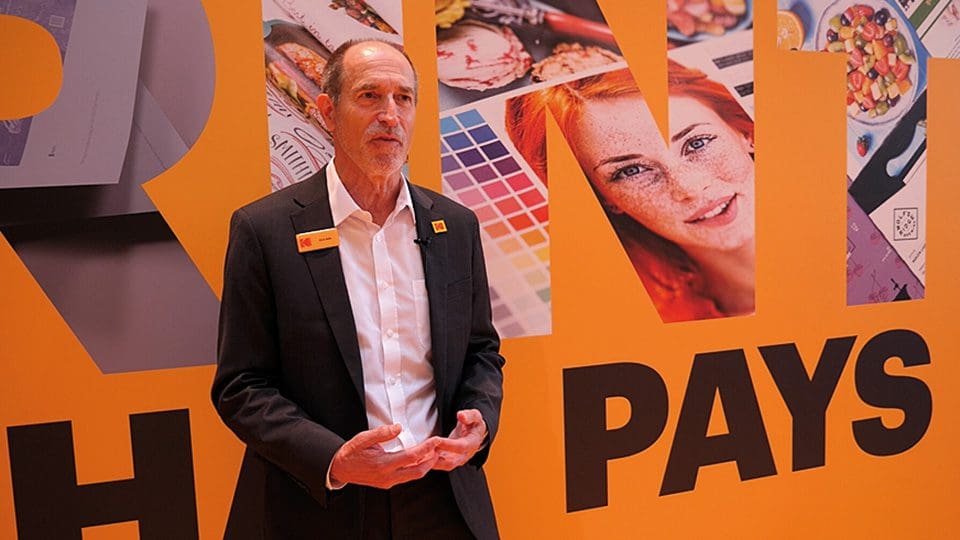
Chris Balls, VP Print at Kodak, says: “We recognise the fact that when you look at the printing industry in general, a lot of the hype and noise is around digital, but a lot of the volume and the mass production is still offset. You’ve got to respect that and a large part of our business is still offset and this is a critical space for us, no doubt.
“Our view is that when printers are looking into the future, it’s not a question of whether you’ll be offset or digital, you really need to be both. So to us, it’s an ‘and’ situation, digital and offset, and we’re providing solutions in both spaces.”
The debate around the shift from traditional to newer printing methods was also touched on by Kornit Digital in its press conference where CEO Ronen Samuel compared this to the shift from screen printing to digital for textiles. Samuel described textiles as “being where paper was 20 years ago – still mainly analogue but with trends showing a move to digital”.
We recognise the fact that when you look at the printing industry in general, a lot of the hype and noise is around digital, but a lot of the volume and the mass production is still offset
Samuel explained that in a world where people don’t want to be the same as everyone else but with an industry that still mass produces textiles and clothing, digital lends itself to on-demand and personalised production now more than ever.
During the press conference, Vincenzo Cirimele, CEO of Teetaly spoke about how using Kornit technology for his on-demand business has enabled him to pivot.
With paper numbers dropping pre-covid, Cirimele moved to textile and says he has made €5m (£4.25m) in revenue in five years. Cirimele credited Kornit technology for making this move from analogue to digital straightforward. He currently uses HP Indigo technologies for paper and stationery products and Kornit for bags, t-shirts, and hoodies.
Canon has also focused on bridging the gap between different sectors with the launch of new machines. Building on the success of its VarioPrint iX 3200 sheetfed inkjet product, Canon has introduced the VarioPrint iX 1700 to complement this portfolio and to close the gap between toner and sheetfed inkjet.
The manufacturer has also introduced the VarioPress iV7 which it describes as closing the gap between the B3 sheetfed inkjet market and offset which typically requires larger format sizes.
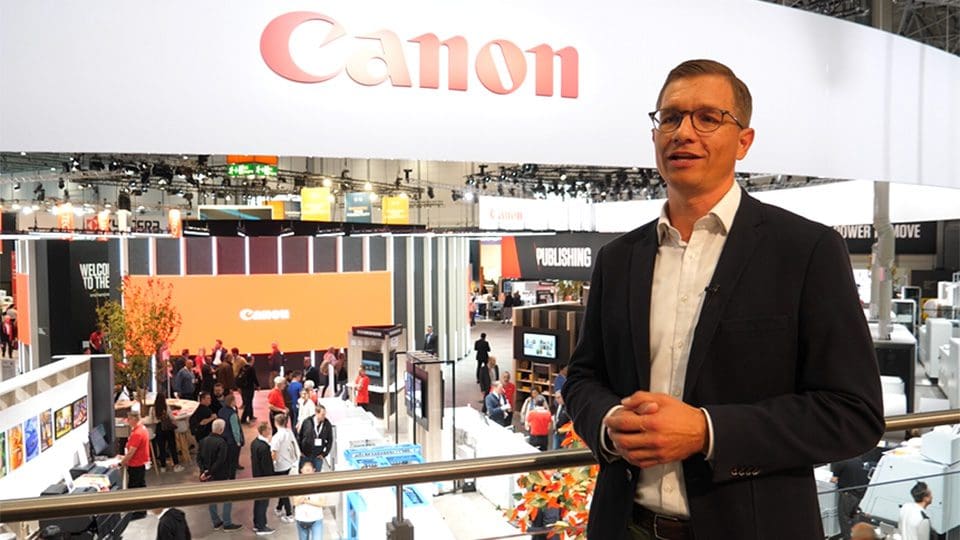
Schmidbauer explains: “With 750 by 640mm, customers can continue with their B2 sheetfed workflows but invest into inkjet and by that, grow their services, be more flexible and more profitably print shorter runs.”
Gelato, which has recently launched its GelatoConnect solution was founded after CEO Henrik Müller-Hansen identified an overcapacity within the print industry for production and a lack of software solutions to bridge all these technologies as the industry evolves.
“As e-commerce has grown and as Shopify, Spotify, Etsy, and Amazon have grown, more and more of the industry has oriented around micro runs and as the production runs go down, the need for software goes up," he says, adding: "If a digital printer wants to support e-commerce, they need to expand their product categories.
“When they do this, it’s more and more difficult to handle procurement effectively. If you sell all four of those categories, you probably have four different workflows. We replace all of those different workflows with GelatoConnect.”
Another theme I noticed during the first week of the show was the number of mentions of the aging workforce and the lack of skilled workers. This is something that we’ve been talking about now for some time, but it was interesting to see manufacturers and software providers developing tangible solutions with this issue at the forefront of their R&D efforts.
Having been designed as an easy-to-use all-in-one solution, Müller-Hansen says GelatoConnect enables companies handing over to the younger generation to transition smoothly.
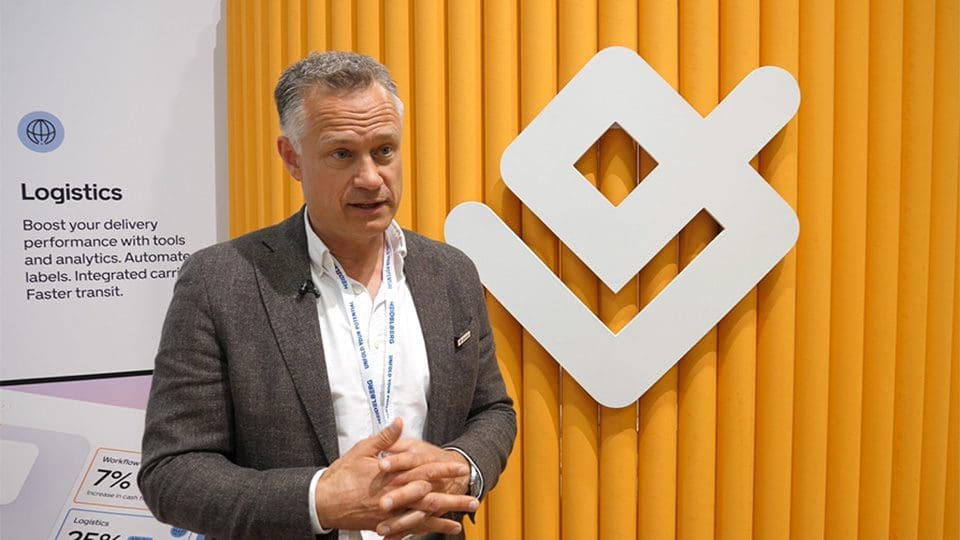
“Many people that we meet are speaking about the next generation in their families. They have a print house or a company and they want that company to be handed over to their children. So I think that Gelato Connect is also a way for the owners of print facilities across the planet to prepare their company for the next generation.
“The question they should ask is, will there be fewer personalised products five years from today or more? Will there be less e-commerce five years from today or more? And will there be more software in the production flow five years from today or more? All trends point to the creator economy, e-commerce, and software.”
Another example is Frontline.io which provides the answer to several pain points in the industry such as difficulty sourcing skilled engineers, the time-consuming problem of having to send out engineers to sites creating downtime in the meantime, as well as sourcing machines for training.
Frontline.io utilises Augmented Reality (AR) and Virtual Reality (VR) technologies for remote inspection and servicing as well as to create digital twins of presses.
Companies such as HP, Landa, and BOBST have all adopted these technologies and Landa has reported a 50% saving in costs as it removes the need to fly people around for servicing and training.
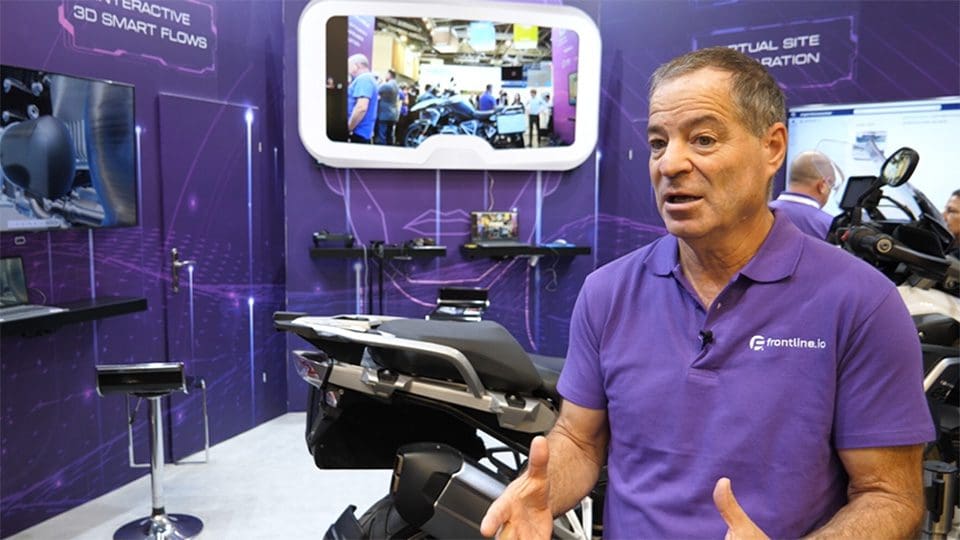
As well as addressing the challenge of sourcing skilled engineers, Gilad Tzori, COO of Frontline.io, explains how this technology is also helping to bridge the skills gap by appealing to the younger generation.
“The younger generation is looking for thrills and for things to happen fast. They don’t have the time to sit for six or nine months to learn the ropes. When they see this technology, see the AR glasses and the VR that they know from home, they really connect with it automatically.
“The nice thing is you can take someone who’s never done any work on a press before, they just need to have the basic skills of how to use a screwdriver for example, and then with our technology, they can fix the press immediately without having to learn for a very long time. I believe it brings the young generation back to the printing industry.”
As short runs and personalisation boom, software is becoming more and more of a pivotal part of the production process, as highlighted by Gelato’s Müller-Hansen and several other manufacturers in their press conferences.
However, with hardware manufacturers such as Canon and Ricoh presenting such creative and impressive stand designs and others such as Fujifilm demonstrating such a broad and eye-grabbing variety of applications, it can be tricky for a software provider to have the same impact.
That being said, we were impressed by the way exhibitors thought outside the box to get their messaging across. Gelato, for example, hosted daily ‘Scoop Sessions’ which included presentations and testimonials from customers as well as giving out free gelato.
This went down well with visitors and acted as an extra marketing tool when these same visitors left their booth to walk around the rest of the show with a branded gelato tub in hand.
Another company that presented its technology in a creative way was Antigro Designer. The company demonstrated its Sticker Builder software by encouraging visitors to take a selfie and have their images printed as stickers which they could place onto a large ‘Drupa Wall’, filling the white text with their faces.
Hybrid Software Group, which is made up of six subsidiaries had a large presence in its hall and hosted regular presentations which were consistently packed with visitors. The company demonstrated its six brands across different areas of its stand with clear messaging and totem pole-style signage filled with information about each offering.
The brands within the group include HYBRID Software, Global Graphics Software, Meteor Inkjet, Xitron, ColorLogic, and iC3D.

Mike Rottenborn, CEO of Hybrid Software Group, comments: “Some people don’t believe in synergy but I believe there is synergy here. For example, our Harlequinn RIP which is actually driving every press in the HP or HP Indigo hall is also the RIP that powers our CloudFlow workflow, the Xitron Navigator DFE and workflow or even our own Smart DFE. ColorLogic products are used by OEMs and they’re also used by end-users so there are a lot of synergies there.
“A lot of these products then tie back to Meteor Inkjet which has electronic drive boards inside inkjet printing devices. We’re the only vertically integrated manufacturer that has everything that you need for industrial printing and packaging.”
Describing the thinking behind the booth design itself, Rottenborn says: “We wanted an open booth that’s welcoming and that’s a place that companies can come and spend some time, perhaps look at a demo and then sit and talk about what their needs are.”
Paul Bates, managing director of Hybrid Software, adds: “This is the first time ever that all our workstations here aren’t running any software. All the software is in the cloud so we’re actually practicing what we preach. We’re showing here systems using an Amazon Web Services system in Ireland and the performance is second to none. It’s so quick and is a highly efficient way of working it.”