From apprenticeships and graduate schemes to in-house training and career development, businesses across print are rethinking how they attract and retain talent. We explore why investing in people is becoming just as important as investing in technology
Rob Fletcher
September 23, 2026
Print has never been an industry that stands still. New technologies, evolving customer expectations, and increasing automation continue to reshape the market – both in the UK and around the world – with businesses having to adapt at pace. While investment in the latest presses and finishing equipment often dominates headlines, many argue that the industry’s greatest asset remains its people.
However, finding the next generation of skilled employees is becoming increasingly challenging. An ageing workforce, changing perceptions of manufacturing careers, and growing competition for technical talent mean businesses must work harder to attract new recruits – all while developing the skills of their existing teams.
While there is no single solution, companies are taking various approaches to attract new talent. Apprenticeships, graduate schemes, and ongoing investment in upskilling existing employees are helping bridge the skills gap and increase the knowledge of existing staff.
Bringing People Together
Addressing one of the current core issues with drawing people to print, Suzi Ward, managing director of FESPA UK Association, says it is “terrible” print is not covered more in schools and colleges. While this remains a challenge, the good news for the industry is the rising number of schemes seeking to not only raise awareness of the opportunities for people in print but also offer a route into the industry.
FESPA UK’s Next Generation is one example. Launched in 2023, the programme is a talent development initiative aimed at 18 to 30-year-olds working in, or looking to enter, the print, graphics, and signage industries.
“The FESPA Next Generation isn’t a formal training programme,” says Sarah Lees of Compass Business Finance and ambassador for the initiative. She adds: “It’s about bringing people together, creating connections, and giving younger professionals access to conversations they might not otherwise have.
Sarah Lees recently became an ambassador for the FESPA UK Next Generation initiative
“One of the biggest challenges is attracting new people into the industry, engaging them, and helping them understand just how much it has evolved. There are so many exciting opportunities across print, graphics, and signage, but a lot of people still don’t know they exist. We also have a huge amount of experience within the industry, and it’s important that we create opportunities for that knowledge to be shared with the next generation.”
Despite being in its relative infancy, the initiative already has many success stories. One of those who has worked with the programme is Michaela Christmas, a print production operative at Moss UK and a FESPA Next Generation Committee member. Christmas completed her industry training with Learn2Print – with more details on the provider to follow later in the feature – before taking on her first industry role.
“The training provided me with a breadth of knowledge about the industry and multiple print processes throughout it,” she says, adding: “This was an invaluable part of my training as I gained knowledge that I couldn’t have had without the classes. The training programme also supported hands-on learning through my workplace, identifying skills I was learning, and reinforcing knowledge that I still use throughout my career now.”
One of the biggest challenges is attracting new people into the industry, engaging them, and helping them understand just how much it has evolved
Also working with the FESPA Next Generation is Clark Shannon, compliance manager at Simpson Print and another FESPA Next Generation Committee member. Shannon admits he was unaware of the range of roles available in print – and how an apprenticeship opened his eyes to these opportunities.
“The apprenticeship provided me with real in-depth experience as to what I may see in my field of work and gave me an insight into how to be a good compliance officer,” he says, adding that it gave him “tips, tricks, and skills” which may not have been covered in a textbook but “will come in handy in the real working environment.”
Don’t Leave It Too Late
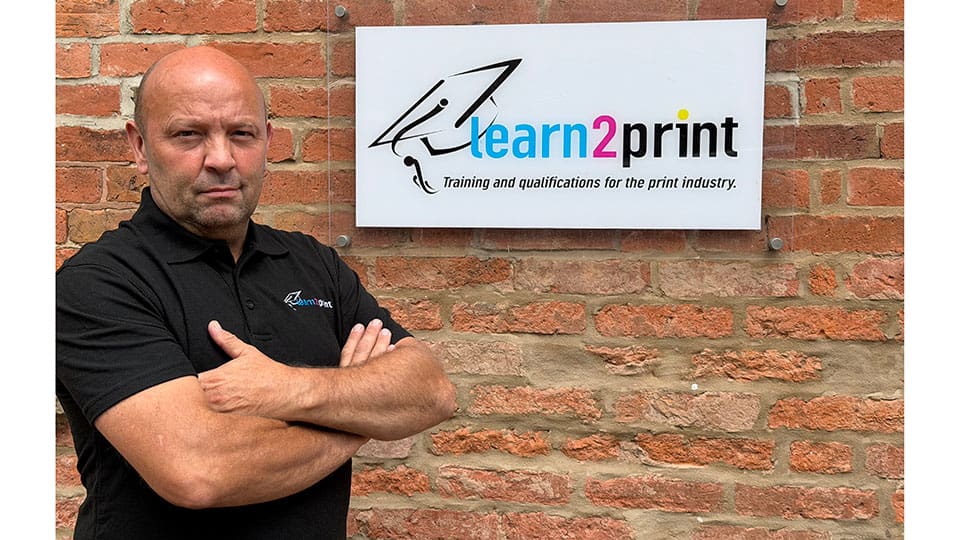
Circling back to Christmas’ experience with Learn2Print, which, as its name may suggest, specialises in training for the printing and graphics industry. Education director, Jon Bray, explains that while the provider is involved with both large and small companies across the UK, the message is the same: people who are retiring, and there is no one to replace them.
“In my opinion, the reason for this is that companies leave it too late to recruit,” Bray says, adding: “The skilled people have left before they have time to mentor new people into the industry leaving companies in a panic. Learn2Print constantly tries and pushes companies to invest into apprenticeship and always consider a five-year plan with a view to not getting caught out. The apprenticeships are funded and the government have some fantastic incentives for companies. Companies need make good use of what is on offer.”
Bray went on to highlight the lack of print-focused training available in the UK. In 1997, he says there were 32 dedicated training providers, whereas at present, there is just two – mainly due to the cost of equipment, with colleges effectively shutting their doors to print. For this reason, he says Learn2Print is more passionate than ever about championing the industry and the opportunities it offers.
Jon Bray of Learn2Print highlights the value of apprenticeships to print companies
“We now operate a national provision to ensure printers everywhere have access to the apprenticeships in prepress, press, and postpress operations,” he explains, adding: “That said, the companies themselves need to reach out and let us help them. It has now got to a stage where the sector is struggling, and we are now being inundated with large and small companies approaching us for help. Learn2Print have double the intake of apprentices since this time last year.”
Learn2Print offers both full-cost, tailor-made training and apprenticeships, though Bray says the latter forms its “backbone”. Options are available in both intermediate and advanced forms, with Bray saying its current eldest learner is 46.
We now operate a national provision to ensure printers everywhere have access to the apprenticeships in prepress, press, and post-press operations
“We work closely with companies to help with their recruitment and help to structure the workforce to support and mentor the apprentices,” he says, continuing: “Companies need to reach out to print apprenticeship providers and find out what is on offer and what the latest financial initiatives are.
“Printing businesses can get up to £3,000 per apprentice. They need to support marketing to schools to get younger people excited about a fantastic career in print.”
Building For The Future
Though specialist training for the industry may be on the sparse side, recent developments suggest there is still a strong appetite for these types of programmes. In May of this year, the British Printing Industries Federation (BPIF) completed the sale of BPIF Training, its regulated apprenticeship training provider that serves employers and learners across the print and packaging sector.
The provider was picked up by Fiona Hudson-Kelly, an experienced figure in apprenticeships, workforce development, and business growth. Hudson-Kelly is perhaps best known as the founder of Smart Assessor, a leading software platform supporting apprenticeship training providers across the UK. Under her leadership, it is hoped that BPIF Training will go from strength to strength and open more opportunities in the industry.
Key to the sale is that the change of ownership has not had any impact on learners, employers, or apprenticeship programmes. BPIF Training has continued to deliver training and support as normal, with existing arrangements, learner support, and employer relationships all unchanged. In addition, BPIF Training will maintain a close working partnership with the BPIF moving forward.
Clark Shannon is compliance manager at Simpson Print and a FESPA Next Generation Committee member
“I am delighted to be joining BPIF Training at such an exciting stage in its journey,” Hudson-Kelly comments, adding: “One of the greatest strengths of BPIF Training is its exceptional leadership team and dedicated people. Karly Lattimore [managing director of BPIF Training] and her experienced team will continue to lead the business day-to-day, providing continuity, expertise, and trusted support to learners, employers, and partners, with my support as chair as we build on the company’s strong foundations and future growth ambitions.”
Lattimore adds: “BPIF Training has achieved significant progress over recent years, with continued improvements in quality, employer engagement, and organisational performance. This new chapter creates exciting opportunities to build further on those foundations, while maintaining the strong sector relationships and values that are central to the organisation.”
Rising Star of the Show
Rounding the discussion off is Liz Ross Martyn, director of marketing and engagement for the Printing Charity, and a key voice in its popular Rising Stars initiative. Rather than acting as an entry route, the programme helps to retain and develop early-career talent already working in the industry.
“The Rising Star Awards provide funding to people aged 18 to 35 building a career in our sector to enable them to undertake the training they know will help them progress in print and the allied trades,” Martyn says, adding: “They’re seeing what’s needed, and putting themselves forward for training that will help meet that need. Through that training, they bring new skills into the sector, which, ultimately, can inspire them to remain within it.
“In addition, the Rising Stars is designed primarily to provide training outside core role areas through developing personal skills. This year, 43% of winner courses were in this category, including project management, leadership, resilience, confidence, and public speaking. Regardless of job role, these all provide excellent preparation for supporting progression and success, and navigating the pace of change.”
The Printing Charity recently celebrated its 2026 Rising Star Awards at an event in London
While there is plenty of positivity around schemes such as the Rising Stars and FESPA UK’s Next Generation, the fact remains that there is an industry skills shortage. So, what can the market do to improve training opportunities and encourage new talent to join? Martyn says that after speaking with several Rising Star Award winners about how young people can be encouraged first to join, and then to thrive in our sector, five key topics emerged.
“First, it’s really key to shout about the fact that print is an industry young people can be passionate about,” Martyn says, continuing: “Second, make it clear that print provides many ways to build a career, while third, there should be a commitment by businesses to provide training and development for their employees, and to be open to those employees’ ideas on what this could look like.
Factoid: Managed by the Printing Charity, the Rising Star Awards provide funding to people aged 18 to 35 building a career in print
“Fourth, becoming part of strong communities and networks matters a lot, so space and time to do this is important. Finally, a commitment to workplace wellbeing and building and modelling the right culture from employers, including showing appreciation and encouraging healthy work-life balance and ‘shutting off’ when not at work.”
While there is no quick fix to the industry’s skills shortage, one thing is clear: the print sector is taking positive steps to secure its future. From apprenticeships and specialist training to mentoring schemes and professional development programmes, businesses and organisations are creating more opportunities than ever for people to enter, grow, and build rewarding careers in print.
The challenge now is to build on this momentum, continue raising awareness of the print industry’s diverse career opportunities, and ensure employers invest in developing talent at every stage. After all, while technology will continue to drive innovation, it is the people behind it who will determine the future success of the print industry.
From advances in print quality and productivity to increasing demand for automation and sustainable solutions, the wide-format market continues to evolve. Rob Fletcher looks at the latest trends, challenges, and developments in this sector
Speaking to a range of print and signage professionals, we discover how a sustainable business model can drive growth, outlining actionable strategies to cut overhead costs, improve eco-efficiency, and boost your bottom line
As finishing continues to become a great way to add extra elements to your print and wow customers, we take a look at some of the creasers, folders, and collators on the market, and ask experts their advice on finding the right solutions
(this was inserted into the PHP of a code block)
Watch our latest video of the week
Print Monthly gives you the latest video coverage of companies, people, and events from within the print industry.