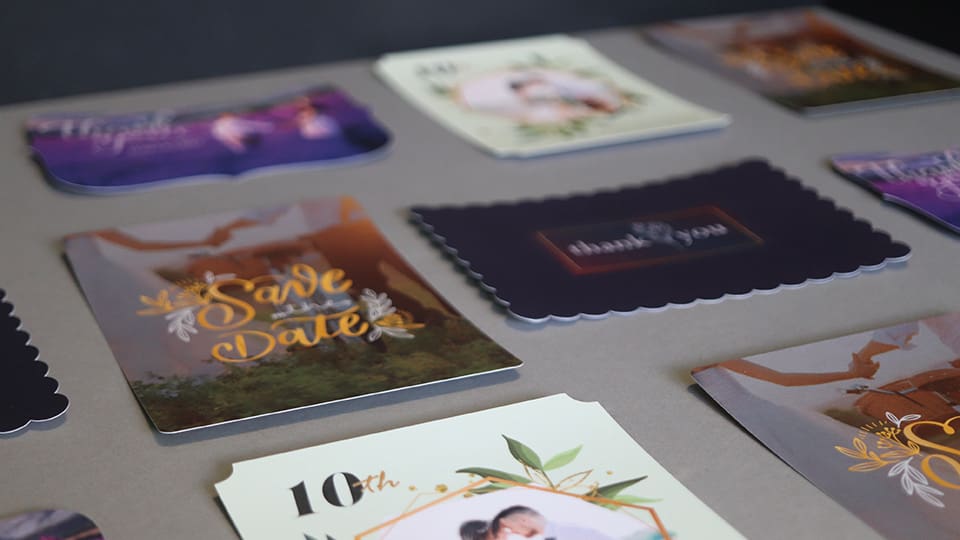
From shaped business cards and custom stickers, to intricate direct mail pieces and short-run packaging, die-cutting remains a key part of production for many printers. Here, we analyse some of the market’s latest developments
Rob Fletcher
July 29, 2026
Die-cutting has become an increasingly important capability for print businesses looking to add value and differentiate their offerings. The ability to produce creative, eye-catching applications can help print service providers (PSPs) win new work and increase margins in competitive markets.
The range of die-cutting technologies available today is broader than ever. Traditional mechanical systems continue to play a key role in high-volume production, while digital die-cutting solutions offer greater flexibility, faster turnaround times, and cost-effective production of short runs and personalised jobs. Advances in automation, precision, and workflow integration are also making it easier for businesses to incorporate die-cutting into their operations.
Here, Print Monthly takes a closer look at some of the latest die-cutting technologies on the market, exploring the advantages of different approaches, and considering how PSPs can select the right solution for the core applications they offer to customers.
Speed, Flexibility, and Quality
Up first to comment is Craig Harry, head of sales for Duplo UK, who says the biggest trends in this market are a shift towards shorter runs, increased versioning, and growing demand for premium, custom-shaped work. As such, he says the conversation is moving beyond simple shape cutting, with customers now demanding speed, flexibility, and production-grade quality in one workflow.
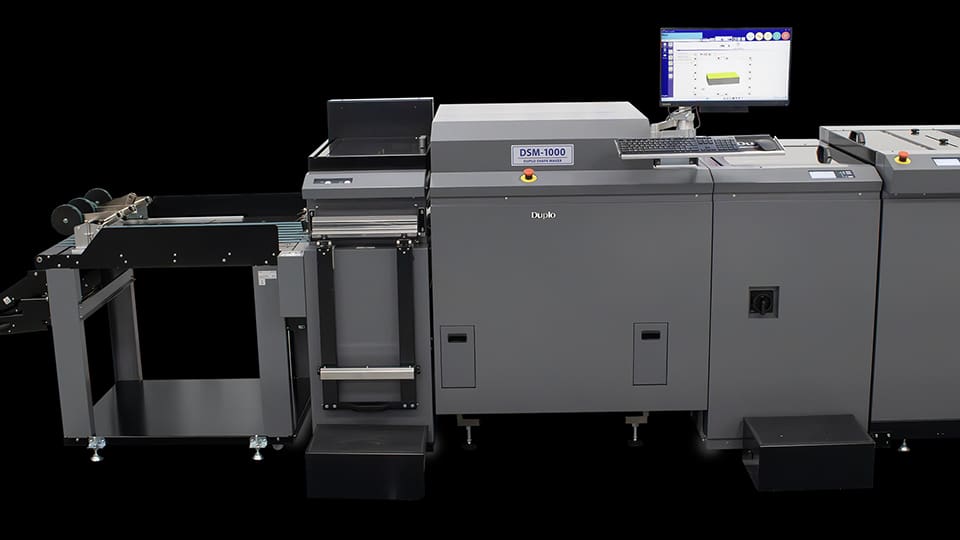
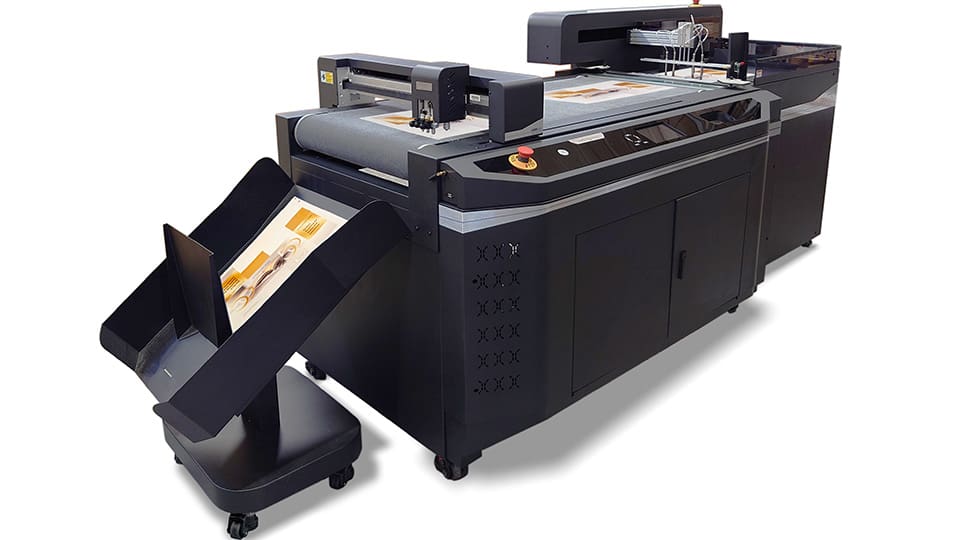
For Harry and Duplo, this is where the DSM-1000 comes into play. He explains how the machine gives commercial printers a “serious” B2 route into cartons, folders, shaped cards and display work, while the PFi Blade B2 and PFi DI-CUT 310 support smaller bespoke jobs, and repeat shaped applications where agility matters.
But how are printers and converters balancing the need for faster turnaround times with pressure on costs and productivity? Harry offers an explanation: “They are doing it by removing touchpoints, bringing work back in house, and investing in systems that spend more time running than setting up.
Duplo says its DSM-1000 gives commercial printers a “serious” B2 route into cartons, folders, shaped cards, and display work
“That is exactly where the DSM-1000 makes a difference. It runs at up to 3,100 sheets per hour, supports fast die changeovers, and can automate waste removal with the separator unit, so the gain is not just headline speed but real production time.
“The PFi DI-CUT 310 plays a similar role for repeat rotary jobs, processing up to 4,000 sheets per hour with registration mark compensation, while the PFi Blade B2 gives printers a flexible way to produce samples, prototypes and short bespoke runs. The common theme is simple – faster turnaround only works if the finishing step stops being the bottleneck.”
Harry also talks up the importance of automation, describing this as central and that when it comes to die-cutting, automation is no longer an upgrade, but instead is the operating model.
Factoid: Die-cutting originated in the shoe industry during the 19th century before becoming a core production process across print, packaging and labels
“On the DSM-1000, operators get PC control, unlimited job memory, integrated registration mark correction, multi cut capability, and optional barcode driven recall,” he explains, adding: “The PFi DI-CUT 310 reads registration marks in X and Y, while the PFi Blade B2 combines automated registration and changeovers with Duplo PC Connect software. That gives printers better consistency, fewer reprints, and much less dependence on one highly experienced operator.
“In a market where labour pressure is real and margins are tight, workflow integration is what turns die-cutting from a manual finishing step into a reliable production process.”
So, how should PSPs be looking to use their die-cutters to expand over the coming years? For Harry the biggest opportunity is that more commercial printers can move into profitable short-run packaging and shaped work without taking on the overhead of a traditional converting setup. He says there is “real headroom” for PSPs that can produce high value work quickly and consistently.
According to Duplo, its PFi DI-CUT 310 can support smaller bespoke jobs and repeat shaped applications
“That is why the DSM-1000 matters,” he says, adding: “It gives PSPs a B2, 40-ton, steel rule die-cutting platform for cartons, folders, point-of-purchase (POP), and premium shaped work, with the automation needed to make that work commercially viable.
“Alongside it, the PFi DI-CUT 310 will remain attractive for faster repeat work, and the PFi Blade B2 is a strong route into samples, prototypes, and short-run innovation. The challenge will be skills, capital confidence, workflow discipline, and meeting sustainability expectations as UK EPR (Extended Producer Responsibility) and the EU PPWR (Packaging and Packaging Waste Regulation) reshape how packaging is designed, produced, and finished.
“The businesses seeing the most success are the ones treating die-cutting as part of a connected production workflow rather than a standalone finishing step. The market is moving towards shorter runs, faster changeovers, and more customised applications, and printers need systems that can adapt to that profitably.”
Balancing Turnaround with Costs and Productivity
Also active within this sector is Plockmatic Group, which counts Morgana among its family of finishing brands. Ed Hudson, UK general manager for Plockmatic, says the die-cutting market is being shaped by sustainability requirements, shorter run lengths, increasing personalisation, and the continued shift towards digital production. As digital printing technology has evolved, customers now expect finishing equipment to deliver the same levels of flexibility, responsiveness and efficiency as their presses.
“Traditional production models based on long runs and dedicated tooling are increasingly being challenged by a market that demands rapid turnaround, versioned products, and economically viable short-run production,” he says, adding: “This is particularly evident in growth sectors such as packaging, greetings cards, labels, point-of-sale (POS) materials, and personalised marketing collateral. The cost, lead time, and inflexibility associated with conventional dies are encouraging many printers and converters to explore digital alternatives.”
The FB9550 Pro-T from Plockmatic is a fully automated, tangential creasing and cutting digital die-cutter
On balancing faster turnaround times with cost and productivity pressures, Hudson says customer expectations continue to rise while margins remain under pressure.
“The response has been to reduce manual touchpoints throughout the production process and invest in smarter, more automated solutions,” Hudson says, continuing: “Digital die-cutting removes the cost and lead time associated with physical dies, while advances in automation allow operators to move between jobs with minimal setup and intervention. Increasingly, the focus is not simply on machine speed, but on overall workflow efficiency.
“The most successful operations are increasingly those that can move efficiently from order entry through to finished product with minimal manual intervention. Productivity today is measured less by headline machine speed and more by the ability to process a greater number of jobs with fewer people, fewer bottlenecks, and greater consistency.”
Ed Hudson, UK general manager for Plockmatic Group, says the outlook for die-cutting is “highly positive”
As has been the case across other areas of production, automation is playing a major role in die-cutting. Hudson describes it as one of the most important drivers of innovation in the sector, with the focus shifting from machine speed to ease of operation and consistency.
Modern die-cutting systems increasingly incorporate technologies such as automated registration, barcode or QR-code driven job setup, preset job libraries, and workflow connectivity. Hudson says these capabilities reduce dependency on operators, minimise setup times, and improve consistency.
The outlook for the die-cutting sector remains highly positive, particularly in areas such as digital packaging, folding cartons, personalised products, web-to-print fulfilment, and short-run production
Looking ahead, Hudson expects AI, predictive maintenance, and automated job preparation to play a greater role, helping businesses reduce manual processes and improve connectivity.
Hudson comments: “The outlook for the die-cutting sector remains highly positive, particularly in areas such as digital packaging, folding cartons, personalised products, web-to-print fulfilment, and short-run production. One of the most significant opportunities lies in enabling commercial printers to diversify into higher-margin applications that were once the preserve of specialist converters.”
Move Towards Digital
Elsewhere, Richard Marlow, sales director at Vivid Laminating Technologies, also picks up on the digital trend. He says customers increasingly want shorter runs, faster delivery, greater personalisation, and the ability to produce multiple versions of the same job without the cost and delays associated with traditional tooling. At the same time, he notes a growing demand for added-value applications such as packaging, labels, POS, and speciality print that help brands stand out in competitive markets.
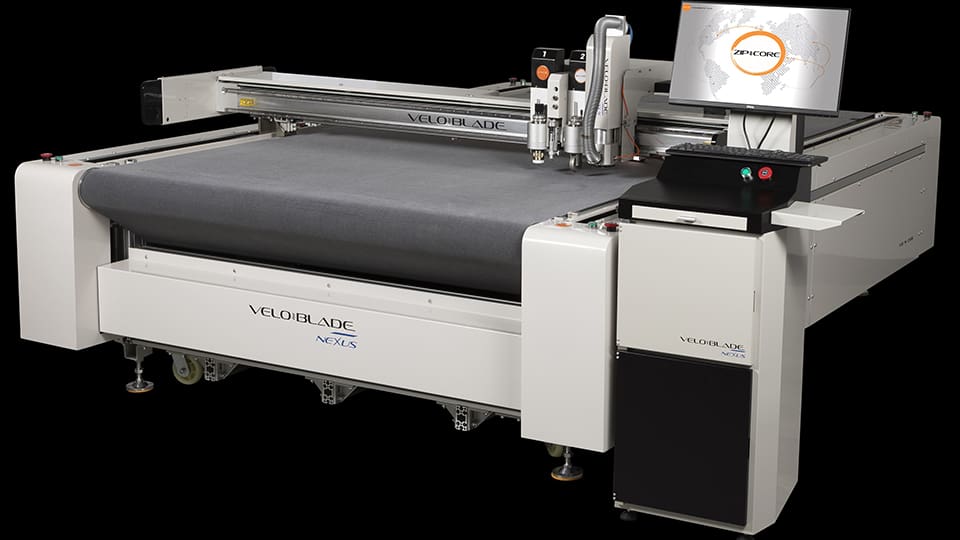
“Solutions such as the VeloBlade range and the recently launched Razar have been developed specifically to address these changing requirements,” Marlow explains, adding: “Customers are looking for flexibility, the ability to handle a wide variety of substrates, and the opportunity to create more intricate, premium products while maintaining profitability.
“The demand is no longer simply about cutting, it is about delivering complete finishing solutions that enable creativity, differentiation and faster routes to market. Razar takes this a step further by combining cutting, creasing, perforating, taping, and raised spot UV in a single system, allowing businesses to produce highly decorative finished products without multiple production stages.”
The VeloBlade Nexus. Vivid Laminating Technologies says digital die-cutting allows printers to move directly from design to finished product
Marlow goes on to say that the most successful businesses are reducing manual touchpoints and bringing more finishing processes in-house. He explains that traditional die-making can introduce additional costs, lead times, and production bottlenecks, particularly for short-run work. However, digital die-cutting allows printers and converters to move directly from design to finished product, eliminating tooling costs, and significantly reducing setup times.
“We’re seeing customers focus on maximising machine utilisation and automating repetitive processes so operators can concentrate on higher value tasks,” Marlow says, continuing: “Systems such as VeloBlade and Razar support unattended production through automated feeding and registration technologies and automated taping with VeloTaper, helping businesses maintain productivity while meeting increasingly demanding turnaround expectations. The ability to switch quickly between jobs without changing tooling is also becoming a key factor in maintaining profitability.”
Looking ahead, Marlow says the biggest opportunity is helping print businesses diversify into high-margin applications. He sets out how demand for customised packaging, personalised products, short-run labels, and premium embellishment continues to grow, creating significant opportunities for businesses that can offer fast, flexible production. On top of this, he highlights “strong potential” in consolidating multiple finishing processes into single workflows, reducing complexity while expanding creative possibilities.
Ultimately, the businesses that succeed will be those that embrace automation, workflow integration, and application flexibility
However, there will be challenges, primarily maintaining profitability within a competitive market, as Marlow explains: “Rising operational costs, ongoing pressure on turnaround times, and the need to invest in new technology will continue to test businesses. There is also a growing expectation that equipment must deliver both productivity and sustainability benefits.
“Manufacturers and print providers alike will need to focus on solutions that reduce waste, improve efficiency, and enable greater production flexibility. Those embracing automation, digital workflows, and value-added finishing will be best positioned to succeed in the years ahead.”
Marlow’s closing comments offer an apt conclusion to the discussion: evolution is crucial if print companies are to keep pace with competition in what is a busy market. This is true across all areas of production, with new developments in die-cutting offering PSPs an opportunity to modernise their offering.
With The Print Show upon us once again, anticipation has been building for the UK’s leading industry event. From product launches and live demos to expert advice and networking opportunities, here’s what to expect at the NEC this September
We examine two rapidly scaling online business models, both growing within the print sector, exploring what they mean for the future landscape of commercial print
With garment print still proving a popular growth market, Rob Fletcher takes a closer look at some of the latest technology on offer in this sector, analysing how these machines can help your business access new opportunities
(this was inserted into the PHP of a code block)
Watch our latest video of the week
Print Monthly gives you the latest video coverage of companies, people, and events from within the print industry.