New magazine launched for UK’s grassroots music scene
Drowned in Sound has launched SHOWNOTES, a new print title supported by Music Venue Trust which is dedicated to celebrating live music in the UK



The BPIF has released its latest Printing Outlook report which highlights a lowering in industry confidence for print and packaging, caused by mounting costs and regulations

The British Printing Industries Federation (BPIF) has released its 2025 Q1 forecast for the printing and packaging industries, outlining what it sees as a “nosedive in confidence” with signs of subdued growth.
According to the organisation’s latest Printing Outlook survey, output and orders in Q4 of 2024 essentially performed as forecast, with the UK’s printing and packaging continuing a steady growth in 2024.
The BPIF confidence data reported for Q3, first revealed in BPIF’s Q4 Outlook report, was also the most positive for two years, with Q4 output and order growth continuing pretty much as forecast.
However, it has been calculated that business confidence slipped in Q4 and subsequently order and output expectations for Q1 have flatlined, with industry confidence lowering.
Responding comments to the Printing Outlook survey suggest that the negative economic sentiment comes from changes to government, additional employment costs, and mounting regulations and administrative burdens on businesses.
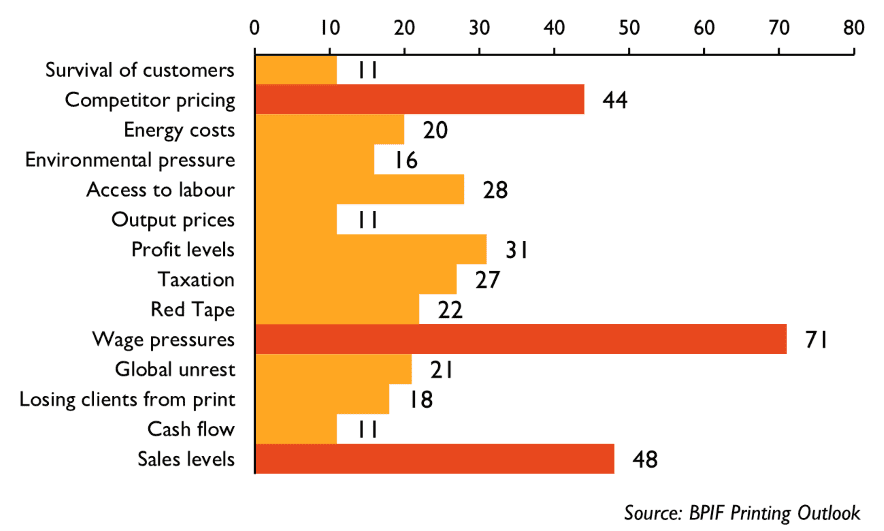
Wage pressure has become the most serious business concern according to the Outlook. According to the BPIF: “Demand is being held back, competition remains fierce, and many companies cannot currently afford to make the investments they seek”.
Kyle Jardine, economist at BPIF, says: “There was a slow but steady improvement throughout much of last year, so it is disappointing to see confidence evaporate at the start of this year.
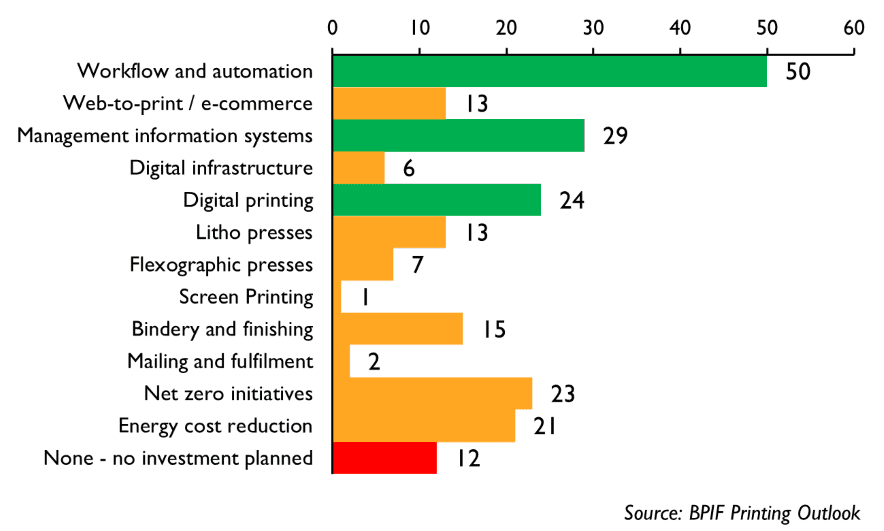
“Wage pressures have become the most critical business concern, and recruitment intentions have been curtailed. Thankfully other costs, excluding energy, have been more stable. Investment remains key, the focus for many companies in 2025 will be on improving workflow and adding automation wherever possible.”
Despite this, businesses in the printing industry are reportedly still investing, with new technologies such as AI being increasingly utilised. Many companies who responded to the Outlook believe that they can make improvements to their workflows and increase automation.
A significant number of those who responded have reported that they are achieving healthy profits and growing. According to the responses, cash flow is holding up, output prices have stabilised, as have paper and board costs, and exposure to bad debt and late payments has decelerated.
Speaking of the Outlook report, Charles Jarrold, BPIF chief executive, comments: “Hopefully the dip in forecast for Q1 is only a short-term blip, and it can be turned around.
“Companies are currently looking to adjust and adapt to government decisions and searching for a way to invest so they can boost their productivity and increase profitability. If government can help stimulate business investment, then confidence could quickly turn positive once more.”