Whether you are looking to protect work or add special effects to applications, lamination opens up a range of options for printers. Here, Rob Fletcher finds out about some of the latest solutions and developments in this area of finishing
Rob Fletcher
September 15, 2025
Lamination is far from a new concept in the print industry, with the technology that printers use today having first been introduced in the 1930s and 1940s. However, the way that print service providers (PSPs) are using lamination has evolved over the years, with its traditional use for protection now just one of several options open to customers.
This technology allows print companies to offer a wider range of finishing options to their own clients. While of course protecting printed work is the primary role of lamination in many applications, PSPs can use the same technologies and techniques to bring added value to printed applications, giving them that extra sparkle that customers crave.
In this feature, Print Monthly sits down with several manufacturers and providers within the lamination area of the market, digging deeper into the potential for lamination and what they can do to help PSPs continue to stretch the boundaries.
In The House
The aptly named Vivid Laminating Technologies is up first to comment. Export director Bruce Cozens says with the expanding use of lamination, more printers are considering bringing the process in-house, and that there are many reasons to do so.
“One of the most significant advantages is the increased control over production,” Cozens says, continuing: “When lamination is outsourced, turnaround times can be unpredictable, and there’s always a risk of delays that impact customer satisfaction. By bringing this process in-house, printers can streamline operations, meet tight deadlines with greater confidence, and reduce logistical complications.
“Additionally, cost efficiency plays a major role. Outsourcing lamination can become expensive over time, especially when factoring in transport and external service charges. Investing in the right equipment allows printers to reduce per-job costs while improving profit margins on laminated products.
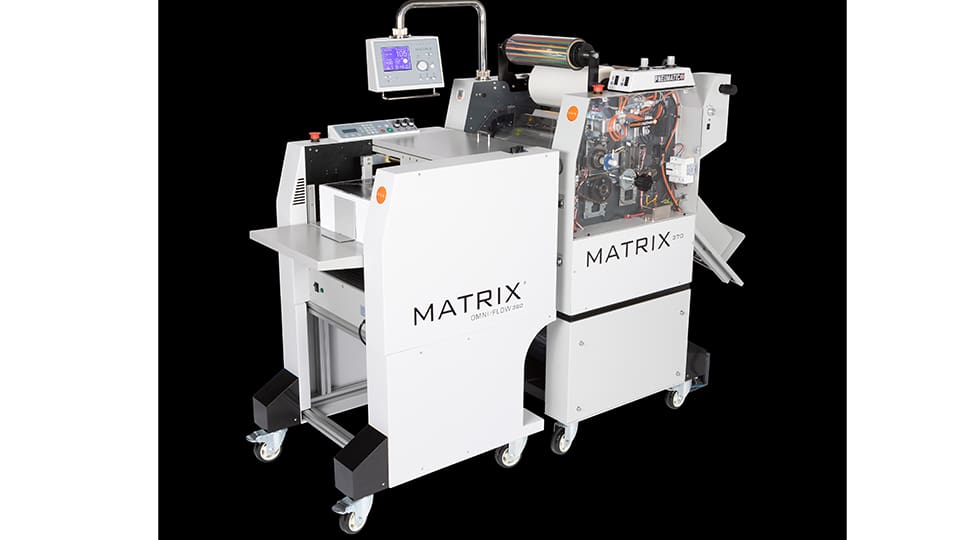
The Matrix MX-370P is one machine in Vivid’s Matrix range of laminating systems
“Furthermore, having lamination capabilities on-site enables businesses to offer a wider range of finishes and services, adding value for clients and helping printers stand out in a competitive marketplace.”
For those looking to bring work in-house, or simply want to upgrade their existing lamination systems, Cozens offers some words of wisdom. He explains that when selecting a quality laminator, it is important for printers to focus on performance, ease of use, and reliability, adding that a good laminator should deliver consistent results, especially for businesses dealing with high volumes.
“Look for the machines that are intuitive and easy to operate, reducing the learning curve for operators and minimise human error,” he advises, adding: “Durability is another crucial factor; laminators need to be built to handle frequent use without significant downtime or maintenance.
“Versatility also matters. Printers should look for systems that accommodate a wide variety of substrates, finishes, and applications, including digital and litho prints. A machine’s ability to switch easily between laminating, foiling, and spot UV-style effects can also provide a valuable competitive edge.”
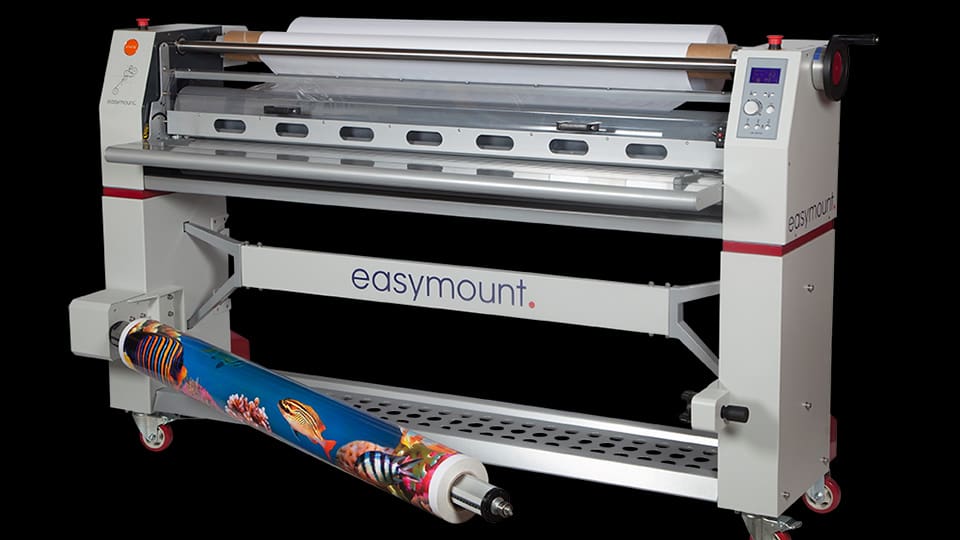
In terms of what Vivid can do to help, for those embarking on a lamination journey, Cozens says the Easymount range of wide-format laminators provide an ideal starting point. Billing the machines as “compact, affordable, and robust”, he says the devices are ideal for small- to medium-sized businesses.
Vivid says its Easymount range of wide-format laminators provide an ideal starting point for PSPs looking to take lamination in-house
“They are easy to use and deliver high-quality finishes for mounting, laminating, or vinyl application,” he says.
For those requiring advanced capabilities, Cozens says the Matrix laminating systems are among Vivid’s most popular and innovative solutions. Designed for commercial printers and finishing specialists, the Matrix features pneumatic rollers and adjustable temperature and speed controls, which the manufacturer says ensure consistent, professional results.
Factoid:One of the earliest large-scale uses of lamination was during World War II to make military maps waterproof and durable for field use
“A standout system in the Matrix series is the Matrix Omni-Flow, which elevates automation with its fully automated feed system,” Cozens explains, adding: “This allows for continuous, unattended operation, ideal for high-volume environments where efficiency is crucial. The Omni-Flow feeder, exclusive to Matrix systems, can be added at any time, growing with your business to handle increased volume and freeing operators for other tasks.
“With additional features like foiling and special effects, the Matrix range not only laminates but transforms prints into impactful marketing tools.”
Speed and Flexibility
Also offering guidance is Sara Alexander, marketing and communication manager of flexible packaging at BOBST. Alexander says bringing lamination capabilities in-house offers several operational and strategic advantages to today’s printers, including significantly faster time to market.
“By eliminating reliance on third-party suppliers, printers can complete jobs with greater speed and flexibility; responding to tight deadlines, last-minute changes, and urgent customer requests without external bottlenecks,” Alexander says.
“Secondly, introducing lamination capability can help to enhance quality control. By taking charge of the lamination process, printers gain greater oversight over every aspect, from substrate preparation to adhesive application and finished lamination.
By bringing this process in-house, printers can streamline operations, meet tight deadlines with greater confidence, and reduce logistical complications
“Another key benefit is potential cost efficiency. Outsourcing lamination introduces markup costs, delivery fees, and minimum order charges that can inflate total project expenditures, especially on short runs or frequently changing jobs. In-house lamination removes these hidden expenses and gives printers total transparency and control over their budget.”
If you are in the market for a new machine, Alexander offers some advice. She explains that choosing the right laminator begins with thorough evaluation of both technology and practical workflow needs. Alexander says one of the critical attributes to consider is ease of use, particularly in both day-to-day operation and maintenance.
“Machines with intuitive interfaces, touch control panels, and easy access to key areas such as the lamination nip allow for speedy set-up and quick interventions, which can significantly reduce downtime and support consistent, high-quality output,” Alexander explains
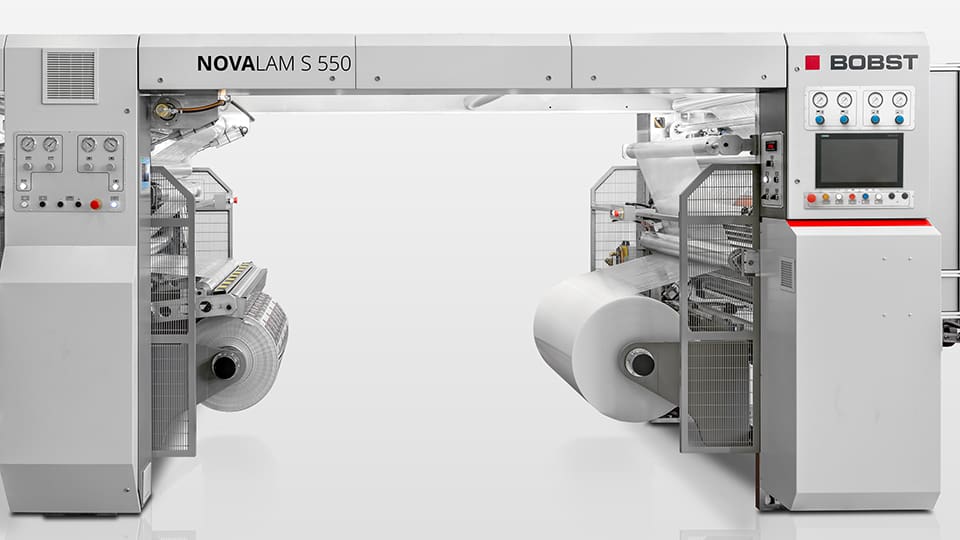
BOBST count the NOVALAM S 550, a compact solventless laminator, among its solutions
“A flexible and versatile laminator is paramount. The multi-technology solutions should accommodate various adhesive and coating technologies and allow for the use of different trolleys or finishing modules. For higher-end applications, options to extend the drying tunnel or adapt the machine for tandem and triplex lamination help printers expand the range of substrates and job types they can process. This adaptability enables printers to handle a broader spectrum of substrates and job types, from simple duplex applications to more complex, multi-layer structures.”
There will be a continued need to produce fast turnaround, short run, or personalised print, efficiently with an emphasis on getting it out the door as quickly as possible
“At the heart of a successful lamination process is partnership with suppliers like BOBST. Such partners can provide both robust machinery as well as deep process expertise, and as market trends evolve, it is increasingly valuable for printers to work with manufacturers that can provide ongoing support and share insights on adapting to evolving industry demands.”
With this, she picks out some suitable solutions from BOBST. These include the NOVALAM S 550, a compact solventless laminator that she says is engineered for effortless installation. The machine offers a plug-and-play setup that can be operational in as little as one week, with a user-friendly interface that means operators can maintain quality standards.
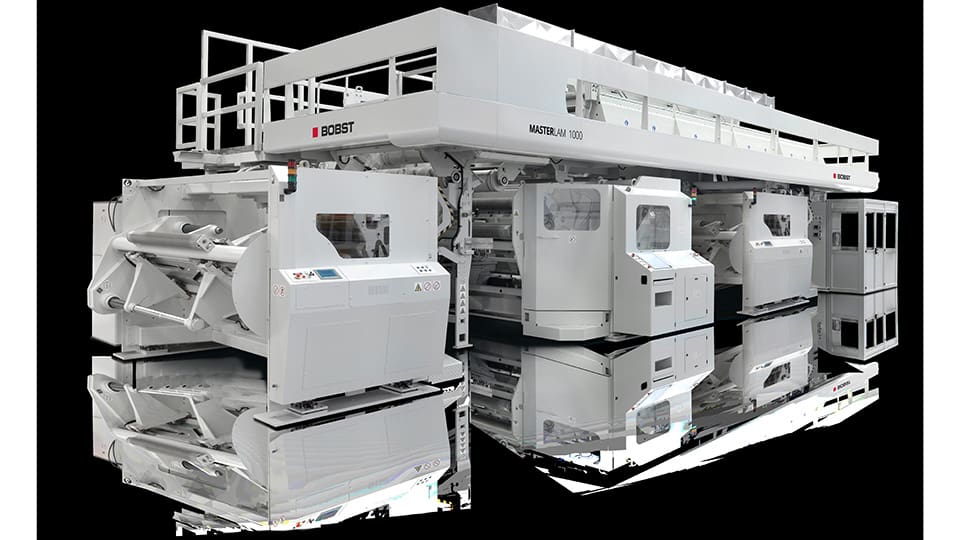
The MASTERLAM 1000 is one of the more advanced machines from BOBST
Also from BOBST are the advanced EXPERTLAM 900 and MASTERLAM 1000 machines, which Alexander says support a wide array of applications, including those demanding barrier coatings for enhanced product protection and shelf life.
“The high-end range is highly configurable with a comprehensive suite of coating trolleys and winder types,” she says, continuing: “The option to extend drying sections and adapt machinery to tandem or even triplex configurations ensures printers can keep pace with evolving job requirements, including complex, multi-layer structures, and the integration of more sustainable materials. Solutions like these demonstrate our commitment to innovation, reliability, and partnership, helping printers of all sizes establish themselves as leaders in an increasingly competitive market.”
Automation Excellence
Meanwhile, Morgana Systems, now part of the Plockmatic Group alongside Intec Printing Solutions, offers various lamination machines. Terri Winstanley, marketing manager for packaging and labels at Morgana, says there are numerous reasons printers would find bringing lamination in-house beneficial.
“Digital print technology will advance rapidly over the next ten years,” Winstanley says, continuing: “There will be a continued need to produce fast turnaround, short run, or personalised print, efficiently with an emphasis on getting it out the door as quickly as possible. Lamination helps complete these jobs to a high standard.
“Quality and cost control are also improved by bringing work in-house, while turnaround times are also kept to a minimum as there is no need to wait for the work to be externally completed and returned. Then there is the option of adding creative value; with gloss, matt, and silk lamination as well as foiling in a wide range of colours like silver, rose, and holographic finishes including crystal, sparkle, and carbon fibre, printers can add embellishments and eye-catching designs that elevate the value of printed sheets.”
If you are in the market for a new machine, Winstanley says highly automated systems that are simple to set up and easy to use are essential. She says ensuring every piece of print is quickly completed to a high standard, while minimising errors and reprints, positively contributes to the bottom line. So too, she adds, does the ability to add value and lift print with vibrant, stand-out, creativity.
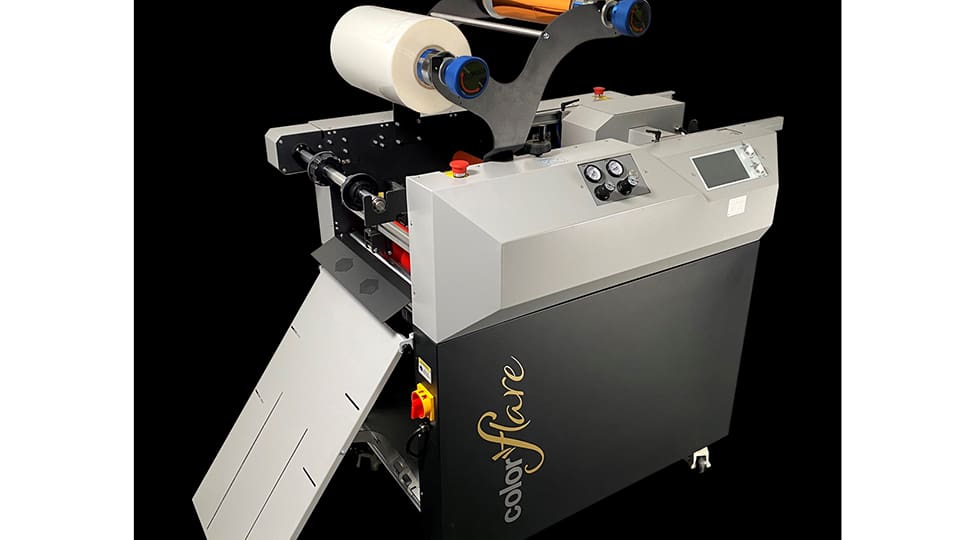
Morgana’s ColorFlare CF2500 Pro is an all-in-one automatic feeding solution for both lamination and foiling
“We believe our laminating and foiling solutions respond to these needs and more,” she says. On this, Winstanley highlights the Morgana Laminator Pro 550, a vacuum-fed, automatic laminator that manages sheets of up to 550mm x 720mm and 400gsm at a speed of up to 25m/min. It incorporates a unique oil system that Winstanley says improves lamination and reduces energy consumption, and has an automatic vacuum feeding functionality for smooth production and an intuitive user interface for simple operation.
Elsewhere, the ColorFlare CF2500 Pro is an all-in-one automatic feeding solution for both lamination and foiling. Its unique oil roller heating system provides consistent temperatures to elevate lamination and reduce energy consumption.
By eliminating reliance on third-party suppliers, printers can complete jobs with greater speed and flexibility
In addition, the compact ColorFlare CF2000 foil-flaring device is dual-laminator and foil-flaring device, designed to offer an in-house decorative effects solution for short-run, on-demand digital applications, as well as lamination for traditional litho output. Its fully controllable pressure and heat processes deliver optimum results with both lamination and flaring-film rolls available in a choice of widths and lengths to deliver great value for cost-effective production.
The running theme throughout this piece is not only the added value lamination can bring to printed work, but also the recommendation to bring this process in-house. Not only will this help save time on producing work, as well as the cost of outsourcing, but open up a wider range of options to print companies, allowing them to be much more creative with print and finishing.
From advances in print quality and productivity to increasing demand for automation and sustainable solutions, the wide-format market continues to evolve. Rob Fletcher looks at the latest trends, challenges, and developments in this sector
Speaking to a range of print and signage professionals, we discover how a sustainable business model can drive growth, outlining actionable strategies to cut overhead costs, improve eco-efficiency, and boost your bottom line
As finishing continues to become a great way to add extra elements to your print and wow customers, we take a look at some of the creasers, folders, and collators on the market, and ask experts their advice on finding the right solutions
(this was inserted into the PHP of a code block)
Watch our latest video of the week
Print Monthly gives you the latest video coverage of companies, people, and events from within the print industry.