As small-format cutting technology continues to evolve, printers face increasing pressure to invest in faster, smarter, and more versatile solutions. Rob Fletcher explores the latest developments, the risks of standing still, and what to consider when upgrading
Rob Fletcher
June 15, 2026
The role of small-format cutting has shifted significantly in recent years, moving from purely a finishing function to a key part of wider production workflows. As print service providers (PSPs) look to increase efficiency and expand their service offering, modern cutting systems are being called on to deliver not only precision, but also speed, automation, and versatility across a broader range of applications.
Manufacturers continue to push innovation in this space, with advancements in areas such as automated job setup, integration with digital workflows, and the ability to handle shorter runs and more complex work. This is enabling PSPs to reduce manual intervention, minimise waste, and respond more effectively to changing customer demands.
However, with these developments comes increasing pressure on businesses to keep pace. Failing to invest in the latest cutting technology can limit productivity and restrict the types of jobs that can be taken on, particularly as turnaround times tighten and expectations around quality and consistency continue to rise. As such, understanding what to look for in new equipment has never been more important.
Integral to Daily Production
Up first to comment is Andrew Edwards, partner sales manager of sign and graphics at Mimaki distributor Hybrid Services, who says for many PSPs, small-format vinyl cutting is so integral to daily production it is often overlooked when it comes to investment. However, he adds it underpins a significant volume of consistent, repeat work such as decals, labels, safety signage and short-run, single colour graphics.
“A small-format cutting plotter is often one of the most heavily used machines on site, but not always the one that gets reviewed when equipment is being upgraded,” Edwards says, continuing: “Older cutters typically show their age through reduced accuracy, inconsistent tracking, and slower throughput.
A small-format cutting plotter is often one of the most heavily used machines on site, but not always the one that gets reviewed when equipment is being upgraded
“If operators are compensating for inaccuracies or re-cutting jobs to achieve an acceptable result, productivity is already being impacted. Increased difficulty when handling laminated or specialist materials is another clear indicator that a machine is no longer keeping pace with production demands.”
So, what should PSPs be looking for when in the market for a new machine? Edwards says for experienced users, precision and reliability should be critical, highlighting features such as consistent tracking, accurate cornering, and repeatable results as fundamental attributes that make a real difference.
“Material compatibility is also a key factor, and higher cutting force achieved by the latest plotters enables users to work confidently across a wider range of media, from standard vinyl through to thicker or more specialist substrates,” he says, adding: “Efficient workflow integration should also be considered, with features that support accurate and integrated print-and-cut.”
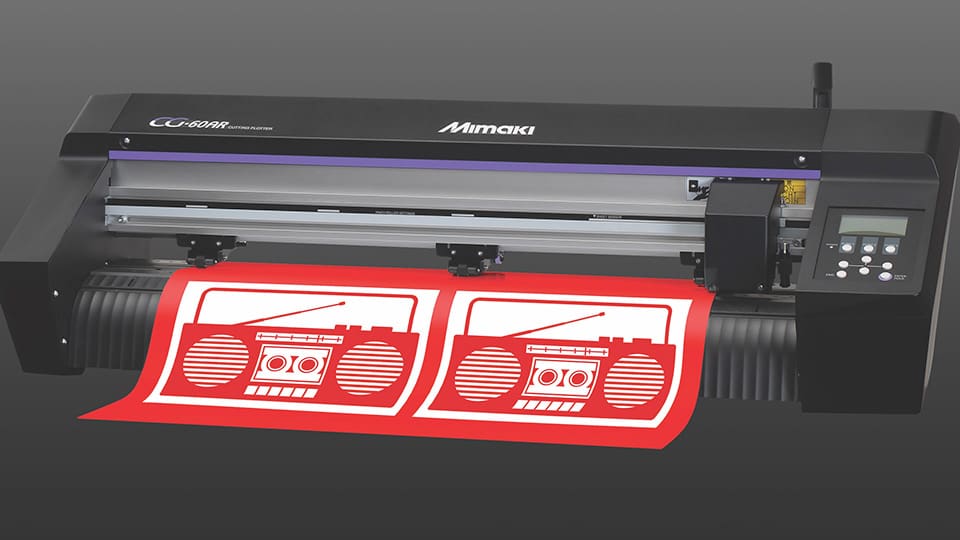
Available from Hybrid Services, the CG-60AR is Mimaki’s latest small-format vinyl cutter
As to what Hybrid Services has on offer, Edwards points to Mimaki’s latest small-format vinyl cutter in the form of the CG-60AR. This offers a 600mm cutting width, which is what he describes as a “class-leading” 550g maximum cutting pressure, and the level of precision historically expected from Mimaki’s cutting technology. Meanwhile, an optional Craft Kit, means the CG-60AR can extend beyond vinyl into light card and packaging samples.
“The CG-60AR is built for consistent, everyday production,” Edwards says, adding: “It’s an accurate, powerful, and dependable workhorse that delivers day in, day out, which is exactly what most production environments require.”
Enabling New Applications
Up next is Lewis Evans, commercial director of Vivid Laminating Technologies, who explains printers should be considering an upgrade when their finishing department starts to limit productivity rather than support it. He says this often becomes apparent through slower turnaround times, increased manual handling, or inconsistencies in quality.
“Another clear indicator is when a business is unable to take on certain types of work, such as short-run packaging or intricate custom jobs, or is forced to outsource them,” Evans says, continuing: “If customer expectations around speed, flexibility, and personalisation are increasing, older cutting systems can quickly become a constraint.
If customer expectations around speed, flexibility, and personalisation are increasing, older cutting systems can quickly become a constraint
“Modern digital cutting technology is not simply about replacing existing equipment; it is about enabling new applications, improving efficiency, and removing bottlenecks from the production process.”
When investing in small-format cutting equipment, Evans recommends that PSPs prioritise precision and consistency above all else, particularly for detailed applications such as labels, packaging, and speciality print. He goes on to say that ease of use is equally important, as intuitive systems reduce training time and allow operators to work more efficiently from day one.
“Versatility is another key consideration,” Evans comments, adding: “A system that can cut, crease, and perforate a wide range of substrates opens up new revenue opportunities and allows printers to diversify their offering. It is also essential that any new equipment integrates smoothly into existing workflows and software environments.
“Finally, reliability and long-term performance should not be overlooked. A cutting system is a core part of production, so it needs to deliver consistent results day in, day out, while also being capable of supporting future growth.”
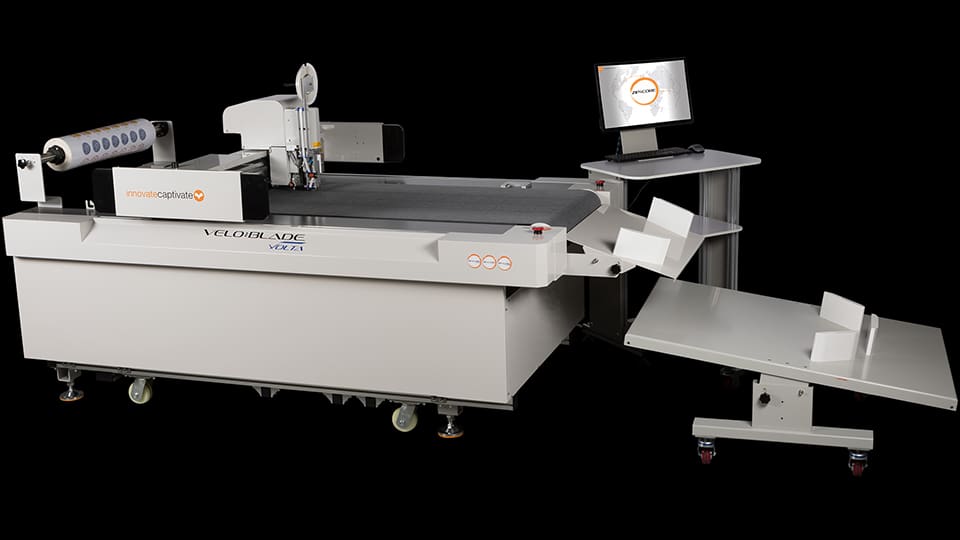
At Vivid, Evans says its VeloBlade range has become popular for printers looking to bring finishing in-house and expand into higher value applications. Within small-format digital die cutting, he highlights the VeloBlade Volta range, saying it combines automation with precision, allowing users to handle cutting, creasing, and perforating in a single pass.
Vivid’s VeloBlade Volta range allows users to handle cutting, creasing, and perforating in a single pass
“Features such as automatic cut depth setting help to reduce setup time and minimise operator error, making it an efficient and accessible solution for businesses of all sizes,” he says, adding: “This capability makes it particularly well suited to applications such as labels, short run packaging, greetings cards, and bespoke print products where accuracy and flexibility are essential.
For those looking to move into larger-format or more industrial applications, Evans points to the VeloBlade Nexus range, saying it offers additional capability by bringing together flatbed digital cutting with routing functionality, enabling users to work with thicker and more rigid materials, including display board and plastics.
“Across the VeloBlade range, the focus is on helping printers increase productivity while also diversifying their services,” Evans says, adding: “By removing the need for traditional tooling and enabling fast job changeovers, these systems allow businesses to respond quickly to demand and take advantage of short run and customised work.”
Striking a Balance
Elsewhere in this market, Terri Winstanley, marketing manager for the packaging and labels business unit at Plockmatic Group, says there is no single rule for when to upgrade small-format cutting kit. She explains that it depends on a printer’s requirements: whether their production volumes have changed, finishing needs have evolved, or they are managing with fewer skilled staff.
“In some cases, upgrading is about adding automation to make up for workforce shortages; in others, it’s about meeting higher quality or faster turnaround expectations, or adding new materials into the mix,” Winstanley says, adding: “Ultimately, it’s a balance between what your current system can deliver and what your customers now demand.
There is no one size fits all answer but knowing your volume and application mix helps you choose the right fit
“Accuracy is key, both in cutting and registration. Companies should also look at flexibility, productivity, and how easily the equipment integrates with existing workflows. Machines need to handle a mix of short, medium, and longer runs efficiently, depending on the work a shop takes on.
“Whether automated or manual, the system should match the business’s production model. There is no one size fits all answer but knowing your volume and application mix helps you choose the right fit.”
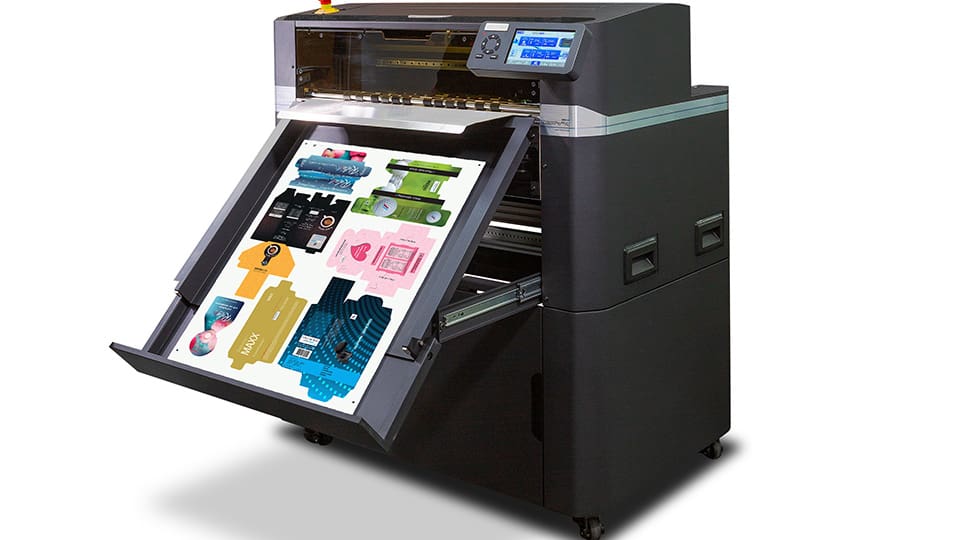
As to how Plockmatic can help, Winstanley highlights the ColorCut range, which she says “answers every finishing challenge with precision and power”. Within this collection is the new SC7800 Pro-RS XL, which Winstanley says is “redefining” small-format performance with patent-pending male and female creasing technology for improved crease quality.
Plockmatic says its new SC7800 Pro-RS XL is “redefining” small-format performance
Also within this portfolio is the ColorCut 6500, which delivers both kiss and through cutting, as well as the production-ready SC7000 series. In addition, complementing the range are the FB580 and FB790 flatbeds, which Winstanley says offer “serious capability” within space-conscious environments when power is needed.
“In the UK and many other parts of the world, our ColorCut 6500 and ColorCut 7000 systems continue to sell rapidly,” Winstanley says, continuing: “They deliver high performance in a compact footprint, offering features that were once limited to larger machines.”
Unlock Capacity
Rounding off the discussion is Seth Morgan, marketing executive at Friedheim International, who says PSPs should consider upgrading cutting systems when they notice a bottleneck or when consistency issues begin to impact quality. He adds that it is important not to wait if this is impacting popular product lines and improve throughput before demand increases too far, as increased pressure can exacerbate quality.
“In fact, it’s common to move a popular product from a more essential or flexible system such as a guillotine into a more specialised solution for this exact reason,” Morgan says, adding: “Printers typically upgrade from a guillotine to a three-knife trimmer to move from a manual, multi-step cutting process to a fully automated, single-pass finishing solution.
“A three-knife system trims head, tail, and face simultaneously, delivering consistent, repeatable accuracy that’s difficult to achieve with manual handling. This not only improves quality but significantly increases throughput, making it far better suited to today’s short-run, fast-turnaround digital workflows.
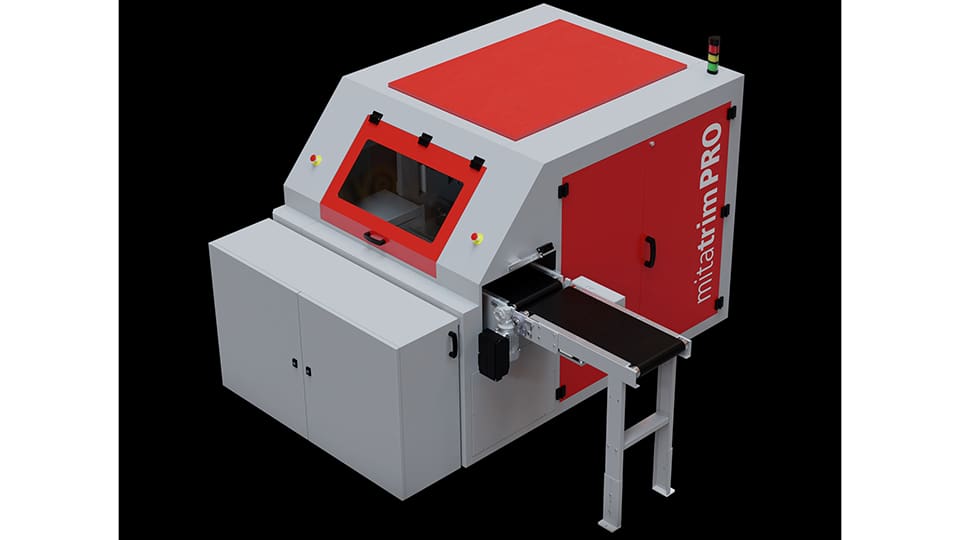
Supplied by Friedheim International, the Digibook Mitatrim Pro is a three-knife trimmer designed specifically for digital book production
“Automating this set of processes into a single system also reduces reliance on skilled operators, minimises handling damage, and enables faster job changeovers through Digibook’s programmable settings. When integrated in line with a perfect binder, it transforms cutting from a bottleneck into a seamless part of a streamlined, end-to-end book production process.”
Going into more detail on the Digibook range, Morgan picks out the Digibook Mitatrim Pro, a three-knife trimmer designed specifically for digital book production, offering automated setup, high-speed output, and seamless integration with binding systems. He says the device has become popular with printers looking to capitalise on the higher margins associated with high quality photobooks and hardback books, especially in web-to-print businesses.
Morgan concludes: “Cutting has a direct impact on both productivity and perceived product quality. Investing in the right finishing technology can unlock capacity, reduce costs, and elevate the overall standard of output.
Factoid: Industry analysts such as Smithers and Keypoint Intelligence say shorter run lengths and increased job variety are placing greater demands on finishing processes
“Key factors include automation level, ease and speed of job changeovers, integration capability, especially in line with binders, consistency of trim quality, and minimal operator intervention. While reliability should be a given, overlooking this can be a big mistake so due diligence on machine build quality and software robustness is essential to ensuring a good investment.”
While there is no specific time to upgrade small-format cutting machinery, there are several factors that PSPs should keep an eye out for that could signal the need for new investment. With plenty of options available on the market from trusted and reliable manufacturers and suppliers, this opens up a whole range of opportunities to those print companies seeking to expand and grow with stronger finishing.
From advances in print quality and productivity to increasing demand for automation and sustainable solutions, the wide-format market continues to evolve. Rob Fletcher looks at the latest trends, challenges, and developments in this sector
Speaking to a range of print and signage professionals, we discover how a sustainable business model can drive growth, outlining actionable strategies to cut overhead costs, improve eco-efficiency, and boost your bottom line
As finishing continues to become a great way to add extra elements to your print and wow customers, we take a look at some of the creasers, folders, and collators on the market, and ask experts their advice on finding the right solutions
(this was inserted into the PHP of a code block)
Watch our latest video of the week
Print Monthly gives you the latest video coverage of companies, people, and events from within the print industry.