The Strategic Commodity Driving Automation and Efficiency
As the industry continues to rapidly change, prepress software becomes more and more relevant to help printers process complex and fast turnaround products. With this in mind, David Osgar speaks to a range of software professionals to find out why prepress investment is more vital than ever
David Osgar
June 15, 2026
When it comes to prepress software in 2026, it is fair to say that it is a tool that is more necessary than ever in order to stay productive, competitive, and efficient. With customers wanting jobs faster and faster, and other constraints like costs and staff putting internal pressures on businesses, having dependable software systems can save hours of work.
In the last few years many different programmes have emerged and changed the ways people and businesses create artwork, designs, and files. Artificial intelligence (AI) has unsurprisingly had a massive effect on the way that designs and files are generated, also impacting the challenges printers might face.
Due to all this, print service providers (PSPs) need to be best utilised to deal with the pros and cons that software such as Adobe, Canva, Figma, DesignLab, and Infinite Design, to name a few, can raise, as well as deal with the typical preflight, colour management, and RIP processes that digital printing typical requires.
With a lot of prepress software now combining several processes and more and more automation being required to help with auto file correction, job ticketing, and batch processing, we speak to several professionals within the prepress space to understand what has changed in this sector of software development and what to consider when investing in prepress technology.
Getting the Right Artwork
A company that has looked to solve inconsistent and poor-quality artwork often being received by printers is Artworker, a company founded by Nate Duckworth after experiencing the issues first-hand as a printer.
“We’re automating the journey from file collection and preflight checks through to standardisation, proofing, and approval. By reducing back-and-forth, and reliance on specialist operators, it becomes a tool anyone can use, not just prepress teams,” says Duckworth, who adds: “This allows roles such as customer support to resolve issues earlier and keep work moving. The result is a more consistent and scalable path into production.”
When it comes to the way print jobs are changing, Duckworth agrees that turnaround times are shrinking, runs are becoming shorter, and SKU counts are rising, putting more pressure on operations. This coupled with customers’ uncertainty regarding print requirements means that manual work is increased and delays and hidden costs can affect bookings.
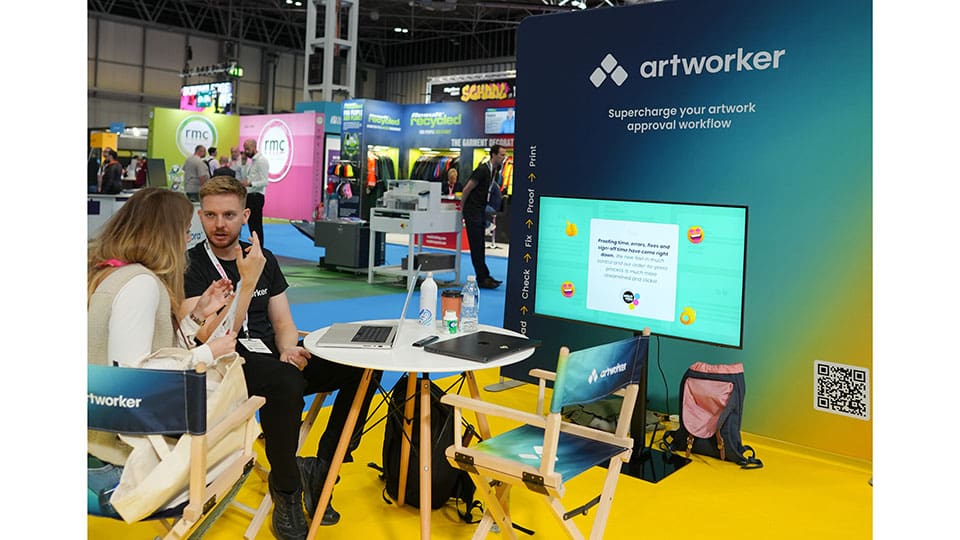
Nate Duckworth, founder of Artworker, exhibited and spoke at The Print Show 2025 about the issues that printers can face when dealing with artwork from customers
Duckworth says that Artworker can absorb that pressure by automatically correcting and standardising files, which in turn means that small or problematic jobs are viable once again.
When it comes to AI and the new innovations taking place in the industry, Duckworth says that Artworker is investing in AI technology as a “practical layer” that acts like an additional team member. “It can run spell checks, visual inspections, and file analysis at scale, as well as normalise data and flag inconsistencies. It also broadens access, allowing more people to run tasks and query information using natural language rather than complex interfaces. Alongside this, deterministic automation remains essential for consistency. The approach is to combine both, with guardrails in place to ensure reliability,” says Duckworth.
Advising on investing in prepress software, and why it is so important, Duckworth emphasises the significance of speed and turnaround, as well as impacts on customer experience and revenue. Duckworth comments: “If there is friction or delay in the process, customers are far more likely to go elsewhere. Faster checks, corrections, and approvals remove that risk, helping retain work and keep jobs moving.
The focus is less on adding tools and more on removing friction
“It also enables sales teams to say yes more often, as jobs that were previously risky or time-consuming become manageable. It is not just about efficiency; it is about protecting revenue and enabling growth through a better customer experience.”
For Duckworth, a lot of the wider changes in prepress software have been built around manual workflows and specialist operators, which he thinks do not scale well. “The shift is towards automation-first systems that embed consistency into the process. More checks are moving upstream to prevent downstream issues,” he says, also touching on the critical importance of connecting MIS, web-to-print, and production systems together to remove delays. “The focus is less on adding tools and more on removing friction”, he adds.
A Variety of Applications and Considerations
When it comes to prepress software, solutions can be applied to the various applications that are offered in the industry including labels, packaging, and wide-format print. While some challenges with artwork can be more specific to certain areas, broadly speaking, the same problems can still exist whether dealing with a poster, label, or piece of packaging.
Problems regarding bleeds, fonts, and file types are faced by printers and graphics specialists of varying types. This is seen particularly by Hybrid Software Group, which provides prepress and workflow solutions to the label, packaging, and commercial print industries. “Our portfolio includes native PDF editing, automated workflows, colour management, and cloud-based collaboration tools such as PACKZ, CLOUDFLOW, and iC3D,” says Steven Steenhaut, chief marketing officer at Hybrid Software.
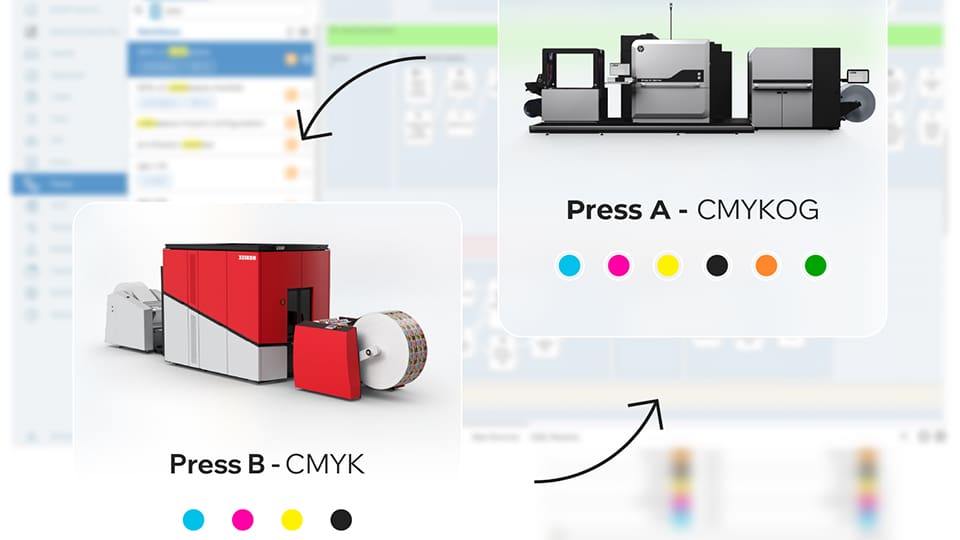
CLOUDFLOW from Hybrid Software can help designate files to specific presses
Steenhaut adds: “We focus on open standards and scalability to ensure seamless integration into existing production environments. Our goal is to streamline the entire production process from file creation to final output.”
Hybrid Software also acknowledges the shift towards shorter runs and increased SKU complexity along with faster turnaround times. Steenhaut says: “This puts pressure on file handling, version control, and colour consistency. Our software addresses these challenges through automation and centralised workflows that reduce manual intervention. As a result, printers can operate more efficiently while maintaining high quality.”
When it comes to the evolution of prepress software, Steenhaut believes that options are now evolving from standalone tools into connected, cloud-based ecosystems with integration across the full workflow, as also touched on by Duckworth.
This aspect is also echoed by EyeC, a provider of automated quality control and print inspection systems for the print and packaging industries. Antonia Weinrich, PR and marketing manager at EyeC, comments: “Prepress software is evolving from local tools to cloud-based, scalable platforms that facilitate team collaboration and MIS integration for faster job prep.
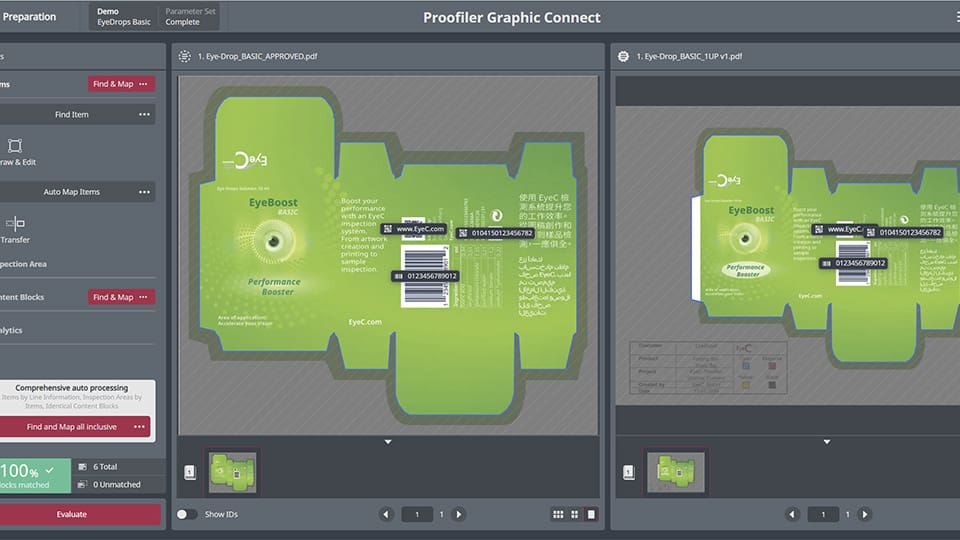
EyeC’s Proofiler Graphic Connect software systematically detects artwork errors like text deviations, graphic shifts, or code issues
“At the same time, automation is streamlining repetitive tasks and cutting lead times. Additionally, data-driven tools help optimise repeats and material use across production runs.”
When it comes to how EyeC is tackling the issues presented by complex designs, variable data, stricter regulatory requirements, and personalised packaging, Weinrich refers to the company’s Proofiler Graphic Connect solution. The software “systematically” detects artwork errors like deviations, graphic shifts, or code issues, before printing, which in turn prevents costly reprints. “This pre-emptive approach supports consistent output in high-stakes areas like food and brand packaging,” adds Weinrich.
Weinrich also points out how printers can often overlook the extra advantages of prepress software beyond just error prevention, pointing out that it can help with providing data analytics for process optimisation such as recurring defects. Weinrich says that Proofiler Graphic Connect speeds up approvals with automated reports and supports compliance audits in regulated sectors like food and pharmaceuticals. “Beyond error prevention, it fosters process repeatability, indirectly supporting sustainable practices by minimising waste from avoidable reruns.”
Beyond error prevention, it fosters process repeatability, indirectly supporting sustainable practices by minimising waste from avoidable reruns
Speaking about the role of AI in EyeC software, Weinrich comments: “AI is currently at the heart of our ProofRunner product line, enabling real-time defect classification for in-line inspection, with potential future integration into Proofiler Graphic Connect on the horizon. For now, our prepress software relies on proven rule-based automation for reliable file checks, ensuring scalability, transparency in regulated environments, and predictable handoffs from design to press.”
Hybrid Software also highlights AI as being core to its offering by providing quicker and more automated solutions which it says detect issues earlier and “optimise workflows dynamically”. Steenhaut says this enables more flexible, scalable, and collaborative production environments.
For Steenhaut, prepress software can go beyond production and act as a “central hub” for collaboration and process control. “Features like remote proofing, version tracking, and real-time job visibility improve communication and reduce delays. Many printers also underestimate the value of workflow data and analytics. These insights can drive continuous improvement and operational efficiency.
“The future of prepress lies in connectivity, openness, and scalability. Printers need solutions that can evolve with their business and integrate easily with other systems. At Hybrid Software, we focus on enabling smarter, faster, and more collaborative workflows. Those who embrace this transformation will be best positioned for long-term success,” says Steenhaut.
The AI in the Room
An area of prepress touched on by EyeC and Hybrid Software is personalisation, which has surged in recent years thanks to the rise of ecommerce but also the advancements of technology and the role social media can play in showing off personalised products.
Enfocus, a Belgian software company that specialises in PDF quality control and workflow automation, has highlighted mass personalisation as the “biggest shift” in prepress software. Enfocus says: “Brands want differentiated print that speaks to individual customers through variable data, versioned artwork, and localised content at scale. That's only profitable if the production workflow is fully automated, balancing both sophistication and intuitive simplicity.
“Our software handles the preflight, correction, and routing of thousands of variants without a single person interacting with any of the files. Automation is what makes personalisation economically viable – and in fact, it turns it into a huge opportunity for printers.”
While Hybrid Software described prepress software as a central hub, Enfocus has compared it to a central nervous system for production. “It’s now an end-to-end platform that connects order management, MIS, web-to-print portals, and finishing systems into a seamless workflow. Cloud deployment and API-first architectures are now standard expectations, but the next meaningful shift is from standalone tools to integrated, orchestrated workflows.”
Factoid: According to McKinsey’s State of AI in 2025 investigation, two-thirds of those surveyed said their organisation has yet to begin scaling AI across the enterprise as it is still in the experimentation or piloting phase
Like other companies we have spoken to, Enfocus also stresses that prepress software is not just a preflight tool for catching bad files. “That's a big benefit, but it’s only the tip of the iceberg,” the company says, explaining that the real value comes from automating entire job onboarding processes such as receiving files, fixing them, and importantly, routing them to the right press. “That's where significant labour costs can be recovered, and staff members can focus on more value-adding work. Printers who haven't explored this are leaving margin on the table every single day,” says Enfocus.
The company also touches on the potential of AI, referring to it as a useful tool for building faster workflows. While AI is still approached cautiously by many industries in regard to content creation, the area it seems to serve the greatest purpose for is software. Enfocus says that elements like rule suggestion, classifying jobs, and flagging anomalies are all AI tools that the company embraces.
“AI is a black box that often works in an opaque way – you cannot always predict or audit what it does with a production file. In print, a wrong colour profile or a missed bleed is a costly reprint” comments Enfocus, adding: “Rule-based logic gives you traceability and certainty. AI accelerates setup; rules guarantee execution. A balance of both helps improve efficiency without compromising on quality or accuracy.”
Enfocus adds: “The printers who are thriving are those treating software as a strategic asset, not a support tool. If you haven't revisited your automation stack recently, now is the time.”
Working With Hardware
When it comes to working with prepress software in a production environment, there are many options also available directly from hardware manufacturers which work directly with their presses.
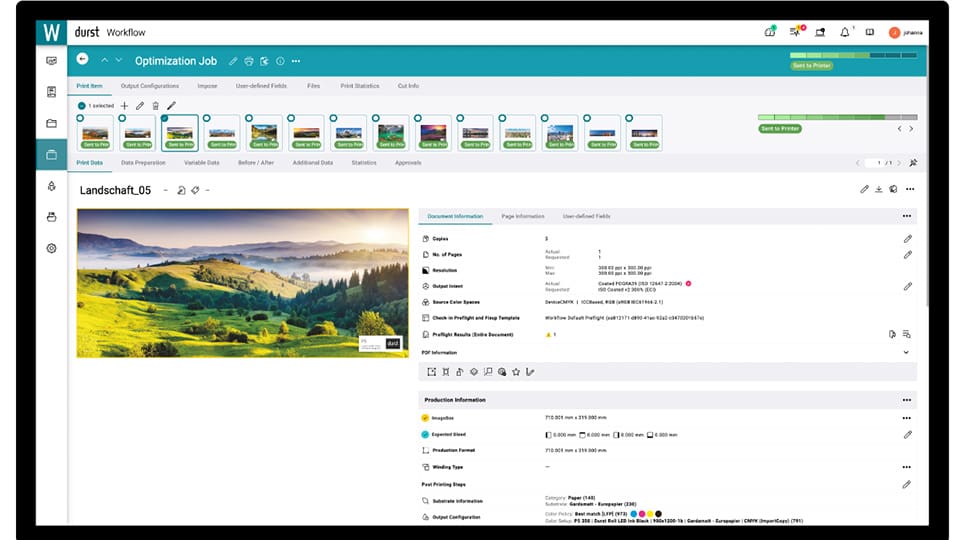
A company that has looked to significantly expand in the area of software and end-to-end workflow integration is Durst Group, which also produces digital printing and production technologies. Introducing its core solution, Durst Workflow, Serge Clauss, production manager at Durst Software & Solutions, says: “Durst Workflow is tailored for Durst printer users, providing a tightly integrated environment from automated file preparation to output. In addition, with Prepare and Produce, we offer an open and flexible solution that supports non-Durst printers, bringing our expertise in quality, automation, and production efficiency to a broader market.”
Serge Clauss, production manager at Durst Software & Solutions, says that the loss of prepress specialists has significantly changed the industry
Touching on the way the industry is changing, Clauss refers to the rapid digitalisation of the print industry, pointing to many of the previous mentioned growth areas like short-run prints and personalised products. “Another key challenge is the gradual loss of specialised prepress expertise, making it harder for companies to maintain consistent production standards,” says Clauss. “Efficient prepress software addresses these changes by automating repetitive tasks, simplifying complex processes, and enabling efficient handling of high-mix, low-volume production environments.”
Clauss also acknowledges the role of prepress in creating a more unified production process, saying that software and automation are evolving towards a “much deeper integration” which involves software, printing systems, and even robotics. “Instead of operating in silos, the goal is to have a single, consistent language across the entire workflow, from file preparation to final output,” says Clauss, who adds: “This level of integration enables smoother communication between systems, reduces friction in production, and ensures that every step is aligned and optimised. As a result, print providers can achieve greater consistency, unlock new levels of efficiency, and build a more future-ready operation that can adapt to new upcoming challenges.”
In Conclusion
So, what are the big takeaways when it comes to using prepress software? Clauss says: “Prepress software is no longer just a technical necessity or a commodity; it is a strategic asset that can define a print provider’s competitiveness. As the industry continues to evolve, flexibility and openness will be crucial. Solutions that combine deep production expertise with ease of use and scalability will stand out in the market.
“Ultimately, the goal is to empower printers to do more with less – less timeless waste, and less complexity, while delivering higher value to their customers.”
Durst Workflow is tailored for Durst printer users, providing an integrated environment from automated file preparation
Finishing where we started, Duckworth concludes: “Prepress remains one of the least optimised parts of the workflow, despite its impact on speed, cost, and experience. Many businesses are scaling on processes not designed for today’s demands.
“The next shift is treating prepress as a connected, automated layer rather than a manual checkpoint. Those that do will be better positioned to handle growth and differentiate through speed and reliability.”
From advances in print quality and productivity to increasing demand for automation and sustainable solutions, the wide-format market continues to evolve. Rob Fletcher looks at the latest trends, challenges, and developments in this sector
Speaking to a range of print and signage professionals, we discover how a sustainable business model can drive growth, outlining actionable strategies to cut overhead costs, improve eco-efficiency, and boost your bottom line
As finishing continues to become a great way to add extra elements to your print and wow customers, we take a look at some of the creasers, folders, and collators on the market, and ask experts their advice on finding the right solutions
(this was inserted into the PHP of a code block)
Watch our latest video of the week
Print Monthly gives you the latest video coverage of companies, people, and events from within the print industry.