With brands turning to print and specialist
finishing to help their products stand out,
Rob Fletcher takes a look at some of
the effects that add that extra shine to a
printed piece
Rob Fletcher
December 12, 2025
Whether it is common effects like metallic finishes or more niche additions such as Braille, print offers up a wide range of options when it comes to helping products stand out. This is perhaps more important than ever, with the modern consumer often distracted by digital screens that seem to pop up wherever we go.
While brands have a basic understanding of some of these effects, the onus is very much on the print service provider (PSP) to open their eyes to the wider options made possible with the power of print. Think spot UV or raised UV coating to help make a logo or image ‘pop’, or even holographic films and foils that catch the light and appear to show an image moving or changing when viewed from certain angles.
Printers know the possibilities are almost endless, but it is crucial to educate your clients as to what you can help them produce. Here, Print Monthly speaks with several manufacturers to learn more about the latest solutions when it comes to producing special effects in print.
Unlocking Opportunities
Up first is Vivid Laminating Technologies, which has a range of solutions for helping printers create special effects. Commercial manager, Lewis Evans says special effects print is evolving rapidly, with a “clear shift” toward personalisation, tactile finishes, and premium-quality embellishments that elevate printed materials and drive consumer engagement.
“There’s growing demand for raised UV, foil effects, and intricate finishing, extending beyond luxury packaging into short-run, on-demand applications across a variety of personalised and bespoke print projects,” he says, adding: “We’re also seeing a big focus on automation and efficiency; customers want high-end finishes, but they need them delivered faster, more affordably, and with minimal manual intervention.”
There’s growing demand for raised UV, foil effects, and intricate finishing, extending beyond luxury packaging into short-run, on-demand applications, across a variety of personalised and bespoke print projects
So, how can printers respond? Where should they be targeting with special effects? Evans says that to remain competitive, printers should focus on value-added services that help their customers stand out, especially in luxury packaging, personalised print, direct mail, and short-run retail.
“These are all segments where special effects can make a powerful difference,” Evans says, continuing: “The key is to bring finishing capabilities in-house. By doing so, printers gain greater control over cost, quality, and turnaround time, while also unlocking the ability to offer quick prototyping and customisation, services increasingly in demand across industries.”
With this, Evans draws attention to Razar, a new machine from Vivid that launched to the market at The Print Show 2025. Billed as the ‘Swiss army knife of finishing’ the machine combines raised spot UV printing, cutting, creasing, and taping into a single, automated pass, enabling users to produce complex, high-quality finishes more efficiently and affordably.
“With Razar, we’ve reduced the need for multiple machines and production steps, helping to cut energy use, waste, and consumables,” says Evans, adding: “Plus, being able to handle both sheet and roll-fed media means printers can operate more efficiently across different job types with less setup and material waste.
“At Vivid, we don’t just build systems, we build partnerships. We support businesses through a mix of cutting-edge systems, ongoing training, and responsive technical support. With Razar, we’re giving our customers a future-proof platform that can evolve with their needs.”
With this Evans, takes a look to the future and considers what it might hold for PSPs in terms of special effects. He notes how more customers are seeking eco-friendly processes that minimise waste and energy use, saying future demand will centre around systems that can deliver luxury-quality output “without the environmental cost typically associated with traditional embellishment techniques”.
“Whether it’s expanding finishing capabilities, reducing production costs, or improving turnaround times, we’re committed to helping printers grow sustainably and competitively in a changing market,” Evans adds.
Sustainable Success
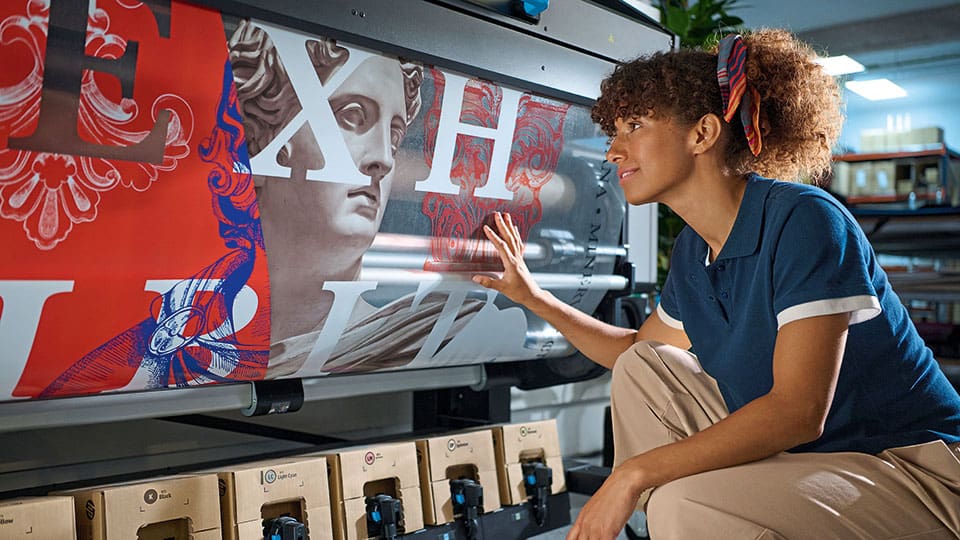
Also able to support in this area is Roland DG, which, like Vivid, was in attendance at The Print Show in September, taking its place within the new, co-located The Sign Show area of the hall. Roland used the double event to display its Dimense DA-640, a 64” digital printer that combines high-definition colour printing with simultaneous structured embossing, all while using environmentally friendly, water-based latex inks.
Rob Goleniowski, head of sales for UK, Ireland, Scandinavia, and Baltics at Roland DG, says it is this planet friendly focus that offers both the manufacturer and users of the Dimense DA-640 an advantage in printed special effects moving forward.
“Sustainability and sensory design are converging,” Goleniowski says, continuing: “Clients increasingly want eco-conscious materials and water-based inks, but they also want print that feels personal and immersive.
“We foresee demand rising for solutions that combine low environmental impact with high creative output, like textured prints that use structural ink on PVC-free media. The DA-640 is one example of how the industry is responding – enabling sustainable, high-impact production without compromise.”
As for wider trends, Goleniowski, like Evans at Vivid, notes a “clear shift” toward tactile engagement; print that does not just catch the eye but invites touch. He picks out special effects like dimensional printing, texture layering, and metallic finishes as options that are gaining traction across sectors from interior decor to retail.
“It’s no longer just about colour fidelity; it is now about creating immersive, multi-sensory experiences,” says Goleniowski, adding: “Embossing, in particular, is emerging as a powerful tool for brands looking to differentiate in a saturated visual market.”
As to how PSPs can apply these trends to their offering and business strategy, he adds: “Print companies should be looking beyond traditional signage and into areas where emotional impact matters - hospitality, luxury packaging, experiential retail, and bespoke interiors.
“Special effects printing allows them to offer something unique: a blend of artistry and innovation. The key is to align capabilities with client aspirations – whether that’s a textured wallcovering in a boutique hotel or a limited-edition art print that feels handcrafted.
“With solutions like the DA-640, we’re not just offering a machine; we’re offering a pathway into new markets and new ways of thinking about print. Our goal is to help businesses stay agile and inspired as the definition of print continues to expand.”
Personalisation and Customisation
Elsewhere and Inkcups can support PSPs with its selection of direct-to-object (DTO) inkjet print technologies. Marketing manager Jessica Makrinos says that more Inkcups customers are experimenting with different effects designed to elevate the finish of a product further than is possible with a traditional adhesive label.
“With demand for unique, personalised and customised items continuing to grow, we are seeing a shift towards more premium finishes for applications like spirit bottles, cosmetics bottles, and even products like reusable water bottles,” Makrinos says.
Makrinos offers the example of creating an elevated effect on matte drinkware for example is the use of spot UV varnish. At FESPA 2024, Inkcups participated in the ‘Personalise Make Wear Smart Factory’, showcasing the capabilities of its Helix cylindrical inkjet printer. Rather than a full-colour design or complex graphics, one of the most popular designs at the event utilised clear vanish on matte drinkware, highlighting the shift to minimalistic and elevated designs.
“By printing UV varnish onto the semi-opaque drinkware, a beautiful effect is created which retains full transparency in the design while creating a striking contrast with the matte finish of the bottle itself,” Makrinos says, adding: “This tone on tone effect can also extend beyond using varnish to create an embossed look and can also be used in applications like using a low opacity colour to bring out the colour of the application. An example of this is enhancing the aluminium of a can by using colour at a low opacity.”
Going into more detail on Inkcups’ technology, Makrinos says its “beauty” is that it utilises UV curing, meaning that not only are the printed applications ready to be used or packaged immediately after printing, but a range of different techniques can be experimented with.
For example, using varnish, varying ink opacity or base layer inks can all create effects that are not possible with alternative printing technologies. Offering another example, Makrinos set out how Inkcups customer Sterkstokers, a bespoke spirit distillery, invested in a Helix ONE cylindrical direct-to-object printer to bring bottle printing in-house. The company was able to achieve a striking effect by utilising varnish on a glass bottle to create a cracked design, giving the effect of old glass with the design then printed on top.
“The result is a tactile and unusual effect that makes people want to touch the bottle and creates a product with a premium feel,” Makrinos comments, adding: “Other effective print innovations include etching, lustre effects, mirror print, and stained glass effects using the Helix digital cylindrical printer. For etching, only white ink is used without varnish at a lower opacity on a glass application.
“Our range of direct-to-object printing technology is constantly developing and evolving to meet the needs of our customers and those seeking new ways to diversify.”
The Inkcups direct-to-object portfolio includes the flagship Helix range of cylindrical printers featuring Nano Pin Curing technology, as well as the entry-level benchtop Helix ONE cylindrical printer with recently launched updates that expand application capabilities and enhance print-on-demand and high-mix production environments. Other options are the flatbed X5-T High Throw direct-to-object printer, enabling printing onto a variety of products from sweet tins and mugs with handles to cool boxes and sporting equipment; and finally, the XJET Switch for printing onto reusable tote bags.
Looking towards the future and what printers can expect in this sector in terms of changing trends and demands, Makrinos agrees with others in this piece that sustainability will be a primary focus moving forward. He says sustainability remains a key consideration amongst print buyers and brands in all spaces from cosmetics to drinkware.
“Consumers are also seeking sustainable products with longer lifespans and as a result we are seeing a shift towards refillable and reusable products such as drinkware, beauty products, and bags,” Makrinos explains, continuing: “Direct-to-object printing lends itself perfectly to this as it is far more durable than traditional labels and its print-on-demand nature reduces unnecessary waste and excess stock.
“For example, digitally printed gin bottle designs such as those created by Sterkstokers’ customers are often so beautiful and tactile that the bottles are kept and used in other ways such as limited-edition keepsakes or as vases or candle stick holders.”
This feature throws up several key conclusions for printers to go away and think about. First, there is plenty of value in adding special effects services to your offering, with this allowing you to work with customers on all manner of projects and applications, particular within the packaging and customisation markets.
However, within the overall rising demand for special effects are several, smaller trends that should also be considered in any future planning strategy. Sustainability is a huge consideration with those that focus on this area gaining access to those clients that want that extra sparkle on their print, but in a way that does not impact the planet negatively.
From advances in print quality and productivity to increasing demand for automation and sustainable solutions, the wide-format market continues to evolve. Rob Fletcher looks at the latest trends, challenges, and developments in this sector
Speaking to a range of print and signage professionals, we discover how a sustainable business model can drive growth, outlining actionable strategies to cut overhead costs, improve eco-efficiency, and boost your bottom line
As finishing continues to become a great way to add extra elements to your print and wow customers, we take a look at some of the creasers, folders, and collators on the market, and ask experts their advice on finding the right solutions
(this was inserted into the PHP of a code block)
Watch our latest video of the week
Print Monthly gives you the latest video coverage of companies, people, and events from within the print industry.