With print service providers reporting a continuing rise in demand for label printing services, Rob Fletcher takes a look at some of the latest developments that can help businesses gain a competitive advantage
Rob Fletcher
December 12, 2025
It is no secret that label printing has been a growth market for some time, with several key factors driving this trend. Huge increases in ecommerce and online shopping have led to more companies seeking support with their labelling requirements, with this going hand-in-hand with a spike in the packaging market.
Add in stricter labelling regulations in areas such as food, beverages, and pharmaceuticals, as well as a rise in demand for paper-based, environmentally friendly labels, and this can only be seen as a positive development for print companies in this sector. However, as is the case with any growth market, where there is opportunity for new work is often competition from like-minded companies seeking a piece of the action.
Here, Print Monthly picks up on some of the latest developments and advancements within the label printing market, speaking with specialist manufacturers and suppliers to find out how print service providers (PSPs) can stand out from the crowd.
Digital Print Dream
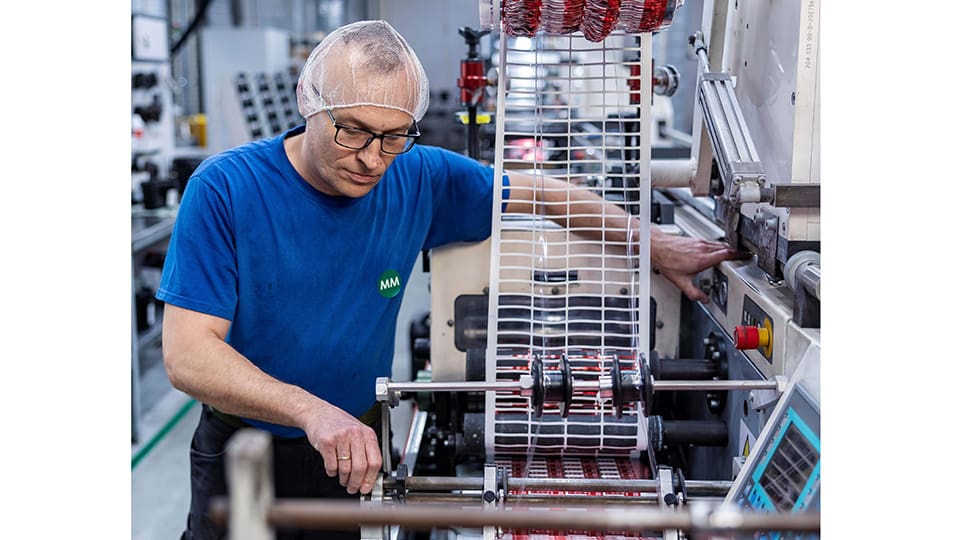
First up here is MM Pharma & Healthcare Packaging, which, as its name may suggest, is a producer of secondary packaging solutions across the pharmaceutical and healthcare sectors. Simon Halsey, product development manager for MM, offers his opinion on where the wider market may be heading over the coming years, as well as the opportunities for growth and expansion.
“The label printing industry moves at a fast pace, and there is a clear shift towards greater flexibility, security, and smart functionality,” Halsey says, continuing: “One major trend is the increased use of digital printing technology, particularly as the demand for smaller batch sizes, custom SKUs, and faster turnaround continues growing. Alongside this, we’re seeing a significant rise in laser die-cutting within finishing lines. This approach offers adaptability and reduces reliance on traditional tooling.
The label printing industry moves at a fast pace, and there is a clear shift towards greater flexibility, security, and smart functionality
“Hybrid presses are also gaining traction, combining the consistency and high speed of traditional print methods with the adaptability of digital. Our Mark Andy hybrid press in Lublin, Poland, is a great example of how the technology can offer both long-run efficiency and short-run flexibility within the same platform.”
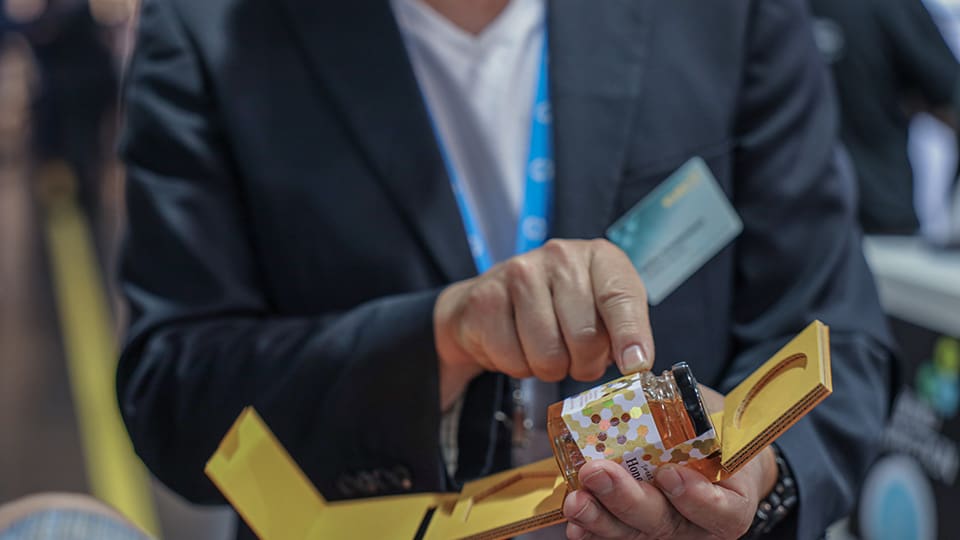
On the security front, Halsey says brand protection remains a top priority. He explains other features like micro-optic elements, covert inks, and digital authentication technologies are increasingly being integrated into labels to combat counterfeiting and support product integrity. At the same time, he notes a growing demand for Radio Frequency ID (RFID) and Near-Field Communication (NFC) technologies.
“These enable everything from product verification to supply chain transparency and even patient engagement, all through the label,” he says, continuing: “Sustainability rounds out the trend picture, with brand owners and manufacturers pushing for solutions that don’t just perform through the supply chain but minimise waste wherever possible.”
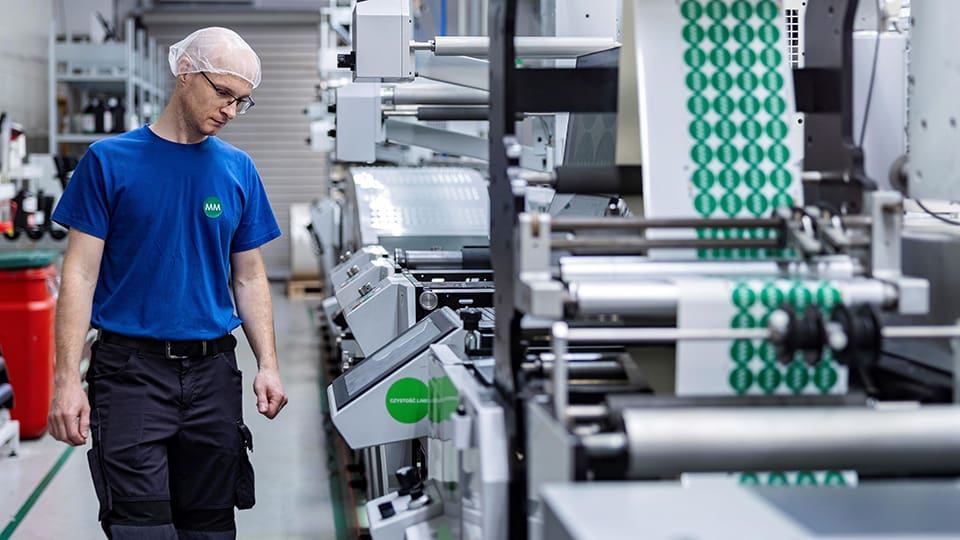
MM Pharma & Healthcare Packaging says one stand-out trend in label production it the increased use of digital printing technology
With this, Halsey says that MM expects to see continued investment in anti-counterfeiting technologies, especially in regulated industries like pharma where product integrity directly impacts patient safety. The focus, he explains, is on layered security solutions that are both discreet and effective.
“Intelligent packaging will play a larger role too,” he says, expanding: “Technologies like UHF RFID offer enhanced supply chain visibility and inventory management, helping reduce waste and improve logistics. Meanwhile, NFC-enabled labels support real-time product authentication and deliver engaging digital experiences, from usage instructions to adherence support, directly to patients via smartphone.
“Sustainability remains another key driver, particularly with regulations like the upcoming Packaging and Packaging Waste Regulation (PPWR) in Europe. We’re seeing increased demand for recyclable materials, mono-material constructions with barrier properties, and wash-off label solutions that support circular packaging systems.”
Speed and Quality
This leads us on nicely to Screen Europe, which counts label printing among its many speciality areas. The manufacturer recently announced details of a new link-up with UPM Adhesive Materials to develop specialised substrates for its Truepress LABEL 520AQ water-based digital label press. Screen and UPM optimised several of their substrates, including a water-based inkjet coated polypropylene (PP) and (BOPP) films with a Jet Matte paper substrate.
For PP, one of the most widely used self-adhesive face stocks within the labels industry, UPM developed a special topcoat to enhance ink adhesion, ensuring ensure it is fully functional with water-based inkjet printing. Coupled with Screen’s Near-Infared (NIR) drying system to effectively dry the aqueous inks, this allows Truepress LABEL 520AQ users to print at speeds of up to 100 metres per minute.
As for BOPP, another important label and packaging material, UPM refined the composition of the film to improve the interaction between water-based inks and the material’s surface. The companies again say that the combination of this with Screen’s drying process allows for high-quality output without slowing productivity or impacting label consistency.
Special inks are becoming a popular feature in printed labels
In addition, for paper applications, UPM developed a Jet Matte paper with an inkjet coating optimised for water-based inks to enable what the companies describe as “sharp text, crisp image density, and vibrant colours”, while maintaining the production speeds required for label converters using paper substrates – as showcased in early testing.
Carlo Sammarco, business development director for packaging solutions at Screen Europe, says this technological collaboration could have a significant impact on the label printing sector.
“Combining Screen’s extensive inkjet printing technologies and expertise within both the commercial and label printing sectors, with UPM’s constant innovations developing new and specialised substrates, together, we hope to successfully highlight a practical solution, bringing the same exceptional high-speed, high-quality printing capabilities familiar to commercial printing, with a cost-effective, future-ready solution available to label converters,” Sammarco explains.
Screen Europe demonstrated the new advancement at the 2025 edition of Labelexpo, which took place in Barcelona, Spain, in mid-September.
Winning With Water-Based
Also set to make strides in water-based technologies within label production is Focus Label Machinery, which, headquartered near Nottingham, recently linked up with Simply Inkjet, a specialist in water-based inkjet technology. The aim of the strategic partnership is to deliver cutting-edge and sustainable, yet cost-effective, solutions for the water-based labels and packaging market.
Focus has been pioneering hybrid inkjet technology for over ten years, developing a robust transport system integrated with UV inkjet to create a one-pass production press with flexo, UV inkjet, and full finishing capabilities.
It will now seek to develop this further through its link-up with Simply Inkjet, incorporating pigmented water-based inkjet technology, which it says will create “the most commercially viable model for digital labels”, achieved through its ability to prime in- or off-line, enabling regular coated and uncoated commercial stocks. This, it adds, will mean customers avoid costs that are two to three times higher.
Security features such as micro-optic elements, covert inks, and digital authentication technologies are increasingly being integrated into labels
James Thomas, head of sales and business development at Focus, explains: “We’ve worked closely with Simon Cooper [Simply Inkjet co-founder] and his team over the past six months to bring this innovative technology to our markets. This is a transformative moment for both companies.
Cooper, who also serves as managing director of Simply Inkjet, adds: “Partnering with Focus Label Machinery, with its state-of-the-art manufacturing facility and deep expertise in narrow web labels and packaging, opens significant growth opportunities for our business.
“We are enthusiastic about the potential of this collaboration. With Focus’s UK-based manufacturing capabilities, they are well- positioned to support our expanding operations across various sectors by engineering print engine chassis for our systems.”
Life In The Label Lane
Like Screen Europe and UPM, Focus Label Machinery used Labelexpo Europe to show off its latest development. The event featured many heavy-hitters from the label printing market, with the likes of HP also among the exhibitors.
HP announced a major milestone at the recent event, in that surpassed 3,000 digital press installations worldwide for labels and packaging. Dublin-based convertor Watershed was installation number 3,000, taking delivery of a new HP Indigo 6K+, which, incidentally, HP handed its global debut to at the event in Barcelona. The machine was shown alongside the HP Indigo V12 with LEP technology, and the HP Indigo 200K for flexible packaging and for labels.
Factoid: Printed labels date back to the late 1500s when those who followed Gutenberg began using woodcuts and engravings for prints
“HP Indigo is leading the rapidly evolving labels and packaging industry with nonstop digital printing, intelligent automation, and AI-powered solutions,” says Noam Zilbershtain, vice president and general manager of HP Indigo, adding: “Our portfolio of presses, including the HP Indigo V12, HP Indigo 6K+, and HP Indigo 200K, is designed to meet various printing needs and empower customers to handle any demand at any scale.”
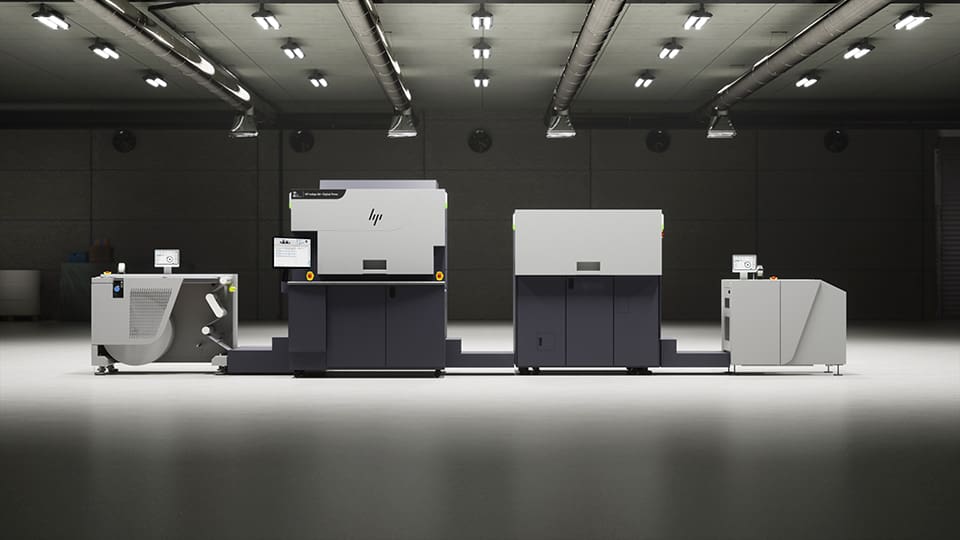
The HP Indigo 6K+ had its global debut at Labelexpo Europe 2025
Focusing on the HP Indigo 6K+, the device features a new SmartControlSystem, which HP says delivers on its vision for “non-stop digital printing with new levels of automation, robustness, and versatility”. The printer supports a wide range of media, has an expansive colour gamut, and runs a number of special inks, while HP says the SmartControlSystem enhances uptime and reliability with advanced hardware and software that drive accurate scaling, diagnostics, and serviceability.
Speaking about becoming a beta site for the new HP machine, Kirwan Waters, director at Watershed, comments: “Investing in the HP Indigo 6K+ was a natural step for us as our demand for digital printing continues to grow. The press has strengthened our lead times, improved on-time delivery, and given us the flexibility to shift shorter runs to digital, freeing up capacity across the business. For our customers, that means better service, faster turnaround, and consistently high quality.”
Maximum Reliability
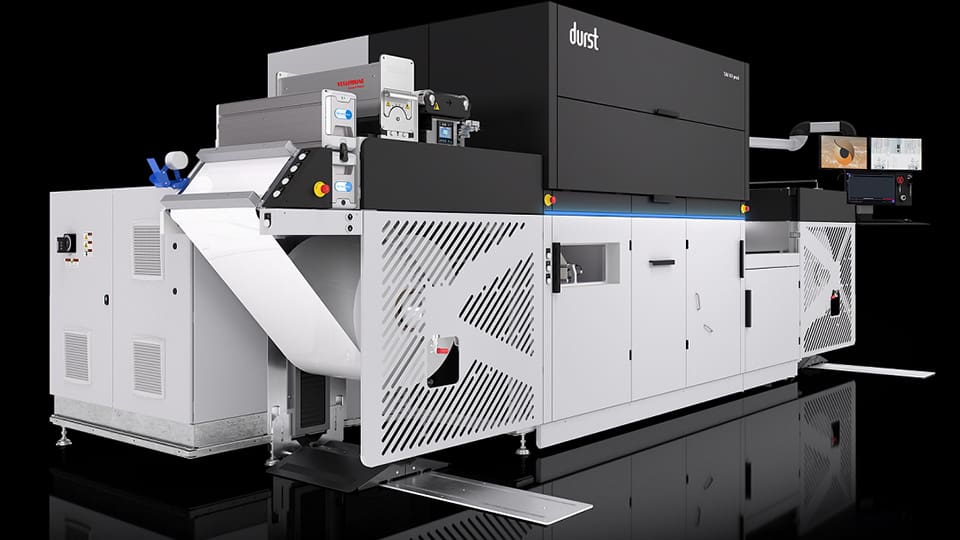
Concluding with another major manufacturer that had a presence at Labelexpo Europe 2025, is Durst. The company used the recent event as a platform to roll out the Tau G3 Portfolio, its latest offering within the label production sector.
The new collection comprises the Tau G3 Core and Tau G3 Peak, both of which can print at a native resolution of 1200 x 1200dpi. The Tau G3 Core has a top speed of 61m/min, while the Tau G3 Peak is the faster of the two machines, with the ability to hit printing speeds of up to 80m/min, with the option to increase this to 100m/min.
Both machines support CMYK plus extended gamut options, including orange, violet, green, and white, and are available with both UV and LED curing. Durst says this, combined with compatibility for substrates from paper to films and aluminium foils raging from 20 to 500µm in thickness range, ensures application diversity across labels and flexible packaging.
Durst used Labelexpo Europe to launch its new Tau G3 range
To further support users, additional features across the new machines include integration with the new Durst Automatic Register Control for real-time colour registration, waste reduction, and quality enhancement, and the new Durst Material Edge Protection, which safeguards printheads with optical edge sensors and protective plates. In addition, both devices can make use of the Durst HAWK AI intelligent monitoring and assistance system, which can be included to automate the colour-to-colour register and to provide closed loop nozzle correction during printing.
“With the Tau G3, we have redefined what a digital label press can achieve,” says Martin Leitner, director of product management for labels and flexible packaging at Durst, adding: “By combining high-resolution inkjet, intelligent automation, and flexible ink options, we are giving converters the tools they need to handle both today’s short runs and tomorrow’s high-volume demands – all with maximum reliability, minimal complexity, and exceptional performance.”
Clearly, there is lots to be excited about when it comes to label production. With demand for labels only set to increase, those involved with this market have plenty of options to consider if they are on the lookout for new kit that could give them an advantage over the competition.
From advances in print quality and productivity to increasing demand for automation and sustainable solutions, the wide-format market continues to evolve. Rob Fletcher looks at the latest trends, challenges, and developments in this sector
Speaking to a range of print and signage professionals, we discover how a sustainable business model can drive growth, outlining actionable strategies to cut overhead costs, improve eco-efficiency, and boost your bottom line
As finishing continues to become a great way to add extra elements to your print and wow customers, we take a look at some of the creasers, folders, and collators on the market, and ask experts their advice on finding the right solutions
(this was inserted into the PHP of a code block)
Watch our latest video of the week
Print Monthly gives you the latest video coverage of companies, people, and events from within the print industry.