As the government continues to put an emphasis on getting young people into work, and the print industry tackles the challenges of an aging workforce, we ask how important apprenticeships are in 2026?
David Osgar
January 21, 2026
Since 2024, training, education, and employment have all been important topics discussed in the world of business following the election of the current Labour government, which promised to improve opportunities for young people.
Recently the government has pledged a £725m package of reforms to the apprenticeship system in order to tackle youth unemployment and improve economic growth. Kier Starmer and The Labour Party have put an emphasis on offering apprenticeships for under 25s in areas like AI, hospitality, and engineering. Add to this the increasing cost of university, which has been emphasised far more in the last two decades, and it is clear to see why an apprenticeship could seem far more appealing.
“Why would you go to university when you can do an apprenticeship, and someone else would pay for your degree?” said Brandon Farley, a trainee solicitor, in a recent interview with Sky News. However, the new focus on apprenticeships does come with negatives, especially when many industries are struggling to attract talent in the first place, as well as an emphasis on only those under 25. Recently The Printing Charity extended the age bracket of its Rising Star Awards to 18 to 35, acknowledging that there are many people who want to develop their careers when under the age of 40.
In reaction to the government's Autumn Budget, Charles Jarrold, chief executive officer of the British Printing Industries Federation (BPIF) said: “The commitment to fully fund SME apprenticeships for under 25s has the potential to make a difference, but SMEs need clarity on eligibility and implementation before they can plan with confidence.”
Charles Jarrold, CEO of the BPIF, has encouraged government initiatives that support apprenticeships
With many questions still remaining, but a clear need for young and talented people in the industry, let’s take a look at the advantages of apprentices, and the best way you utilise the scheme for yourself or your business.
Learning the Trade
When it comes to training and apprenticeships, one organisation which has had a clear influence in the printing industry is the BPIF, especially its subsidiary, BPIF Training.
Recently the organisation celebrated numerous prize winners and graduates at its yearly ceremony where individuals from the Level 5 Operations/Departmental Manager and Level 7 Senior Leader apprenticeship programmes attended. Award winners for 2025 included Kristian Plumb, print technician at Graphic Packaging International, who received the One to Watch prize, and Jessica Butler, print technician at Colin Cross Printers, who won the Personal Achievement award.
Baker Labels was recognised with the Outstanding Employer award while mentors and tutors were also awarded from the likes of Pure Print Group and BPIF Training itself.
Karly Lattimore, managing director of BPIF Training, said at the event: "Our tutors, assessors, quality, engagement, and compliance teams are the backbone of everything we do. Their dedication and care make all the difference, and today's success belongs to them as much as it does to our learners."
Speaking of the organisation, Max Walkington, operations director at BPIF Training, says that apprenticeships are at the “heart” of what the organisation does, saying that they are the main route the company uses to bring new talent into print, packaging, and manufacturing.
Giving his advice to businesses looking to utilise an apprenticeship programme, Walkington says: “Start by identifying the skills gaps or future roles you need to plan for, then choose apprenticeship standards that directly support those needs. Engaging early with a training provider helps ensure the programme is tailored to your equipment, workflows, and long-term plans. Finally, involve line managers from the outset. Consistent mentoring and clear expectations make a noticeable difference to apprentice progress and confidence.”
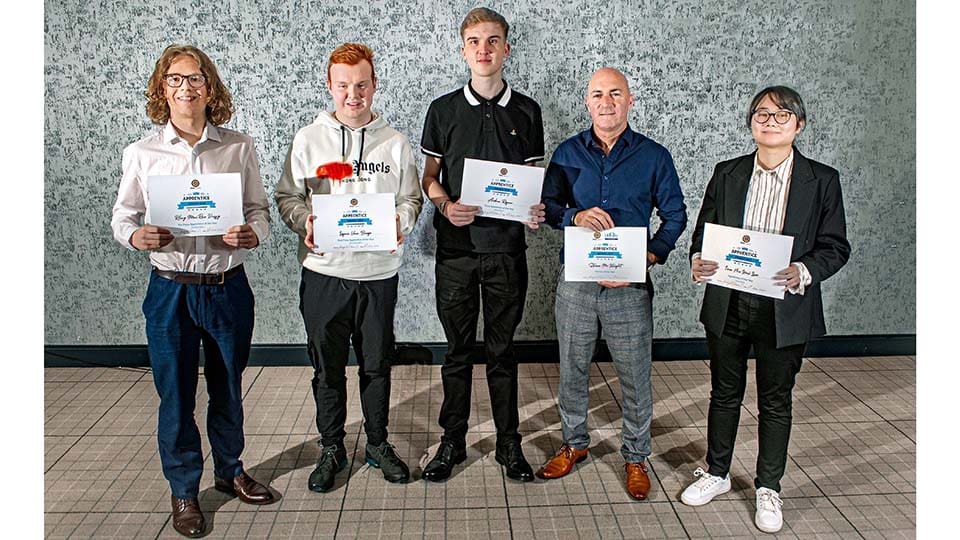
[L to R] Riley MacRae Duffy, CX Services; Logan Van Beuge, Push Print; Aidan Rogan and Steven McKnight, CCL Design; and Ines Hiu Wai Law, Spirit Labels
Walkington says that the vast majority of BPIF Training’s apprentices progress to permanent roles, leadership positions, or further professional development pathways. “We’ve also expanded our curriculum of business programmes so we can engage with different roles across the sector,” says Walkington, adding: “In the last five years over 600 Apprentices have been through our flagship Print Operative and Print Technician apprenticeship programmes – but we need to keep going if we are to address the skills gap within the sector.”
For Walkington, he believes the main focus is to ensure that employers, apprentices, and training providers all work together to help see transformations in individuals and businesses. “The print and packaging sector depends on skilled, committed people, and apprenticeships remain one of the most effective ways to secure that future talent pipeline.”
Speaking of the advantages of an apprenticeship, Walkington emphasises that print and packaging are highly technical sectors, where practical skills matter just as much as theory. “Apprenticeships provide structured learning alongside real production experience, giving individuals both competence and confidence. Because the industry continues to adopt new technologies like automation, colour management systems, and finishing equipment, apprentices gain relevant, up-to-date skills that make them valuable from day one. This often leads to faster progression, better job security, and a clearer route to supervisory or technical specialist roles,” adds Walkington.
Recognising Talent
A company that has seen success through its apprenticeship programme is Domino Printing Sciences, which is a global provider of variable data printing solutions.
The scheme which started as an entry route for school leavers at Level 2 and 3 has now evolved into a structured pathway which provides degree-level qualifications. Mark Gearing, R&D director for Print Systems at Domino, says: “Our approach is holistic. It’s not just about technical skills; apprentices rotate through different departments, gain exposure to business practices, and receive mentoring that helps them grow into well-rounded professionals. Beyond Domino, we’ve also helped establish the Automate UK Apprenticeship Cluster, which brings companies together to share skills and strengthen retention across the industry.”
For Domino, Gearing says the company is particularly proud of its strong 75% retention rate, which he believes is higher than the average graduate hire retention rate. Gearing says that many of the company’s apprentices have advanced from entry-level roles to degree-qualified engineers that don’t carry the burden of a £60,000 to £70,000 student debt that others may get from university.
“There are some great success stories,” says Gearing, who cites Bradley Moore and Tom Fleckney as examples of successful candidates who went on to become mechanical design engineers, with Moore being awarded Exemplary Academic Achievement. “Chetachineke Nwandu, an engineering apprentice has been instrumental in shaping our Apprentice Cluster and supporting Automate Best events. Her journey reflects the impact apprentices can have, not only on their own development but on our industry,” adds Gearing.
[L to R] Tom Fleckney and Bradley Moore from Domino Printing Sciences
“Perhaps the greatest reward for me is witnessing their personal growth, seeing promising school leavers transform into confident professionals who now represent Domino at industry panels and events.”
When it comes to advice for businesses, Gearing advises to start early: “Engage with schools and STEM initiatives to spark interest in engineering careers. Be prepared for changes from education providers and ensure you have contingency plans in place. Also, offer variety – rotations across departments can help apprentices discover their strengths.
“I would also add that investing in networks is extremely valuable. Collaborating with other businesses, as we’ve done through clusters, enriches the experience for apprentices and strengthens industry ties. Finally, think long-term. Apprenticeships aren’t a quick fix – they’re about building sustainable talent for the future.”
Gearing also emphasises the important role Domino has played in encouraging diversity into print and packaging. “The UK faces a significant engineering skills gap, and programmes like ours help address that by opening doors for underrepresented groups, including women in STEM. By promoting inclusivity and equal opportunities, we can inspire the next generation of innovators and strengthen the industry for the future,” says Gearing.
Because the industry continues to adopt new technologies like automation, colour management systems, and finishing equipment, apprentices gain relevant, up-to-date skills that make them valuable from day one
Speaking of the advantages of an apprenticeship, Gearing highlights soft skills like teamwork, communication, and leadership through collaborative projects. Gearing says that the experiences apprentices gain mean they are highly employable and are ready to contribute to an industry that demands precision, innovation, and adaptability.
“Many apprentices start with one discipline in mind but discover new strengths – moving from mechanical to electrical engineering, or even into project management. Some go on to roles in product management or marketing,” concludes Gearing.
Securing the Future
When it comes to implementing apprentices into businesses, it is clear that these initiatives are imperative for many companies which have seen talent grown through the training and education apprenticeships bring.
In 2025 Print Scotland recognised a number of apprentices, including Ines Hiu Wai Law from Spirit Labels, who was named Apprentice of the Year at the annual Print Apprentice of the Year awards. Ines was recognised after immersing herself in the technical and design aspects of the craft, with her employer, Laura Roy, commenting that she has been “exceptional” and “remarkable” when at the company.
At the time of the awards, Jim McKenzie, Print Scotland’s training officer, called Ines “a standout and one of the best apprentices we have ever had". McKenzie added: "Her success also highlights a positive trend of more women entering the sector, with Spirit Labels currently employing four women.”
Other awards given out at the ceremony included Press Apprentice of the Year, Mentor of the Year, Post-Press Apprentice of the Year, and Pre-Press Apprentice of the Year. The awards demonstrated the importance of both apprentices and those that mentor and employ them coming together to address the challenges the industry faces.
Following the awards, Garry Richmond, director of Print Scotland, said: “With this new stream of print apprentices present today we can be cautiously optimistic about the future of our industry.
“The print sector has significantly enhanced its support for apprentices in recent years and is definitely seeing the benefit of this forward-looking approach for employers and individuals. We urge the Scottish government and its agencies to reinforce our success by continuing to invest significantly to allow us to create more opportunities for our young people.”
Another company which has seen the benefit of apprenticeships is Bishops Printers, a family-run business which has been running for over 40 years. Paul Cull, production director at the company says: “I want apprenticeships to be a key part of our approach to building the future of print.”
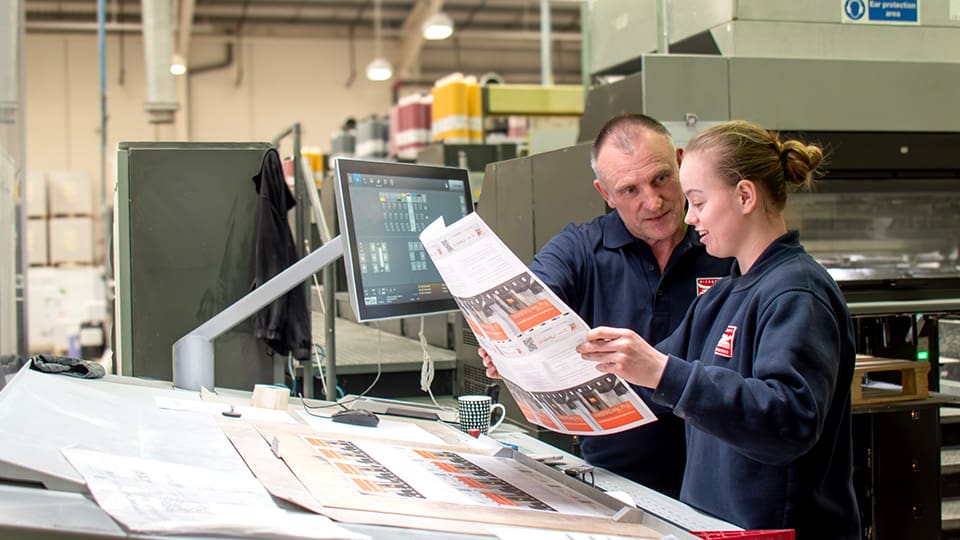
[L to R] Keith Kirby showing Lavinia Tewkesbury the ropes at Bishops Printers
Cull adds: “They allow us to bring fresh talent into the business, develop practical skills in real-world production, and ensure that the next generation of print professionals are well-prepared to meet evolving industry demands. I’d like to see an apprentice in every production department.”
Cull’s comments highlight the need for the industry to work together to address a challenge that is affecting all businesses now and will only grow as an issue if not addressed soon.
Similar to other awards, Bishops Printers has also seen success for both its apprentices and mentors, with Cull adding: “Our most recent experience has been incredibly successful in both nurturing talent and re-energising our team.
“Lavinia, our print apprentice, is already running a HEIDELBERG XL75 independently and Keith, her mentor, was recognised at the Chichester & Portsmouth Apprenticeship awards with a commendation. It has helped us to foster a culture of mentorship, with experienced staff guiding new entrants and giving them renewed purpose for coming to work each day.”
Apprenticeships aren’t a quick fix – they’re about building sustainable talent for the future
According to Bishops Printers, Lavinia “Vinnie” Tewkesbury quickly became a “catalyst for change” as she come into the business with a strong work ethic and “insatiable curiosity”.
Speaking about the experience of mentoring Tewkesbury, Kieth Kirby, one of Bishop’s most experienced printers, said he didn’t expect the mentoring experience to be as gratifying as it was. “It’s the most rewarding thing I’ve ever done,” says Kirby, who adds: “Vinnie is fantastic. She challenges me, she listens, she asks questions, and she makes me laugh. She’s changed the atmosphere in the print room.”
Fellow mentor, Simon White echoes Kirby’s comments, adding: Having someone like Vinnie around makes you look again at everything you know and why it matters. It’s reminded us just how much we have to offer.”
Tewkesbury joined Bishops as a folder operator leading her to the print room where she expanded her skills and knowledge. “There’s so much to learn. Every shift there’s something new. I always knew I didn't want a desk job, but it never occurred to me that I could be a printer. I’m on my feet all day, which I enjoy, and it’s busy – which is great. Keith & Simon are so enthusiastic about teaching me – it makes such a difference,” says Tewkesbury.
Cull says that Bishop’s aim is to create a self-sustaining model of learning and leadership with the next intake targeting 17- to 18-year-olds in order to support young people who might not see a place for themselves in manufacturing. Speaking of the advantages of an apprenticeship, Cull says: “Apprenticeships give individuals practical skills and industry knowledge that they can’t get anywhere else, so they’re highly valued.
Factoid: According to the Chartered Institute of Personnel and Development (CIPD), the number of young people starting on new apprenticeships has fallen by over 40% since the 2017 training levy was introduced
“They provide a foundation for career growth, opening doors to specialised roles in production, finishing, and management. Beyond technical skills, apprentices also develop problem-solving abilities and workplace experience that make them highly employable across the sector.”
When it comes to advice, Cull says to invest time in structured support and pair apprentices with the right mentors. “View apprenticeships as a long-term investment. Retaining and developing talent benefits both the individual and the wider business,” adds Cull.
From the many voices and examples we have looked at in this feature, it is clear that apprenticeships are an effective and important part of the industry in order to keep nurturing talent and developing the next generation of printers.
As Cull puts it: “Apprenticeships aren’t just about training. They’re about building confidence, fostering creativity, and securing the future of our industry.”
From advances in print quality and productivity to increasing demand for automation and sustainable solutions, the wide-format market continues to evolve. Rob Fletcher looks at the latest trends, challenges, and developments in this sector
Speaking to a range of print and signage professionals, we discover how a sustainable business model can drive growth, outlining actionable strategies to cut overhead costs, improve eco-efficiency, and boost your bottom line
As finishing continues to become a great way to add extra elements to your print and wow customers, we take a look at some of the creasers, folders, and collators on the market, and ask experts their advice on finding the right solutions
(this was inserted into the PHP of a code block)
Watch our latest video of the week
Print Monthly gives you the latest video coverage of companies, people, and events from within the print industry.