Baddeley Brothers: Over 160 Years of Historic Print
Known for its premium stationery, envelopes, and packaging, we take the chance to find out more about this 167-year-old company by speaking to the directors of the business

From models of Ant and Dec to a confetti canon in mid-pop consisting of 35,200 pieces of paper, we look at the intricate and award-winning work of paper artist Nathan Ward

I first became aware of paper artist Nathan Ward’s work by accident whilst roaming the aisles of the VM & Display Show in London this April. Walking past the Antalis stand, two colourful parrots caught my eye. I was even more intrigued when I realised they had been created using paper.
After stopping for a chat about the papers used, we were directed across the hall to “the giant whale made from paper” and there we found Ward exhibiting his work. From robins and dachshunds to the large-scale whale and its calf taking up the stand space, I couldn’t help but be in awe of the intricacy of Ward’s work, as well as the creativity.
A full-time professional paper artist, Ward operates from his paper design studio in Kingston, southwest London, and has been working with paper since around the age of 16.
“I began working with paper as it is such an accessible material,” he explains, adding: “Paper is familiar to all of us and I love that something so simple, often overlooked or taken for granted, can be transformed in such amazing ways!”
In a digital age where much of our time is spent on screens, Ward says it’s nice to feel something real. “Even photographed, I think a real sense of tactility can be conveyed through paper textures like those in G.F. Smith’s Colorplan,” he says.

Ward studied BA Illustration Animation at Kingston School of Art and throughout his schooling, he says paper is something he kept coming back to time and time again. “University tutors encouraged me to think big and challenge the perceived limitations of the material. Often, I would manipulate their illustrative briefs to resolve them with papercraft outcomes.
“I fell in love with photographic illustration and explored ideas around set design, developing ideas further through movement or animation. My drawn ideas quickly outgrew their pages and became sculptures.”
Now represented worldwide by Début Art, Ward has built sets, props, and models for the likes of Google, Jo Malone, Links of London, and Tom Rosenthal and clients he has worked for include English National Opera, John Lewis & Partners, and more.
Ward has also been received a number of industry awards including being a 2023 VM & Display Awards Finalist, winning the 2022 Graphis Design Poster Silver Award, and being the 2021 London Festival of Architecture Showroom Showcase Winner.
One brand Ward has worked closely with throughout his career so far has been 135-year-old paper merchant G.F Smith. The company’s education manager Vanessa Fletcher paid a visit to Kingston School of Art to give a talk on the possibilities of paper and the pair sparked a conversation about running a project together.
Working with two graphic design students, Ward and Fletcher collaborated to concept the first student-led exhibition in what was the G.F show space, an underground gallery called the White Space supported by G.F Smith.
“G.F Smith has been so supportive of my work over the years,” Ward says. “As a creative company, they really understand education and the importance of nurturing the next generation of creatives, supporting educational institutions with paper and outside opportunities.
“As my practice has grown, so too have the paper companies I work with, but the quality of G.F Smith’s paper and the support they showed me in my early career will not be forgotten as my practice expands.”
Reflecting back on the collaboration, Fletcher describes the ‘Underwater’ installation as “a pivotal moment in G.F Smith’s long-standing commitment to students and young creatives”.
“We are incredibly honoured that Nathan has chosen to work with our papers for so many of his exciting projects,” Fletcher continues. “Through nurturing our relationship with graduates like Nathan, we are able to make introductions within our vast network.
“Nathan’s work was seen by the incredible Mount St Printers when it was on display at G.F Smith, which led them to commission Nathan to design window displays at their prestigious showroom.”
G.F Smith also introduced Ward to The Ned and more recently The Young V&A. Fletcher adds: “Our passion for connecting and championing our clients is one of the most satisfying parts of our jobs.”
This May, Ward was invited on a mill visit with G.F Smith to the James Cropper paper mill in the heart of the English Lake District to fully understand the paper-making process.
“G.F Smith has been committed to supporting people at all stages of their creative journey – from education to professional practice – since the 1960s,” Fletcher says. “We will continue to do whatever we can to help emerging creatives like Nathan, because we believe creativity is essential both to the UK economy and society as a whole.
“It is our hope that the importance and value of the creative industries will be properly understood, and appropriately recognised with meaningful Government investment in creative education.”
Having heard about its reputation through a number of design friends, Ward has also worked closely with London-based printer F.E. Burman.
Described by Ward as a “quality design-led printer”, F.E. Burman works closely with G.F Smith papers. This enables Ward to continue working with these materials even when clients require specific Pantones for sustainability and quality textural finish.
Ward explains that for F.E Burman to print onto Colorplan, for example, the company first adds a Sapphire coating to the paper to allow better ink adhesion.
“F.E. Burman supplies me with untrimmed B2 poster prints which they print on using their digital HP Indigo press. These prints are perfect for me as I can easily run them through my cutting digital equipment, minimising any waste.
“I’ve recently started working with a couple of other printers that have HP Indigos for no other reason than to explore different print options when I’m on a tight deadline,” Ward adds.
Using a Graphtec cutter plotter with print-and-cut technology, Ward can generate barcodes that F.E. Burman can print, which he then cuts back at his studio to create uniquely branded pieces.

F.E. Burman has now managed a number of professional print jobs for Ward, including for Santander x Mastercard, the Financial Times, Samsung, and Who Gives a Crap toilet roll where printed patterns or specific Pantones were required, and it was not possible to use colours from a collection.
Roger White, creative and technical director at F.E Burman, comments: “Understanding the intent of a client’s project, who it’s for, and what needs to be achieved is the beginning of the creative process to finding the right solution for each project. Working together with our clients is what we love to do.
“We encourage clients to come in and see us to talk and show us their mock ups and ideas. In turn this gives the client the opportunity to explore our vast show space filled with endless creative samples and papers, which only fire up their creative juices even more.”
Nathan’s ability to ask questions and enquire about alternatives which he may be unaware of that we can guide him through makes him the kind of creative we love to work with
White goes on to say that by working with clients to find the right solution through print, finishing, or web-based systems, F.E Burman can be “more than a provider” and become partners and build relationships instead.
In terms of the printer’s capabilities, White says F.E Burman utilises different creative software, papers, print, and finishing technologies to further enhance its clients’ projects and provide deeper experiences and engagement.
This ranges from high-end magazine covers, personalised marketing material, bespoke packaging, event and trade materials, to custom web-to-print websites each tailored to meet a client’s specific needs.
Reflecting on F.E Burman’s relationship with Ward, White adds: “We have a wonderful relationship with Nathan, whether he only requires flat sheets or a series of complicated variable data PUR Books utilising different papers, he’s not just a skilled designer, he understands the print process which strengthens his artwork ability.
“Nathan’s ability to ask questions and enquire about alternatives which he may be unaware of that we can guide him through makes him the kind of creative we love to work with.”
With his projects quickly having gone from smaller tabletop-based practices to large-scale installation-based pieces, Ward says managing projects of such different sizes has been something he’s continually developing and becoming more skilled at.
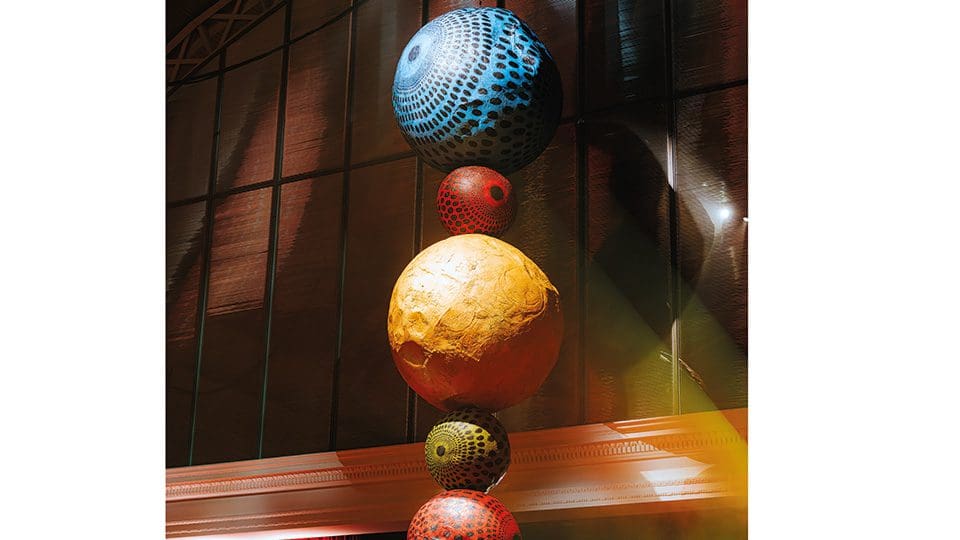
Some projects of note include work for The Ned’s fifth birthday installation and a papier mâché ball installation for the Grassroots Soccer Charity Gala. Ward says: “There is so much to consider when working on that scale, from rigging to in-depth material knowledge and managing assistants’ delivery and installation.”
For The Ned’s fifth birthday project, Ward produced a paper installation for the historic hotel’s atrium in May 2022. The project was inspired by a confetti canon in mid-pop and the design consisted of 35,200 individual pieces of G.F Smith paper incorporating offcuts of G.F Smith Colorplan in eight different colours, collected from the factory cutting room floor.

Sitting across six polycarbonate rings attached to the ceiling, the multi-tiered construction was created by a team of 20 people, involved a week of preparation to trim the paper, and took over seven hours to install.
Managing the business aspects of his career has been another learning curve to navigate and not something you’re typically taught at art school. “Though I have illustration agent representation and a supportive team around me, the bigger projects take lots of planning and communication,” he explains.
We’ve seen from Ward’s work with F.E. Burman the specific requirements that can be made when working with brands and on large-profile projects when it comes to colour management and printing.
However, with so many paper weights and finishes, we were also curious to know what is involved in the process of paper crafting itself and what considerations are needed for this type of work.
“A scalpel and my hands were where it all started for me. I used to spend hours painstakingly measuring out the nets for my 3D shapes, working out complex trigonometry with a protractor and compass, and making multiple iterations and mock-ups until I was happy with the results.”
Today, Ward says it’s a very different story and whilst he still pays the same attention to quality and detail, he now has a fully equipped studio and freelance teams of assistants to support commercial projects and large production jobs.
With each project’s outcome bespoke and tailored to the brief, Ward’s work can take anywhere between a couple of days and a couple of years to complete. When it comes to commercial work, he says he is used to only having a few weeks to deliver.
I used to spend hours painstakingly measuring out the nets for my 3D shapes, working out complex trigonometry with a protractor and compass, and making multiple iterations and mock-ups until I was happy with the results
“Depending on the project, I have a number of trusted freelance assistants I can call upon to support,” he says. “This allows me to flexibly increase or decrease production in line with the project’s demands. For editorial projects and photoshoots, I might have a few days. For larger sculptural pieces, I may have months. My offering is tailored according to the clients' budget and needs.”
Having developed his skills and knowledge over several years, he now shares this experience with others.
Ward was recently exhibited in an international paper art exhibition at MAKE Southwest in Devon and regularly leads workshops where he shares techniques and insights for working with paper. He also appeared as the papercraft TV judge on Channel 4’s Kirstie’s Handmade Christmas.
So, where does Ward's inspiration come from? He says a lot of inspiration for his personal work comes from the world around him including nature, sports, and the outdoors.
“Inspired by design books and galleries, I am becoming increasingly interested in forms within sculpture, product, and furniture design and alternative construction methods,” he explains.
Because commercial briefs have often been carefully considered by teams of creatives, Ward says in these cases they have come to him for his high craft skills. “I describe it as the difference between being employed for my hand or head. I enjoy both types of projects.”
Despite many greenwashing claims of paper being unsustainable with the rise in digital alternatives (see Two Sides’ myth-busting website full of facts and information!), paper is in fact one of the most circular materials.
Although sadly, like much of the visual media industry, many of Ward’s projects find themselves in recycling, a benefit of his work is that it is genuinely sustainable. Ward only uses paper from sustainable suppliers that are B Corp and FSC certified and he emphasises the fact that paper offers a better alternative to traditional sculptural mediums such as foam carving and casting.
“Often, after projects have served their purpose, store retail teams will take the items home for enjoyment. This was the case with my Hobbs project where I was commissioned to create numerous papercraft robins and pinecones for their Christmas displays. For a few of my projects, I store and license them for use.”
Quizzed on what some of his favourite projects have been, Ward says: “That is a really difficult question! Each of my projects have taught me something new. The ones I enjoy most are often some of the most challenging! I get excited about problem-solving. The more complex a structure, the more interesting it is.”
Ward describes his work for Santander x Mastercard creating Ant and Dec as “one of the funniest and bizarre creations to date!”, and another memorable project was making a paper bum for the sustainable toilet roll brand Who Gives a Crap.
“I am quite used to receiving strange requests from agencies who come to me with concepts as paper and my low-poly technique allows for the creation of lots of interesting shapes! If you can imagine it, I can probably make it in paper!”
You can find out more about Nathan Ward and his work here:
www.thisisnathan.com
nathan@thisisnathanward.com
@thisisnathanward
07712738597