Capturing headlines inside and outside the industry, there is no mistaking the buzz around artificial intelligence. But what advantages does it offer?
Rob Fletcher
July 10, 2024
It is probably fair to say that artificial intelligence, or AI if you would rather, has generated both positive and negative media coverage over the past few years. On the one side, we have been promised all manner of wonderful technologies that will make our lives easier, but on the other hand, concerns have been raised over the impact it could have on people’s jobs in the long-term.
Make no mistake, AI is here and is very much here to stay, including in our industry, which has so long relied on the incredible skills of its dedicated workers. While we are some way off seeing robots “take over,” so to speak, we are now seeing elements of AI filter through into the industry, with some print service providers (PSPs) already starting to take advantage of these developments.
So, what else can we expect from AI? Print Monthly picks out some current examples of AI working in the printing industry and considers how it will impact the market as we move further into the modern, digital world.
Elevating Capabilities
To begin, it is important to note that it is not just PSPs that are using AI to improve their offering, with manufacturers and suppliers also making moves into AI to strengthen and evolve their solutions. One such manufacturer is Scodix, which specialises in digital embellishment technologies.
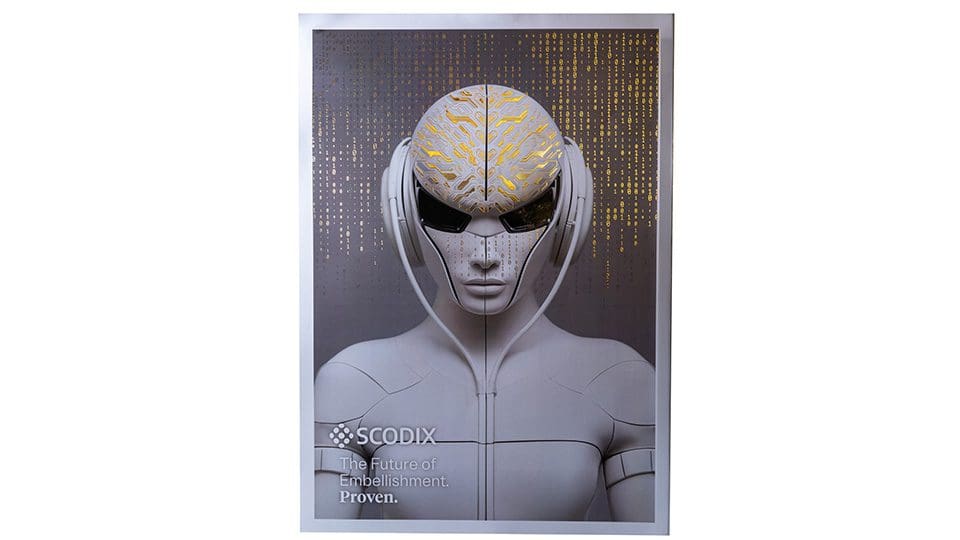
Ahead of Drupa 2024, Scodix announced two new presses, each of which will boast a new feature built using AI. Scodix AI, an automated embellishment creator tool. According to the manufacturer, the application will be used to help boost design capabilities for even the most un-savvy designers.
“With Scodix already being market leaders in the embellishment sector, their extensive database of designs sets them apart from any competitors on the market and will help to make this new application a success on the market,” Scodix said in its pre-Drupa media comments.
Scodix says its new automated embellishment creator tool will help boost design capabilities for PSPs of all shapes and sizes
“Elevating capabilities for enhancing print even further, Scodix is the first to introduce AI technology for automating embellishment additions. Drawing from databases of Scodix-enhanced pages, it suggests intelligent, proven design options, whilst also providing data on cost-per-page so print buyers can create embellished designs quickly and intelligently.”
Alongside Scodix AI is Scodix MLE (Multi-layer Enhancement), which the manufacturer says opens a whole new dimension for embellishments on uncoated paper, favoured for sustainability and affordability. The key to Scodix MLE is the ability to apply multiple Scodix layers in a single pass.
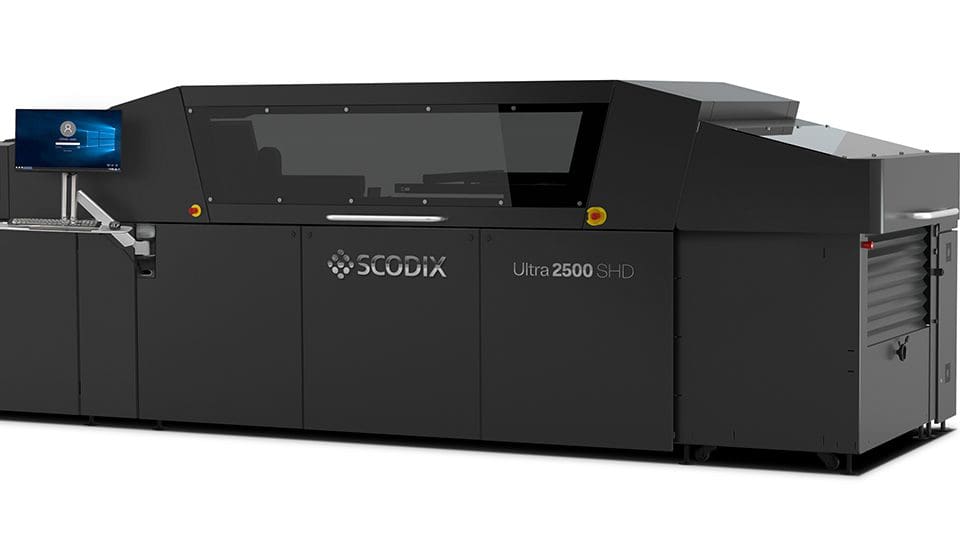
Both tools will be available with the two new presses that launched at Drupa, namely the Scodix Ultra 2500 SHD and the Scodix Ultra 6500 SHD. The machines are also boosted with Scodix SHD (Smart High Definition) technology, which is now integrated into the presses, meaning that along with Scodix MLE, Scodix is adding six new applications to the current ten, making Scodix the only solution with 16 embellishment options available.
The Scodix Ultra 2500 SHD, one of two Scodix presses that launched at Drupa, features the new Scodix AI
“Both of the presses deliver new levels of automation and reduce the cost-per-page for incorporating value-added enhancement into printed products,” Scodix says, adding: “The new product introductions signify the continued innovation Scodix brings to the world of enhancement, bridging the gap between traditional and digital technologies.”
Eli Grinberg, co-founder and chief executive of Scodix, also comments: “With over 400 successful installs across the globe, we stand as the most proven enhancement technology in the market.
“However, we refuse to settle in that position, we are committed to elevating digital enhancement and driving the success of our customers even further. With these new products and technologies, we’re not just leading the pack – we're setting the pace for the future of embellishment.”
Infinite Opportunities
This is also the case with Vivid Laminating Technologies, which uses an element of AI within its Zip Core Packaging Suite. This CAD/CAM packaging software, Vivid explains, has been created to optimise every aspect of packaging design from start to finish, helping guide PSPs through the process to ensure they receive the desired output.
“Our software provides businesses with a wide range of tools that expedite the everyday jobs of packaging designers, graphic designers and salespeople involved in the creation and production of packaging,” explains Amelia Hodgson, software and design manager at Vivid.
“The Zip Core Packaging allows users to delve into an endless library of editable packaging templates, giving customers an infinite choice of packaging opportunities.”
Produced to enhance the Veloblade Nexus and Veloblade Volta range of digital die-cutting systems, Zip Core Packaging Suite is compatible with both desktop and cloud solutions. The software is integrated with Adobe Illustrator, one, of, if not the most popular, design software options in the print industry. This, Hodgson explains, means that the user can apply graphics to their packaging designs while also being able to view a 3D model of the structure before production.
Going into detail on some of the other features of Zip Core software, the library of packaging designs covers folding carton and corrugated cardboard, including the full ECMA and FEFCO codes. Standards are appropriate for PVC and corrugated plastics are also available.
Users also benefit from a complete set of design features for creating and modifying 2D structures, with smart drafting based on a library of parametric components. Tying in with this is the 3D element, with Vivid saying that a 3D environment realistically presents the final look of the packaging and displays, along with their applied graphics, finishing effects, and external 3D objects. As such, PSPs can generate a 3D PDF for customer inspection before the packaging is produced physically.
In addition, built-in optimised laying out of one-ups on sheets corresponds to the different machines with which the software is compatible. This includes automatic layout generation for comparing and selecting the best option.
“Seamlessly export your completed 3D package designs to end users as virtual 3D files, offering a professional and personalised approach for fast approvals,” Hodgson says, adding: “It is also compatible with mobile devices for swift approvals whilst on the move.”
Making Life Simple
Also getting in on the AI act is Printbox, which specialises in personalised photo printing. Ahead of exhibiting at drupa, the company released details of several new developments related to AI, with visitors to the event finding out more about these on the company’s stand.
Among these is Printbox’s updated ‘Image to Image’ feature, which it says “revolutionises” personalised invitations and other custom products by allowing users to transform their photos into stylised products. While still in development, this feature supports products such as ‘Masterpiece AI Invites’ for personalised birthday invitations and custom dog posters.
In terms of how the feature works, users can upload pictures and describe the main object, with the AI then generating images in the selected style. Printbox says this process ensures that each creation is unique and tailored to individual preferences.
Also new from Printbox is advanced AI-powered content moderation, with the overall aim of ensuring enhanced legal compliance and protecting user content. This system pre-moderates uploads, filtering out inappropriate material and analyses user prompts for any potential copyright violations.
Printbox says its latest AI advancements are designed to “empower” users
“Our commitment to continuous review and updating prompt categories guarantees that our users can create confidently, knowing their work attaches to copyright laws,” Printbox says.
Finally, Printbox sets out detail on Prompt Enhancer V1, which it says simplifies and improves the AI prompting process. This tool analyses user inputs and offers suggestions to refine prompts, which Printbox says in turn improves the quality and relevance of generated content. Printbox adds that the Prompt Enhancer feature is particularly useful for those users unfamiliar with specific terminology, providing intuitive suggestions and making the creation process more accessible and efficient.
Jakub Kuśmider, head of product for Masterpiece AI at Printbox, adds: “Our latest AI advancements are designed to empower users by simplifying complex processes and ensuring high-quality, personalised results.
“The Image-to-Image feature, enhanced copyright protection, and Prompt Enhancer V1 are part of our continuous journey to improve and simplify the personalised printing industry.”
Supporting the Future
While it is understandable that some still hold concerns about what sort of impact AI will have on the industry, especially when it comes to people’s jobs, from what has been said here, it is becoming clearer that, when used correctly, AI can be a hugely useful asset that can support workers in their day-to-day work.
This opinion was widely shared during the recent AI for Print Conference, hosted by Marcus Timson and Frazer Chesterman, the minds behind Future Print. Staged at the Møller Institute in Cambridge, the event welcomed 16 speakers from a range of markets to explore insights including using generative AI for content creation and market research, using AI to generate images and haptics for packaging, and even making accessing educational materials easier.
Speaking on the day Timson admitted it is hard to know where to begin when discussing AI, given the fast-evolving nature of the space. He describes the current status of AI as being “at the summit of Mount Hype”, referring delegates to the Gartner Hype Cycle, comparing the current hype around AI to the hype around 3D printing in 2012.
At present, Timson says generative AI is considered to be at the very top of its “hype cycle” and it is hoped AI can be used to bridge the technology gaps from what Timson described as “the great resignation”. Tying in with this, he says Gen Z are distracted, with print not even on their radar, proposing that AI could be used to solve the challenge of attracting young talent and position the industry as a forward-thinking technology adopter.
One of the key messages from the day is that AI is not new; the concept has been around for some time now, it is now becoming more widely acknowledged, with its potential being realised thanks to large language models – such as those featured with chatbots – and generative AI, with ChatGPT serving as an example of this.
Admittedly, the topic remains something of a minefield, with a lack of knowledge about the technology leading to some level of confusion about its core benefits. However, with AI now becoming more widely used, including by industry manufacturers, suppliers, and even print businesses, the advantages of AI are beginning to shine through.
From advances in print quality and productivity to increasing demand for automation and sustainable solutions, the wide-format market continues to evolve. Rob Fletcher looks at the latest trends, challenges, and developments in this sector
Speaking to a range of print and signage professionals, we discover how a sustainable business model can drive growth, outlining actionable strategies to cut overhead costs, improve eco-efficiency, and boost your bottom line
As finishing continues to become a great way to add extra elements to your print and wow customers, we take a look at some of the creasers, folders, and collators on the market, and ask experts their advice on finding the right solutions
(this was inserted into the PHP of a code block)
Watch our latest video of the week
Print Monthly gives you the latest video coverage of companies, people, and events from within the print industry.