A stand-out buzzword of recent years, automation is becoming increasingly important for print service providers (PSPs) seeking an advantage over the competition. We speak with manufacturers about their latest developments
Rob Fletcher
September 6, 2024
While not really a new concept for the print sector, with elements of the technology having been around for some time now, automation has really come to the fore in recent years, with manufacturers and suppliers alike keen to spread the word about the benefits this can offer to print companies.
With automation, it is becoming apparent in technologies across the whole print production process, with the benefit of working with automated machinery being felt from the actual print phase right through to finishing. In other words, life is becoming easier for those staff working with equipment.
In this feature, Print Monthly speaks with several manufacturers that are hammering home the message of automation, introducing new features to machines, and easing the strain on operating personnel.
Efficiency and Productivity
Among those manufacturers taking advantage of advancements with automation is Vivid Laminating Technologies. Director Lewis Evans says automation can be seen not only in physical technology but also across workflows and systems – with all offering benefits to the print service providers (PSPs).
“Automated workflows help streamline efficiency and productivity by reducing manual labour, leading to faster turnaround times without compromising on quality or profits,” Evans says, adding: “Automation technologies allow for greater customisation of print jobs and meet the increasing demand for personalised products.
“Additionally, automated systems can handle larger volumes without an increase in labour, helping businesses keep up with demand and stay competitive in a rapidly evolving market.”
Fiery VeloFlow automates submission and job preparation processes across Vivid’s VeloBlade products
Evans goes on to say PSPs that do not adopt automation risk falling behind competitors that can offer faster, cheaper, and higher-quality services. He explains manual processes are labour-intensive and prone to errors, leading to higher costs, and as demand grows, businesses relying on manual processes may struggle to keep up, limiting their growth potential.
“Printers should look for systems that seamlessly integrate with existing software and hardware to streamline the workflow,” Evans says, adding: “Trusted support and user-friendly interfaces are essential to ensure minimal learning curves for operators, reducing downtime and enabling quick resolutions. Additionally, the ability to offer personalised print products can provide a significant competitive advantage, so the technology should support customisation.”
Glancing at Vivid’s own advances with automation, Evans highlights its partnership with Fiery Workflow Solutions, which he explains has revolutionised job preparation for the manufacturer’s VeloBlade digital die-cutting systems and flatbed taping systems, offering print operators an integrated, end-to-end solution.
Here, Fiery VeloFlow automates submission and job preparation processes, generating print-ready files complete with finishing instructions, registration marks, and QR codes. This, he says, streamlines the finishing process and minimises the need for rework.
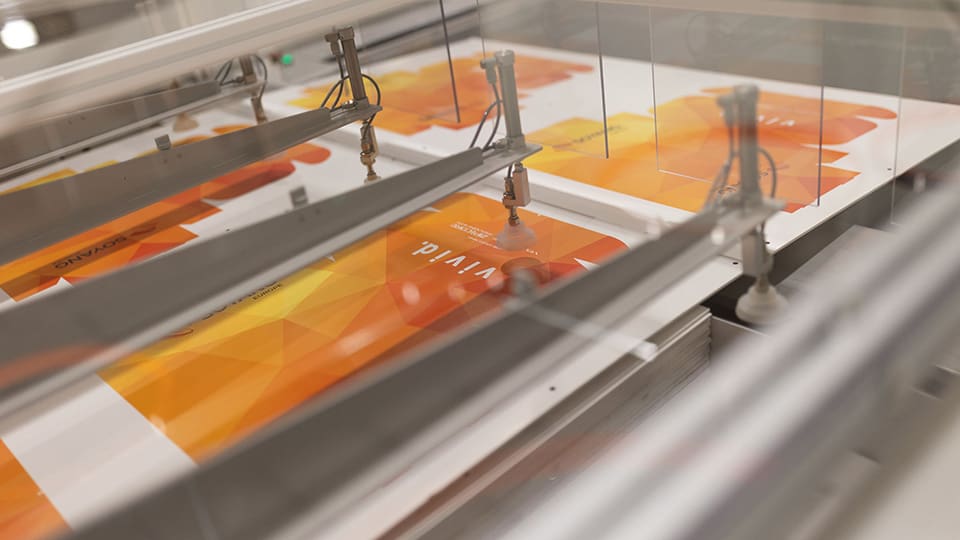
As for physical equipment solutions, Vivid’s wide-format digital die-cutting automation includes the VeloBlade Nexus feeder and stacker. This automatic feeding and stacking system can be retrofitted onto all VeloBlade Nexus models, which Evans says offers a time-saving production process with a stacking capacity of up to 100kg – eliminating the need for manual loading, saving both time and money.
Overcoming Challenges
Sticking with the software/automation crossover for the time being, Four Pees is a print automation specialist, working with PSPs to help modernise their businesses. Founder Tom Peire says with print companies facing numerous challenges, from rising material and energy costs to supply chain issues, shortages of skilled labour and margin erosion, automation can play a key role in helping them succeed.
With this in mind, Four Pees has introduced Atomyx, a cloud-based print production management platform with the idea of ‘connected automation’ in the print industry. Peire explains: “Simply put, it is an approach whereby connectors ‘plug in’ different platforms and technologies that didn’t communicate before. Automated systems exchange information or perform actions based on events, such as an incoming order or an updated status in production, all without the need for manual intervention.
“Its goal is simple – to allow information to circulate and to eliminate the need for re-entry of data from one system to another, thus making the production process more transparent and efficient.”
Peire goes on to say Four Pees’ long-term vision is very much a future where individualising print jobs and producing runs as low as one is not only possible at scale, but profitable too. To achieve this, he says PSPs need to take a holistic approach to the entire printing process from concept and order through to production and delivery, instead of just focusing on single tools.
“This means looking for solutions that will be scalable as they grow and, more importantly, that will enable them to integrate their management information systems with both their input and output systems,” he says.
“Consolidating data in this way will make it easier to spot the points in a business’ workflow that would benefit from improvement, investment, or reinvention. This holistic approach extends beyond information about the print business itself all the way to the customer’s experience, because only when you understand the whole customer journey alongside your performance data will it be possible to spot opportunities to add value and sell relevant additional services.
Much of Four Pees’ efforts will focus on Atomyx, which only launched in February. A SaaS platform, Peire says it empowers printers to leverage cloud technology to facilitate connectivity.
“Atomyx integrates disparate data sources into one central hub, simplifying the production process, while the platform streamlines operations, reduces costs, and enhances efficiency using three robust products – Atomyx Manage, Atomyx Prepare, and Atomyx Layout,” he adds.
Plenty of Benefits
Switching attention back to printing hardware and Duplo is another manufacturer that has been taking full advantage of advancements in automation and integrating the technology within its own solutions. Craig Harry, head of sales for Duplo UK, explains automation is a process that more and more industries are aiming towards, with the print sector being no exception to this trend.
“Whether it is by necessity or a simple result of progress and innovation, markets, including the printing industry, see plenty of benefits in automating their process,” Harry comments, continuing: “Using automation in your print production process has many benefits.
“Among these is to enhance productivity, minimise manual touchpoints, and reduce makereadies and set-up times, which means that the workflow is working as efficiently as possible so that more work can be produced and moved out the door in a shorter time. This increases profitability and reduces the hours needed to do the same amount of work.
“You can also expect to minimise errors throughout the print and finishing process which can save reprints and a printer’s reputation. With Duplo automation, using the barcodes and QR codes on the print means that the machines automatically set themselves up for each job, with no manual intervention so that operators can move on to more labour-intensive tasks or other jobs throughout the production process.”
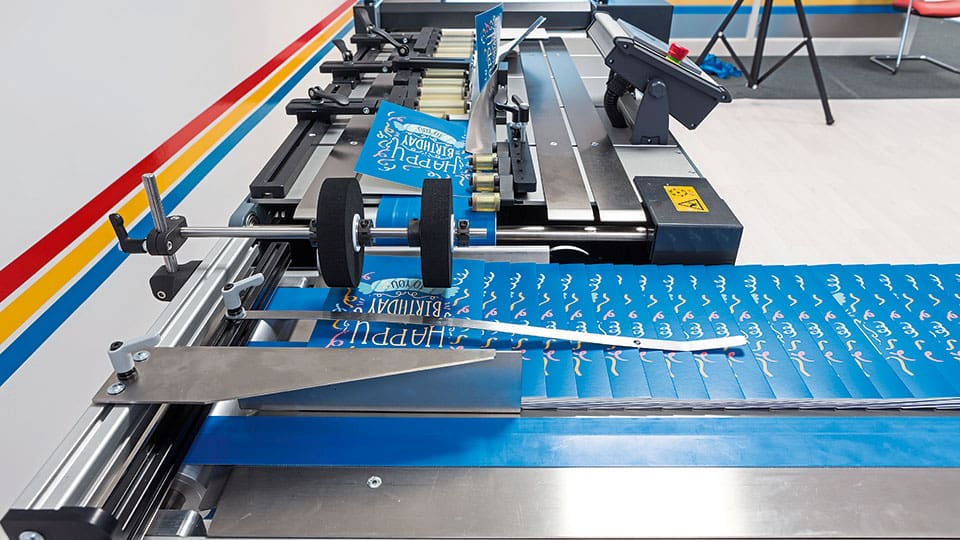
Duplo says many of its solutions feature automation. Pictured: the DBM-700 Booklet Maker
With this, he offers up a recent installation of Duplo’s DC-618 multi-finisher, integrated via Fiery through a digital press into Kingston-based The Printstore, highlighting the need and the importance of automation.
Ben Pickard, general manager of The Printstore, comments: “Before installing the DC-618 we had to farm out the quirky jobs or ultra-short runs from our clients, now everything is kept in-house, automated, hassle-free, and opens us up to more revenue.
“We are 100% in control of our costs and timeframes and can keep deadlines with our customers. They have trusted us for years and this investment will show that the trust is not misplaced. The little Duplo multi-finisher has proven itself because in terms of sales against profit, with a reduced team and less equipment and overheads, we’re doing really well.”
Leading on from this, Harry says automation is “the key to everything that Duplo has stood for since its inception”. He says Duplo invented the multi-finisher as we now understand it – a device that slits, cuts, and creases in one package, with the Duplo range also perforating in one pass.
“Ideal for common applications such as business and greetings cards, covers, direct mailers, leaflets, concertina folds, in fact anything with the combination of slitting, cross-cutting, scoring, and perforating,” he says, adding: “Over the years, Duplo has increased its portfolio of finishing equipment to booklet production, automatic saddle stitching, sensory coating, and digital cutting tables, and we’ve steadily developed automation to match market demands.”
The latest machines that were on display at drupa 2024 include the DDC-8000 B2 DuSense, automatic spot UV machine, DC-20K B2 cutting system, DC-648 slitter cutter creaser, new iSaddle Senshi, new DC-F100 integrated folder, and the new DSM-1000 automatic die-cutter. All, Harry says, encompass the latest automation techniques and integrations for modern printers across the country.
Consider Your Own Needs
Concluding our discussion, we look at Durst UK and Ireland, whose managing director, Peter Bray, says while automation is all about efficiency and getting the best productivity, it may not be for everyone. “It really depends on customer applications and job specifications and may not always suit the customer production demands,” Bray says, adding: “With every customer, we consider their specific requirements and provide detailed recommendations on what we believe would be in their best interests. It might be full automation, three-quarters automation, or a standard feed set-up. And it also depends on other factors, such as the finishing processes, material set up, run length, and application.”
For those customers where automation is the right way forward, Bray says they need to be looking at reliability and build quality, as well as the ability to upgrade when the time is right.
“Some prefer to start with a standard system, then add in three-quarter automation at a later stage and then full automation after that,” Bray explains, adding: “The compatibility with other processes is an important consideration.”
Printers should look for systems that seamlessly integrate with existing software and hardware to streamline the workflow
As for Durst’s progress with automation, one development of note is P5 Robotics, which Bray bills as the next level of automation for flexible and continuous production cycles with long run times. Unveiled at FESPA last year, at the heart of P5 Robotics is the P5 350 HS D4 hybrid printing system, which has a feeder/stacker unit formed by two KUKA robots to handle the unmanned production of a complete shift. Bray says that the importance of software has shifted significantly over the years. Back in 2018, Durst Group founded the Software & Solutions business unit, with the company currently employing around 100 people in software.
“At drupa this year, we unveiled a raft of new developments that will have an impact on automation,” he says, adding: “This included a software ecosystem: the spectrum ranges from web stores and online graphics editors to comprehensive workflow and analytics solutions and ERP/MIS systems. Artificial intelligence is also used in software development.”
PSPs are always looking for ways to make production smoother and ease the workload on staff; from speaking to several manufacturers and suppliers, it appears automation is one of the most effective ways of doing this. Consider speaking with your manufacturing partners about the automation features of their solutions and how these can help your business expand and grow.
From advances in print quality and productivity to increasing demand for automation and sustainable solutions, the wide-format market continues to evolve. Rob Fletcher looks at the latest trends, challenges, and developments in this sector
Speaking to a range of print and signage professionals, we discover how a sustainable business model can drive growth, outlining actionable strategies to cut overhead costs, improve eco-efficiency, and boost your bottom line
As finishing continues to become a great way to add extra elements to your print and wow customers, we take a look at some of the creasers, folders, and collators on the market, and ask experts their advice on finding the right solutions
(this was inserted into the PHP of a code block)
Watch our latest video of the week
Print Monthly gives you the latest video coverage of companies, people, and events from within the print industry.