Hitting accurate colours each time is of paramount importance if you are to win and retain valuable customers. Here, we speak with several specialists in colour management to find out about the latest developments with this software
Rob Fletcher
July 16, 2025
In a market where competition for work is very high, print service providers (PSPs) cannot afford to be lax or even complacent when it comes to managing colour. Skimp on this and you run the risk of producing below-par printed work that could cost you, both in terms of having to re-print pieces and potentially losing customers to a sharper-eyed competitor.
For this reason, colour management is more important than ever. This specialist software allows PSPs to carefully manage colour output, helping them to avoid costly mistakes and ensure they are hitting the colour targets set by their customers.
In this feature, we speak with providers of, and specialists in colour management software to get insight into some of their latest developments and how investment in a new solution or simply upgrading their existing setup will grant PSPs access to a greater range of benefits.
Unmatched Colour Precision
First up to comment is Colyer, an authorised partner of Xerox, Fujifilm, HP, Summa, Epson, and other leading brands in the print industry. Among its other partners is Barbieri, which specialises in spectrophotometers and colour measurement tools for digital print, especially in the wide-format, textile, and industrial sectors.
“Barbieri enables unmatched colour precision across all substrates, saving time through automation and delivering a competitive edge, especially for high-end or colour-critical applications,” says Oliver Gosden, sales director at Colyer.
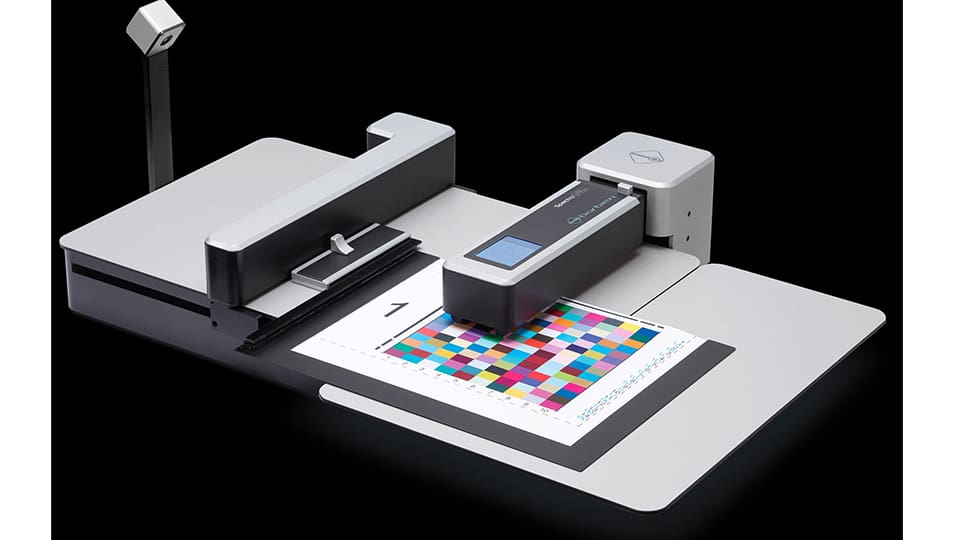
Picking out some of the key features of Barbieri systems, Gosden first highlights automatic chart scanning, which handles textured, transparent, and reflective media, which he says are beyond the limits of desktop devices.
Colyer has partnered with Barbieri, which specialises in spectrophotometers and colour measurement tools for digital print
Other stand-out Barbieri features include transmissive and reflective measurement, which Gosden says are ideal for applications like backlit displays and window graphics, as well as built-in camera and alignment system to help ensure accurate readings on large or flexible substrates.
As for Barbieri Gateway software, this has profiling, validation, linearisation, and integration with RIPs such as Caldera, Onyx, PrintFactory, and EFI Fiery. In addition, users can benefit from M1/M2 light standard support to maintain colour accuracy under various lighting conditions.
“A colour measurement instrument is essential; it delivers those measurable results, verifies accuracy, and keeps colour on target across every job,” Gosden says, adding: “PSPs should expect accurate, consistent, and repeatable colour across devices and media from a quality solution, as well as one that delivers measurable results that ensure long-term reliability.
“Poor colour management can lead to high reprint and waste costs, missed industry standards, and lost customers due to inconsistent output. Investing in automated and precise solutions, like those from Barbieri, streamlines workflows, reduces manual effort, and ensures consistent, high-quality output.”
Colour in Flexo
Also weighing in is BOBST, which has developed oneECG technology as an ‘Extended Colour Gamut’ (ECG) solution tailored for CI flexo. Bill Duckham, technology sales director for flexo, says this enables converters to achieve highly accurate, repeatable colour using a fixed set of seven inks (CMYK + OGV), to achieve up to 95% of the PANTONE colour book, eliminating the need for spot colours.
This standardisation, Duckham says, unlocks faster changeovers, greater press uptime, and significantly reduced waste, up to 63% on startup materials and ink. He explains: “What makes oneECG ideal for today’s high-performance printers is its full digitalisation. Colour matching is handled during prepress, so the process is no longer dependent on operator skill or press conditions. This leads to greater stability across multiple presses, jobs, and production sites.
BOBST has developed oneECG technology as an ‘Extended Colour Gamut’ (ECG) solution tailored for CI flexo
“The solution is part of a wider BOBST ecosystem of technologies, including smartGPS for automatic register and impression setting, and BOBST Connect for data-driven performance monitoring and traceability. All BOBST CI flexo presses – new or installed – are oneECG-ready, requiring no hardware upgrades.”
Leading on from this, Duckham says in CI flexo, achieving uniformity and predictability in colour reproduction is “essential”. He recommends PSPs look for solutions that offer digital colour matching, minimal variation, and full process control across all stages of production, adding that a high-quality colour management system needs to reduce dependency on operator interpretation and standardise results across different presses, shifts, plants, and sites.
“At BOBST, we believe automation and digitalisation are critical to achieving this,” he says, continuing: “A robust solution should integrate seamlessly into prepress, tooling, and press operations, ensuring brand colour targets are met consistently. It should also support ECG workflows, enabling converters to replace spot colours with a fixed ink set to increase press efficiency, reduce waste, and support sustainability.”
Failing to prioritise colour management in CI flexo, Duckham adds, can lead to variability in print quality, longer setup times, higher material waste, and ultimately, brand dissatisfaction.
A robust solution should integrate seamlessly into prepress, tooling, and press operations, ensuring brand colour targets are met consistently
“Brand owners expect colour consistency not just from one job to the next, but across packaging types, substrates, and global print sites,” he comments, adding: “If colour accuracy fluctuates, it reflects poorly on the converter’s production quality and reliability.
“From a production standpoint, without proper systems, operators are forced to then make manual adjustments that introduce variation and increase downtime. Underinvestment here also limits a converter’s ability to optimise workflows or adopt sustainable practices.”
Build Customer Trust
Also able to support in this area is Contact Originators, which, based in Manchester, works with customers on packaging origination, graphics management, and flexographic plate production. Technical support manager Gareth Heward says a quality solution should ensure data gathered during fingerprinting is reliably translated into a press-ready profile, meaning any file separated to that profile prints exactly as expected.
“Equally important is proofing,” he says, adding: “Printers need to trust that what they see on a contract proof is a target that’s both accurate and achievable on a press. We work closely with customers to ensure their profiling and proofing systems are fully aligned, so they can operate with complete confidence from prepress to print.”
Contact Originators works in partnership with GMG Color to support customers
When colour management is overlooked, Heward warns, the cost is felt across the entire process. He explains inaccurate or incomplete profiles create problems that cascade through prepress and onto press, resulting in slower approvals, increased waste, and even full reprints in worst-case scenarios. “This not only affects costs, but also press uptime, lead times, and customer trust.”
As to how Contact Originators can help, the company has a long-standing partnership with GMG Color, which he describes as the “gold standard” in colour management and proofing technology. He says GMG Color technologies are a “particularly strong fit” for the packaging sector, where there is no such thing as a ‘standard’ profile.
Colour management is ultimately about control and confidence – the ability to consistently deliver accurate, repeatable colour across runs, substrates, and formats
“We regularly work with a wide variety of substrates, ink systems, and applications, often requiring the integration of spot colours into complex separations,” Heward explains, adding: “The GMG Color tools we use give us the flexibility and precision to create tailored profiles that hold up under real production conditions.
“Colour management is ultimately about control and confidence – the ability to consistently deliver accurate, repeatable colour across runs, substrates, and formats.”
Never Stop Learning
Rounding off the feature is PRINTING United Alliance, which has launched a number of schemes to help PSPs with issues related to colour management. Joe Marin, senior vice president of member services, says before investing in any colour management solution, it is essential printers first understand the fundamentals of colour management and why it plays such a critical role in print production.
“This is where training becomes invaluable and it’s important for print businesses to ensure their print operators and pre-press departments are regularly trained in this area,” Marin says, continuing: “Ensuring that employees are up to date with best practices allows a business to get the most out of any colour management technology. Without this foundation, even the most state-of-the-art systems won’t reach their full potential.
“When it does come to investing in a colour management solution, printers should look for tools that deliver reliable, repeatable results across devices and substrates, and that are up to date and ensure accurate and consistent colour reproduction. A good quality solution will include features such as device calibration, ICC profile creation and management, as well as the ability to monitor, evaluate, and adjust output regularly. Modern solutions should offer support for a range of print conditions and media types and be capable of handling complex requirements such as extended gamut printing.”
Equally important, Marin adds, is seamless integration with an existing workflow. He explains colour management should support production, not slow it down, and recommends PSPs look for solutions that work well with your RIPs, design software, and production systems to eliminate bottlenecks, reduce manual intervention, and ultimately minimise costly errors and reprints.
“Underestimating the importance of colour management, or underinvesting in it, can have serious consequences for a print business and the importance of high-quality colour management within a print business cannot be understated,” he says, adding: “Colour is the cornerstone of branding and inconsistent colour output can damage client trust and diminish brand value, particularly when it comes to brands that rely heavily on specific colours.”
Ensuring that employees are up to date with best practices allows a business to get the most out of any colour management technology
As to how the PRINTING United Alliance can support, he picks out the iLEARNING+ portal, which is available around the world. This allows industry members to access courses and certifications, reports on industry trends and best business practices, quality control devices, and other resources in a single place.
ILEARNING+ offers certifications for specific print applications from cut sheet digital to direct-to-garment, wide-format, and flexo, and a range of colour management specific courses including an expanded colour gamut printing course aimed at designers, print staff, press operators, and production management which provides a deep dive into traditional and digital applications.
ILEARNING+ also offers two, globally recognised, certification levels: Colour Management Professional: Creative Certification and Colour Management Professional: Fundamentals Certification. The former examines issues critical to ensuring content output meets the intended design and corporate brand objectives and the latter offers the latest in colour theory and applications in colour, providing a comprehensive educational foundation for colour managing a graphics workflow.
Factoid: A spectrophotometer is an instrument that measures the amount of photons (the intensity of light) absorbed after it passes through a sample solution
Another option for colour management training is the G7+ Expert Certification program, exclusively led by PRINTING United Alliance. Available either live online, live in-person, or as on-demand training, this is an industry-recognised certification for all learners regardless of their schedule or availability.
“This G7+ Expert course and certification equips professionals with the skills to analyse colour and print-related challenges such as colour management, calibration, and press optimisation and covers theory, ICC profiling, linearisation, quality control, and compliance,” Marin says.
The message appears pretty clear: neglect colour management at your own peril. There are plenty of options available to PSPs to improve their setup, while they can also make use of various training schemes to bolster their knowledge and improve output. Consider which might be the best route for you and your business.
From advances in print quality and productivity to increasing demand for automation and sustainable solutions, the wide-format market continues to evolve. Rob Fletcher looks at the latest trends, challenges, and developments in this sector
Speaking to a range of print and signage professionals, we discover how a sustainable business model can drive growth, outlining actionable strategies to cut overhead costs, improve eco-efficiency, and boost your bottom line
As finishing continues to become a great way to add extra elements to your print and wow customers, we take a look at some of the creasers, folders, and collators on the market, and ask experts their advice on finding the right solutions
(this was inserted into the PHP of a code block)
Watch our latest video of the week
Print Monthly gives you the latest video coverage of companies, people, and events from within the print industry.