Getting Direct to Profit with Direct-to-Object Printers
One of the fastest growing markets in the industry, direct-to-object printing presents a wide range of opportunities. Here, we speak with several manufacturers to find out how best to go about securing new, profitable work
Rob Fletcher
May 9, 2025
While the direct-to-object (DTO) printing market is still in its relative infancy, there is simply no way one could miss the rate at which this sector is expanding. A recent report by Future Market Insights valued the segment at more than $3.00bn (£2.38bn) in 2024, with this set to hit $4.00bn by the year 2034.
Driving this growth is not only increasing demand from customers around the world but also new developments from leading manufacturers within the sector. New products are coming to market at a steady pace, offering those in and around DTO access to solutions than can help them gain an advantage in the market.
In this feature, Print Monthly catches up with some of these manufacturers and suppliers to find out where the main opportunities lie for print and signage companies which are keen to make further inroads into DTO, as well as how their latest technologies can support them in their quest.
Exciting Developments
Up first to comment is Nick Macfarlane, regional sales representative for the UK and Ireland at DTO specialist Inkcups. According to Macfarlane, we have now moved beyond the hype about the potential of DTO and instead are seeing it start to make inroads into multiple different markets, particularly packaging, promotional, and consumer print-on-demand.
“This growth is being driven by numerous different factors, among them a growing emphasis on more environmentally friendly production methods, the seemingly unending increase in consumer demand for individualised products and experiences, and, of course, DTO printing’s suitability for cost effective on-demand printing,” Macfarlane explains.
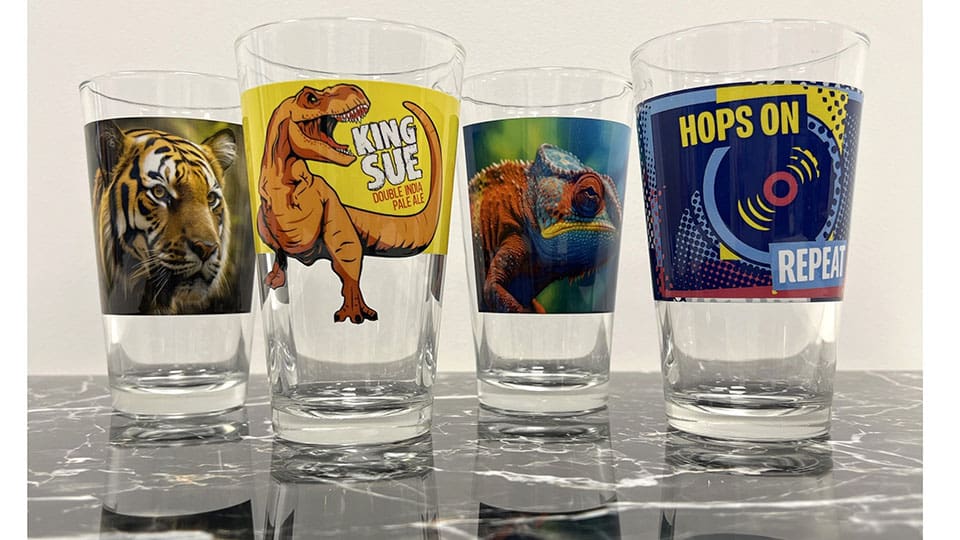
Macfarlane goes on to say there is a growing number of print and signage businesses investing in DTO printing capabilities to enable them to offer complementary products to customers, such as exhibition specialists moving into branded merchandise or hospitality décor printers adding customised glassware and candle holders to their offerings.
“These moves aren’t laden with as much risk as entering a completely new market, because businesses can sell existing customers something that they may already be buying, or considering buying, elsewhere,” he says.
Inkcups launched the XJET Switch flatbed UV digital printer to meet growing demand for printing directly onto bags and totes
Macfarlane also highlights another key trend in that DTO printing is democratising packaging, which is in turn enabling start-up and independent brands to be bold and creative with their packaging by producing small volumes as they’re needed.
“Larger brands are getting in on the action too, using DTO print technology to decorate limited edition products or enable campaigns responding to seasonal or fleeting social media trends,” he adds. As to how Inkcups can help companies take advantage of new opportunities, he sets out how most DTO printing is done using flatbed UV inkjet printing machines. With this, he picks out the Inkcups XJET800, a small-format flatbed printer, which he says is well suited to work such as coasters and sweet tins.
On the flip side, the manufacturer also offers taller, large-format machines such as the Inkcups X5-T flatbed UV digital printer, which can handle taller items such as coolers and footballs.
In addition to this are specialist flatbed machines such as the Inkcups XJET Switch flatbed UV digital printer, which launched in 2023 to meet growing demand for printing directly onto bags and totes made from PVC, polyester, non-woven materials, and other materials.
DTO has been on an exciting journey since its inception, and we expect 2025 to bring more of the same
On top of this, Inkcups has a range of Helix cylindrical UV inkjet printers, which use specially designed fixtures to hold each item to be decorated, making it possible to produce full-wrap, full-colour images on most straight-walled and tapered cylindrical items such as drinkware, spirits bottles, thermoses, sports bottles, candle holders, glass bottles, beverage cans, cosmetics bottles, and even make-up containers.
“DTO has been on an exciting journey since its inception and we expect 2025 to bring more of the same,” Macfarlane says, adding: “We have moved beyond the early adoption phase, and DTO print is now well and truly shaping and even creating market opportunities.”
Growing Trends
Another company able to support in this market is Graphtec GB, the distributor for Mutoh printers in the UK. Managing director Tom Kneale says market trends are driving demand for DTO, sounding out unique on-demand products such as promotional items and personalised merchandise as key areas to focus on.
“Mutoh’s ability to cater to small-batch production aligns perfectly with this trend,” Kneale says, adding: “Currently, around 35% of our printer sales are going to DTO applications and we can only see this trend growing.
“As with everything digital, the customer is now demanding short run unique branding, which provided you are working with flat surfaces, is not an issue. However, this becomes more of a problem if we are talking about 3D shapes. Mutoh has resolved this by allowing all of our DTO printers to print on objects up to 150mm thick, and with automatic media height and obstacle detection our printers can produce this safely while avoiding head crashes.”
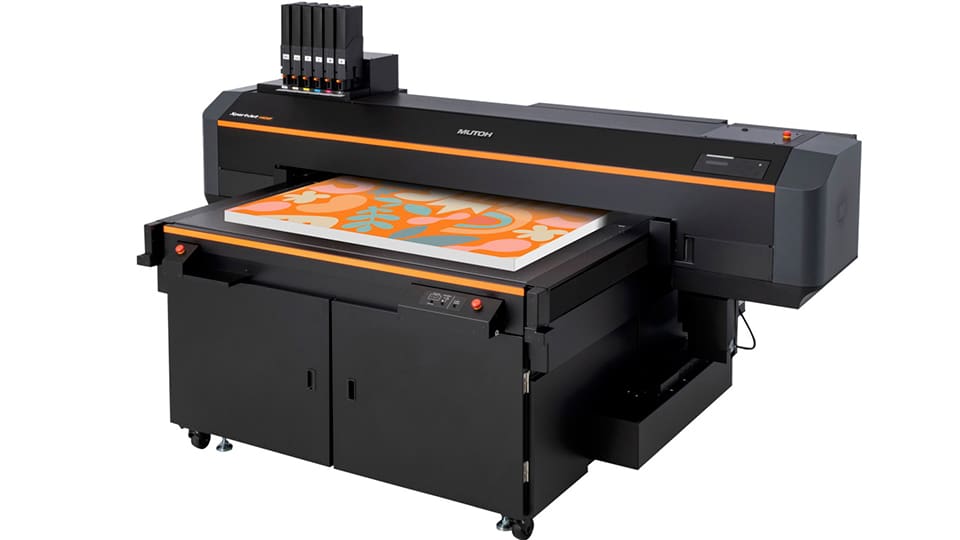
On top of this, Kneale says, is a focus on workflow efficiency. He explains how Mutoh has developed maximum versatility with its printers, enabling simultaneous printing of multiple substrate sizes on the same table, which he explains is perfect for batching up jobs and making maximum use of the bed. Looking more closely at some of the options available from Graphtec and Mutoh, Kneale says the current range boasts a total of three flatbed printers, with bed sizes ranging from 1,420mm x 700mm to a more affordable solution in the XPJ-461UF with a bed size of 483mm x 329mm.
Available from Graphtec GB, the Mutoh collection of flatbed printers has bed sizes ranging from 1,420mm x 700mm to 483mm x 329mm. Pictured: the XPJ-1462UF
“Mutoh’s LED UV print technology brings a whole new dimension to digital printing,” Kneale says, continuing: “The applications are only limited by imagination, with one off, on-demand designs, objects, prototypes, interior decoration, signs, packaging, and labels all possible.
“I am still thrilled by the magic of white and varnish inks. Print on dark, coloured, or clear substrates. Users can create all sorts of stunning special effects such as special structures, embossed designs, or spot varnish.”
In addition to this is the next generation UV LED inks that run on the Mutoh printers, which Kneale says have been one of the biggest selling points in recent years. Inks are available in four-colour (plus white and clear) and can be used across both transparent and coloured substrates. They are also Greenguard Gold certified to meet stringent standards for low VOC emissions.
“Working with these inks mean output is dry and ready to finish right from the printer, while they are suitable for use on work that is being installed either indoors or outside,” he says, adding: “They also feature cool UV cure technology for low energy consumption and ideal for heat sensitive media, as well as offering excellent adhesion and scratch resistance on both roll and rigid applications.”
Factoid:According to Epsilon, 80% of consumers are more likely to make a purchase from a brand that provides personalised experiences
And the development does not stop there. Earlier this year, Mutoh announced the launch of Mutoh Hydratron, which, powered by AQUAFUZE, is an advanced UV-curable water-based ink technology developed by Fujifilm.
“This hybrid ink system combines the benefits of water-based and UV-curable inks, utilising Fujifilm’s proprietary dispersion technology to achieve low-VOC, low-odour, and non-hazardous printing,” Kneale explains, adding: “While eco-solvent and UV will always have a place, I believe this is a sign of things to come.”
Continued Growth
Regarding the performance of inks, Xaar is a specialist developer of printheads. Director of sales, Justin Noble, says the future of DTO printing looks promising, with continued growth expected as OEMs integrate inkjet technology’s many advantages into new print machinery solutions.
“These advancements enable printing on a diverse range of substrates, delivering exceptionally fine details, and accommodating irregular surfaces through non-contact printing,” Noble says, continuing: “Additionally, the development of high viscosity inks tailored for different materials will further expand the versatility of DTO printing, allowing for high-quality customisation across various industries from luxury packaging to life-saving medical devices.”
Noble agrees growth is primarily being driven by manufacturers responding to consumers’ desire for bespoke and personalised products. He says this trend is particularly evident in the luxury wine, spirits, cosmetics, and perfume industries, where packaging plays a crucial role in helping products stand out on crowded retail shelves.
“High-impact visuals and tactile effects are essential in attracting consumers’ attention and enhancing brand perception, with the latest inkjet technologies and inks helping to meet this demand,” he comments, adding: “Beyond aesthetics, direct-to-shape printing can offer significant cost advantages, with premium packaging producers able to reduce costs and streamline production. The combination of efficiency, and sustainability, alongside the ability to create striking, customised packaging, is fuelling the rapid adoption of DTO printing.”
According to Xaar, the future of DTO printing looks promising, with continued growth expected in the coming years
With this in mind, Noble says the latest printheads provide the quality and speed required for DTO printing productivity and enable reliable printing in different directions on curved or complex surfaces. He gives the example of how Xaar’s printheads can print in any orientation, including vertically, thanks to its TF Technology. By recirculating fluid at a very high flow rate and ensuring nozzles remain continuously primed and operational, Noble says this makes them ideal for challenging DTO applications.
Going into further detail on Xaar’s innovations, Noble highlights High Laydown and Ultra High Viscosity Technologies, which have supported Kammann’s machine advancements in digital printing.
“By integrating Xaar's printheads, Marabu's Ultra High Viscosity fluids, and Kammann's innovative digital print technology, it has been possible to create embossed effects on glass bottles and other packaging with a laydown build height of up to 3mm – and without compromising intricate details or sharp contour edges,” he explains.
“This innovation was driven through the collaboration of all three partners, with printhead manufacturer, ink supplier, and machine builder using their expertise to open new possibilities that traditional analogue printing methods cannot deliver. Such digital processes are transforming packaging design, offering unprecedented customisation options beyond the reach of traditional methods.”
These closing comments will only generate more excitement about the future of DTO and what this may hold for those companies active in the sector. Those seeking to make a move into the market should consider reaching out to manufacturers and suppliers such as these featured here to learn more about entry-level solutions, while those looking to strengthen their current offering should also evaluate the latest options to see how these can help them evolve.
With The Print Show upon us once again, anticipation has been building for the UK’s leading industry event. From product launches and live demos to expert advice and networking opportunities, here’s what to expect at the NEC this September
We examine two rapidly scaling online business models, both growing within the print sector, exploring what they mean for the future landscape of commercial print
With garment print still proving a popular growth market, Rob Fletcher takes a closer look at some of the latest technology on offer in this sector, analysing how these machines can help your business access new opportunities
(this was inserted into the PHP of a code block)
Watch our latest video of the week
Print Monthly gives you the latest video coverage of companies, people, and events from within the print industry.