A critical component in the finishing process, what are the latest guillotine solutions on the market and what benefits do they offer to print companies seeking sharp and accurate cutting?
Rob Fletcher
July 10, 2024
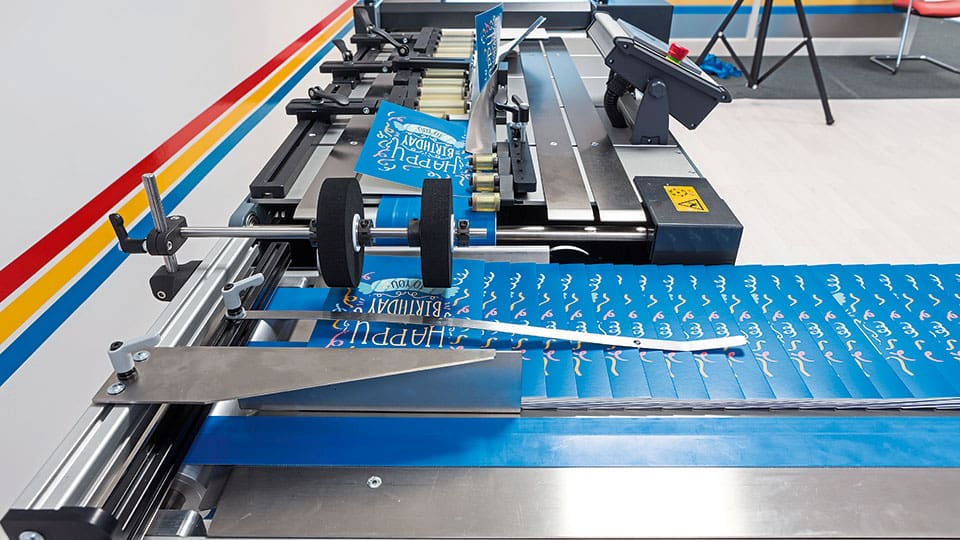
The AeroCut X is a card cutter and creaser from Morgana
Guillotines have been part of the print production process for several centuries, establishing themselves as a hugely important component when producing all manner of printed work. From the simple cutting of business cards to more intricate finishing on trickier prints, having a reliable guillotine in place helps print service providers (PSPs) achieve a smooth finish.
In essence, the modern guillotine performs the same task as its early ancestors that were introduced to the industry hundreds of years ago; they allow print professionals to easily cut printed work. Of course, the technology has continued to evolve over the years to the point where workers can now program machines to perform tasks without having to stand by and constantly monitor the device.
So, where do guillotines go from here? How can manufacturers continue to improve on a technology that has been around for so long? Print Monthly speaks with several suppliers to find out.
Taking Control
One name synonymous with the finishing market is Morgana Systems. Ray Hillhouse, vice president of sales and marketing for the Offline Business Unit at Plockmatic Group, which owns Morgana, says, in short, having a guillotine on-site means taking control of paper cutting needs.
“Start-up printers will very soon find the need for a guillotine for paper cutting, whether that be the need to trim finished work to the desired size, or to cut larger sized sheets down to the format required for printing,” Hillhouse says, adding: “While multi-function finishing devices can handle some standard trimmed formats, they are limited. Even a relatively small-format guillotine can start paying for itself immediately by cutting larger, lower cost sheets down to the desired print size.”
While multi-function finishing devices can handle some standard trimmed formats, they are limited
Advising PSPs on what to look for when investing in new machinery, Hillhouse explains there are several key features to look for, no matter the size of the print business. Firstly, from a health and safety aspect, he points to the inclusion of a light-beam guarding the front table area, with this legally required in any modern machine. He says if the beam is broken, the cut either cannot be started or the motion will stop immediately if a cut is in process, thus preventing any nasty accidents.
Other stand-out features to keep an eye out for include the ability of the machine to store and retrieve multiple cutting programs. Hillhouse says this allows for often-used cutting sequences to be recalled fast, saving both time and, hopefully, errors. Linking in with this, Hillhouse says most users prefer to work with a machine that has a touchscreen interface to further improve overall ease of use.
In addition, he says the actual format of the machine might be considered a critical feature. Hillhouse explains larger guillotines might allow users the opportunity to buy their chosen substrate at the optimum price by buying larger-sized sheets and trimming them down to a preferred printing size – possibly cutting down from A2 to A4 sheets.
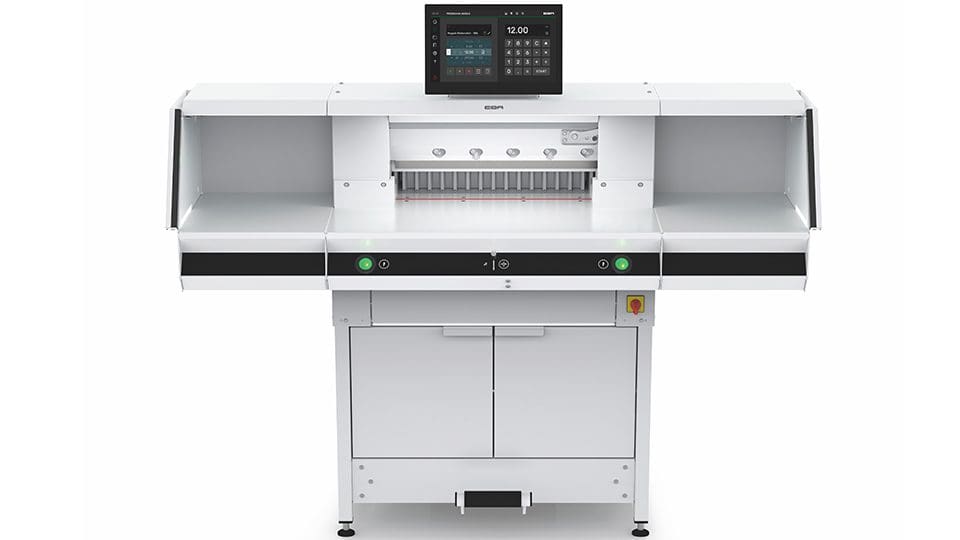
Supplied by Morgana, THE 56 from EBA has a maximum cutting width of 56cm
“Beyond this basic cost-cutting exercise, the guillotine opens up a whole raft of print work that might require an image to bleed off the edge of a sheet,” Hillhouse says, continuing: “This needs over-sized sheets and an accurate trim to remove the excess paper after the printing process. With longer sheet printing now being a feature of many digital print engines, format is a very important thing to get right.” In terms of how Morgana can help, Hillhouse has several suggestions. He picks out the 55cm EBA 5560 as its most popular guillotine, but adds that in recent years, Morgana has seen more demand for its 65cm 6600 and 72cm 7260 machines due to digital print manufacturers moving to larger sheet sizes and promoting long sheet applications.
As for new solutions, Hillhouse picks out THE 56 from EBA. The device features a 15.6” multi-touch control screen as well as a maximum cutting width of 56cm and stack height of 8cm. In addition, when programs are entered, the machine gives a visual guide to turning the stack in the correct direction for the next cut, helping operator efficiency and productivity.
In addition to EBA, Morgana supplies the Mohr range. Mohr machines are a heavier duty hydraulic range of units in 66cm and 80cm cut sizes, with Hillhouse saying the most popular model is the 80cm Mohr 80. Although normally supplied as a three-phase unit, the 66cm version can also be supplied as a single-phase machine.
“Both the Mohr 66 and Mohr 80 Plus are controlled by a colour 18.5” touchscreen, which also shows job visualisation, taking the operator through each step in the cutting process,” he says, adding: “The PLUS models can also be equipped with a barcode-reading capability, delivering the desired cutting programme by reading from a barcode added within the trim of the printed job.”
Automation Equation
Next up is Intelligent Finishing Systems (IFS), which offers finishing solutions from a range of brands, including BaumannPerfecta and its collection of guillotine machines. Eric Keane, managing director at IFS, says a guillotine should be regarded as an essential element for any in-house bindery.
“With fast turnaround short runs increasingly becoming the staple workload, a system that is easy to operate and quick to set up will help ensure smooth and streamlined production,” Keane explains. However, before investing, Keane says PSPs should consider how they can benefit from the latest technology and what performance gains can be realised. This could include greater productivity with features such as touch-screen programmability and job memory storage; increased efficiency with the calculation of optimal cut sequences; and lower labour costs by adding joggers and jogging tables.
Above all, Keane says, is automation. He explains that from the cutting process to quality checking systems preventing operator errors, every step can be highly automated ensuring reliable, repeatable, quality.
“Intuitive technology can support ease of set up and operation to create a dynamic bindery with streamlined production,” he says, adding: “Touch screen operation supports quick set-ups, and a programmable memory helps the efficient completion of short-run fast turnaround jobs. Saving minutes on multiple jobs per shift can quickly add up dramatically impacting capacity. This is vital for binderies managing shorter runs and tighter deadlines.
“Ongoing development will continue to focus on the user experience making operation and paper handling as smooth, streamlined, and easy as possible – essential to maximise production and increase capacity for short-run fast turnaround work.”
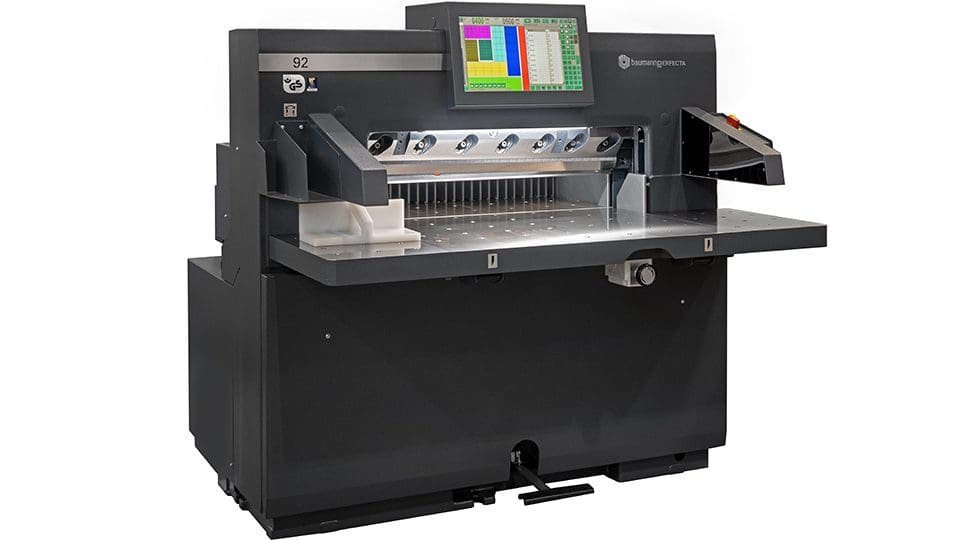
Available from IFS, the BaumannPerfecta collection of economic high-speed guillotines includes models such as the 92 and 132
As for the most in-demand machines at IFS, Keane points to the BaumannPerfecta collection of economic high-speed guillotines. These range from the BaumannPerfecta 80 to the BaumannPerfecta 225. These solutions, Keane says, feature a new and modern design, focused on functionality, ergonomics, and safety.
“The centrepiece of the new design is the large, inclinable menu-guided touch screen that manages a variety of cutting jobs: single cut, programme cut, repeat cut, clamping without cut, and automatic actual-value transfer,” he says.
“In combination with the newly developed CUTPIT control, machine operation is easier than ever. Another highlight is the new cutting cell that grants a significantly longer knife life thanks to an innovative damper system. The modular concept of the systems means they can be easily complemented by other peripheral machines to offer complete system solutions through to fully automatic cutting systems.”
For cutting B2/SRA2 and B3/SRA3 digitally printed sheets, IFS also supplies fully automated digital cutting solutions from Horizon with the SmartStacker and SmartSlitter. In addition, it works with TECNAU on its Stack 1212 and Stack 1010.
“Research and development will continue to focus on the user experience by making operation and paper handling as smooth, streamlined, and easy as possible - essential when managing short run, fast turnaround jobs,” Keane adds, concluding: “Automation of the cutting process will continue to grow as will quality checking systems to prevent operator errors.”
A Vital Cog in Production
Another aptly named specialist finishing supplier is AfterPrint, whose director, Chris O’Brien, says outsourcing guillotining can cause significant logistical issues as well as a rise in costs and less control over a vital cog in the print process. For this reason, he recommends PSPs consider taking the process in-house.
“One of the highest costs for any printer is purchasing paper and media,” O’Brien explains, continuing: “Guillotining in-house gives you greater control over these costs. The less handling the paper merchant needs to input the lower the costs to you the consumer. Therefore, having a guillotine allows you to purchase larger formats which can then be cut down in-house.
“We think the most important factors to consider are a proven reliability record, robust build quality, ease of use, and ongoing costs for service, parts, and blades, which is certainly an area that is often overlooked.”
Leading on from this with more advice for PSPs, O’Brien says quality is often hard to define and it is easier to consider a recognised brand as opposed to a different manufacturer the PSP may have not necessarily heard as much about.
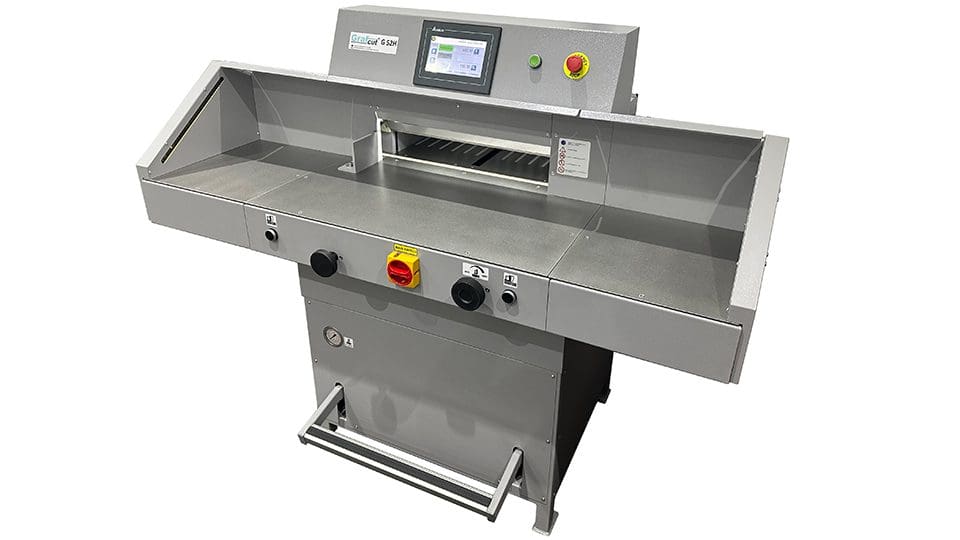
Offered by AfterPrint, the Grafcut G52H, has recently been upgraded with a larger 175mm touchscreen
“This is something we come across quite often with our Grafcut Guillotine range,” he says, adding: “Grafcut may not be as well-known as some of the more established brands even though it has been trading for over 20 years. However, Grafcut’s build quality and proven reliability track record is second to none.
“Looking back to one of our first thoughts when considering a quality guillotine, ongoing costs, such as servicing and parts and this is an area where Grafcut comes into its own. Grafcut utilises standardised parts from Sick, Omron, and Delta in its manufacturing process.
“This means significantly lower costs, easier access to parts across the UK, and guaranteed quality. Place this alongside our own servicing abilities in the UK and you have a powerful package offering incredible quality and value for money.”
Factoid: The first paper-cutting guillotines were introduced during the Renaissance in Europe
Going into more detail on the Grafcut solutions available from AfterPrint, O’Brien begins with the Grafcut G52H, which he says is the most popular machine from the manufacturer. The device has recently been boosted with the upgrade to a larger 175mm touch screen.
“In our opinion, the Grafcut G52H is the most powerful guillotine on offer which is aimed at the digital printer,” he says, adding: “The G52H incorporates fully hydraulic operation, which guarantees effortless performance. Fully programmable with up to 100 job memory, all of which can be given full names using the popup keyboard within the touchscreen.”
Other options include the Grafcut G73H, with the ability to cut up to a 100mm stack and with an operating width of up to 730mm. O’Brien adds that the G73H is perfect for high volume digital and commercial printers due to powerful hydraulics, high-speed servo-driven back gauge, and fully programmable air table.
As for new solutions, Grafcut used Drupa 2024 to launch the G80H. This new model, O’Brien says, offers an 800mm cutting width, powerful hydraulics with an ultra-high-speed action for improved production as well as the Servo Driven back gauge.
The message is clear: outsource cutting at your own will. Of course, bringing this process in-house will incur an initial cost, but from speaking with manufacturers and suppliers here, the long-term benefits of investment far outweigh these costs.
From advances in print quality and productivity to increasing demand for automation and sustainable solutions, the wide-format market continues to evolve. Rob Fletcher looks at the latest trends, challenges, and developments in this sector
Speaking to a range of print and signage professionals, we discover how a sustainable business model can drive growth, outlining actionable strategies to cut overhead costs, improve eco-efficiency, and boost your bottom line
As finishing continues to become a great way to add extra elements to your print and wow customers, we take a look at some of the creasers, folders, and collators on the market, and ask experts their advice on finding the right solutions
(this was inserted into the PHP of a code block)
Watch our latest video of the week
Print Monthly gives you the latest video coverage of companies, people, and events from within the print industry.