Maintaining the right level of humidity is essential in print environments. With this in mind, we speak with several companies in this area to learn more about their latest solutions and the benefit of upgrading a humidification system
Rob Fletcher
July 16, 2025
As we move into the warmer summer months, some of us may be lucky enough to be jetting off to the sun, sea, and sand for a week or two. Often, foreign climates can prove challenging for us Brits, with the heat and humidity not something we are really used to here in Blighty.
However, humidity is something print service providers (PSPs) have to contend with all year round, with the constant running of large printing machinery meaning that this is almost unavoidable. That said, there are plenty of options available to PSPs to help them manage humidity in the print room.
Here, we sit down with manufacturers and providers of humidity solutions to find out how PSPs can go about identifying the best options for their facilities and the long-term benefits of proper investment in quality kit.
Avoid Costly Issues
Up first to comment is Stephen Finkel, regional sales manager at DriSteem, who says that as even slight fluctuations can affect paper stability, ink adhesion, and the overall quality of the final product, maintaining the right level of humidity is crucial for printers.
“Paper can expand or contract without consistent humidity control, leading to misfeeds, registration errors, and uneven print results,” Finkel says, adding: “Static electricity also becomes a major issue when humidity drops too low, causing problems with sheet separation and attracting dust that can interfere with print quality and equipment performance.
“Reliable humidity control not only protects the integrity of materials but also helps extend the life of printing equipment and ensures smoother, more efficient production runs.”
When evaluating humidification systems, Finkel says it is important to consider solutions that deliver stable humidity levels throughout the year, regardless of changes in outdoor conditions. He explains a system should be easy to maintain in order to reduce the risk of unplanned downtime, while also noting energy efficiency as critical, especially as it contributes to lower operating costs over time.
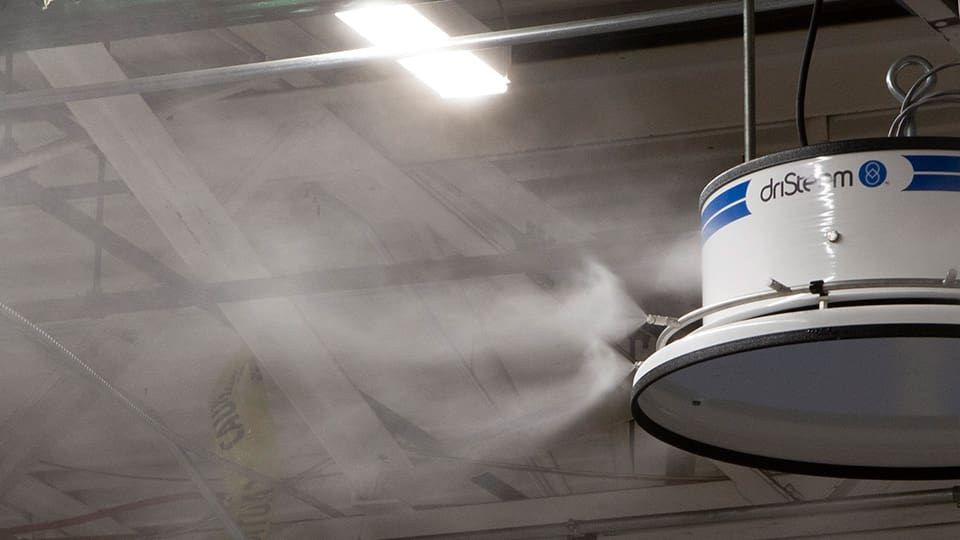
DriSteem offers a range of humidification solutions to the print market
Finkel adds that seamless integration with building management systems allows for more streamlined control and monitoring, and that the ideal solution should be flexible enough to adapt as the facility’s production needs evolve.
“Failing to properly manage humidity in a print shop can lead to a wide range of costly and disruptive issues,” Finkel comments, adding: “Perhaps most critically, poor humidity control can lead to dissatisfied customers, especially if print jobs are delayed or fall short of quality expectations.
“In a competitive industry where reputation and reliability matter, the consequences of neglecting humidity control extend far beyond the shop floor. It can erode customer trust, reduce repeat business, and ultimately impact the profitability of the entire operation. In short, overlooking humidity control can directly affect a printer’s bottom line in day-to-day operations and long-term brand reputation. It’s a risk no serious print operation can afford to take.”
As to how DriSteem can help, Finkel says its Adiatec high-pressure humidification systems are popular with larger print facilities that prioritise energy efficiency and low operating costs. These adiabatic systems introduce fine water mist into the air, cooling and humidifying at the same time, making them suitable for high-volume print facilities where both humidity control and energy savings are top priorities.
Factoid:A patent for the Electric Vaporizer, the first electric-powered steam humidifier, was granted in May 1927
For applications that require tight humidity control, such as digital printing or specialised finishing processes, Finkel recommends RTS electric humidifiers, which he says offer precise isothermal performance with clean steam output. With options for wall-mounted or ducted installations, Finkel adds that the RTS line is both versatile and easy to integrate into existing infrastructure.
In retrofit scenarios, especially common in older UK buildings, Ultra-sorb steam dispersion panels offer a compact solution. Panels are fully customisable to fit within tight ductwork and are engineered to provide rapid steam absorption without condensation, reducing the risk of water accumulation and potential damage to equipment or materials.
Top Priority
Also offering guidance is Dave Marshall-George, UK and Ireland sales director at Condair. He says to maximise the return on investment in a humidification system, PSPs should consider not just the initial purchase and installation costs, but also long-term operational expenses and support offered by the supplier.
“Humidifiers come in various types, including steam, spray, evaporative, and ultrasonic systems,” he says, adding: “The best choice depends on the specific needs of the project, which is why consulting a supplier with a broad product range is key. They can offer unbiased guidance without favouring one technology over another.
The best choice depends on the specific needs of the project, which is why consulting a supplier with a broad product range is key
“Hygiene should be a top priority, with features designed to prevent water from remaining stagnant in the humidifier or pipework during periods of inactivity. User-friendliness and the ability to perform routine maintenance in-house are also important, helping to reduce ongoing service costs.”
Marshall-George admits that as low humidity problems do not affect UK PSPs all year round, they are often dismissed as a seasonal inconvenience, with an expected dip in productivity or quality that simply occurs each winter. However, he says the consequences can be more significant than they appear, especially if they lead to reduced print quality and the potential loss of clients.
“These impacts are not always obvious, as dissatisfied customers may choose not to voice their concerns and rarely inform suppliers when they decide to switch providers,” he explains.
“To make a well-informed decision about investing in a humidification system, a printer must recognise and link any recurring productivity or quality issues to low humidity conditions. Next, they need to assess the financial impact of these issues and compare it to the cost of a humidification solution – both the initial investment and long-term operating costs.”
Condair supplies solutions for both small and large printing environments
While there is no universal solution for managing humidity in the print industry, Marshall-George says the ideal approach depends on several factors: required humidity levels, room layout, contents, air circulation, and budget, among others.
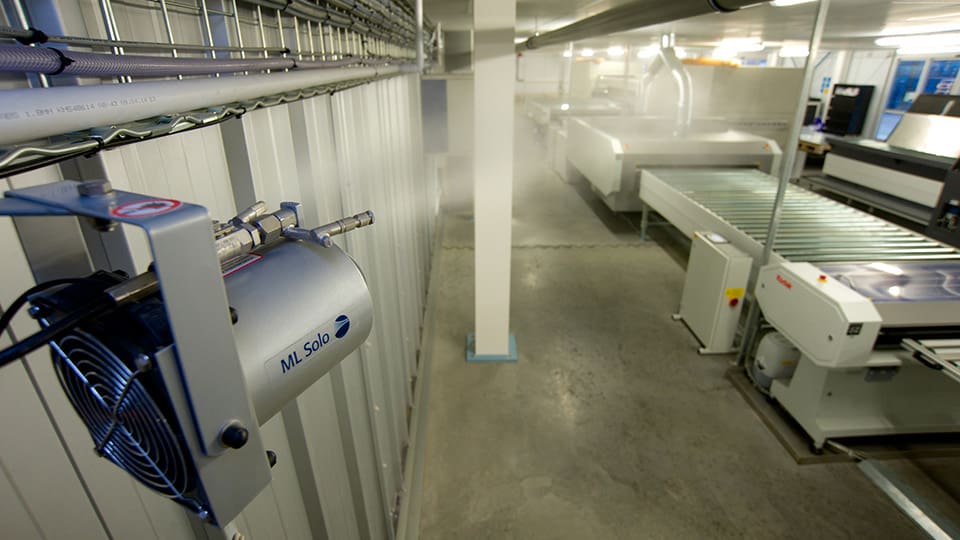
For smaller environments, he recommends a wall-mounted steam humidifier with a fan, such as the Condair EL, as these systems deliver between a few kilograms to 40kg of steam per hour.
In larger print facilities, Marshall-George says spray humidifiers are typically more effective. In addition to regulating humidity, they provide free evaporative cooling, which he sees as a valuable benefit in spaces where print equipment generates significant heat.
“Older industrial buildings used by printers often have inadequate ventilation, leading to issues like condensation, mould, and excessive moisture absorption by paper,” he explains, adding: “To address this, Condair also supplies a full range of dehumidifiers to help maintain optimal environmental conditions.”
Significantly Minimise Issues
Elsewhere and Rory Depree is marketing manager of the aptly named Humidity Solutions. For optimal printing and paper storage conditions, he says relative humidity should be kept between 50 to 60 to avoid various issues.
These problems may include paper misfeeds and creasing when dry air pulls moisture from the exposed surfaces of paper stacks, causing the edges to tighten and shrink. PSPS may also encounter size and alignment issues as changes in paper dimensions can affect how colours align in multi-colour print jobs, leading to misregistration and reduced print quality.
“By maintaining relative humidity within the recommended range, PSPs can significantly minimise these issues,” he says, adding: “This not only improves print quality but also reduces waste, increases production efficiency, and boosts overall profitability.
“Failing to invest in proper humidification can have a serious impact on printing performance and efficiency. While every printer aims to achieve top-quality results with minimal waste and high-speed output, these goals become much harder to reach without consistent humidity control.
Humidifiers come in various types, including steam, spray, evaporative, and ultrasonic systems
“Ignoring this technology means missing out on the opportunity to reduce waste, boost productivity, and ensure consistent print quality – day in, day out – by removing one of the key environmental variables printers face.”
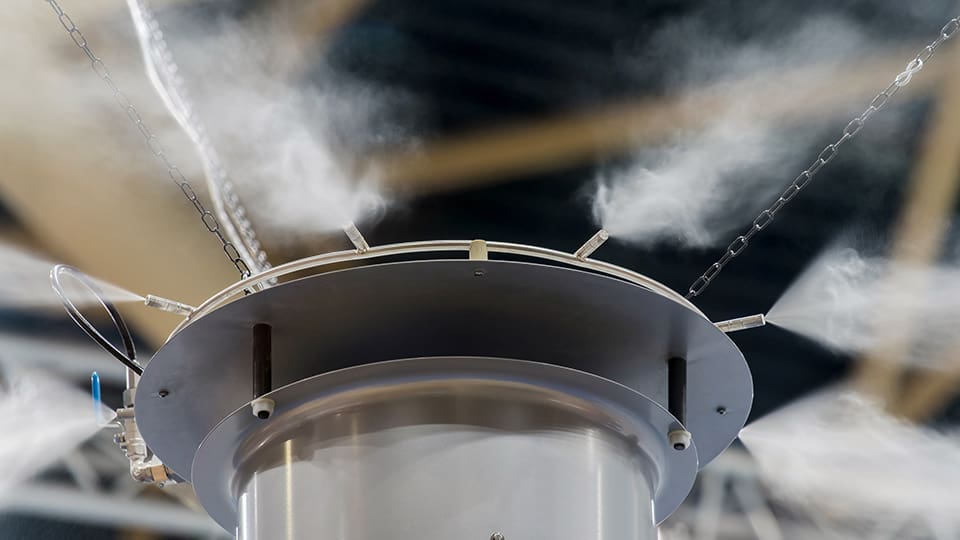
So, how can Humidity Solutions help? Depree says high-pressure water systems are popular with printers. This system uses a low-energy pump to pressurise water, producing an ultra-fine mist through atomising nozzles mounted at high levels or on wall-mounted delivery heads.
For environments where ceiling height is limited or where precise, low-maintenance humidity control is needed, Depree says evaporative systems, such as the Neptronic SKVF, are an alternative. While they do not produce a visible spray, he says they deliver the same benefits as high-pressure systems and can be suspended from the ceiling or positioned near critical zones, such as the feed end of a press.
Another option is to use high-performance fans to recirculate air through a moisture-laden matrix. This, Depree explains, allows moisture to evaporate into the air, offering targeted humidity control in key areas.
“Across the manufacturing sector, efficient humidity control plays a crucial role in curing adhesives, preserving material quality, enhancing a finish, and ultimately driving profitability in a highly competitive market”.
Return on Investment
Concluding our round-up is Bailey Hutt, marketing manager at Seal Pump. Hutt says without control over the humidity levels around the printing process, problems will occur within the printing process which can lead to costly machine downtime, breakdowns, and wasted materials such as ink and paper.
“Investing in a high-quality, high-pressure humidification system eliminates these issues, and while there is an obvious up-front cost to the system, the payback can be extremely quick,” Hutt says, adding: “Printers are a considerable investment so protecting that investment with a well-designed humidification system will help printers create the perfect environment for the print machines to run efficiently and with no issues.”
Investing in a high-quality, high-pressure humidification system eliminates these issues, and while there is an obvious up-front cost to the system, the payback can be extremely quick
With this, Hutt draws attention to Seal Pump’s partnership with Austrian company Merlin Technology. Hutt says a system such as its Merlin high-pressure humidification solution offers a “high-quality and reliable solution”, which ensures fully automatic control meaning little input for the operators and printers.
“Our systems give them the peace of mind that the environment will always be controlled to the correct humidity level,” Butt says, adding: “The Merlin systems also offer high hygienic operation, which is essential when creating such a finely atomised droplet. A great deal of thought has gone into every component that makes up the system to allow for peace of mind operation.”
On this, Hutt says Seal Pump’s systems can be used to control large print halls and smaller print or storage rooms all from one controller, with the system expandable should a user add other areas that need control. For example, the Viscore High Pressure controller can control up to four separate zones, while the larger Alpha system can control as many as 12 separate zones, which Hutt says is ideal for larger facilities who want to control each step of the process.
“Some of the latest developments we offer with these systems is remote monitoring of the humidly levels in each zone,” Hutt explains, adding: “At a time when running costs are in the front of people’s mind, Merlin’s high pressure water systems offer extremely low running costs, so the benefits are two fold, by accurately controlling the environment to the humidity level needed, and also greatly reducing running costs if replacing an old system or a steam system.”
The message is short and simple: failure to invest in quality humidification systems can cause all manner of issues for print companies. Connect with specialist providers, such as those in this feature, and you will find yourself gaining even further insight into the latest offerings available and how these can help you improve overall production.
From advances in print quality and productivity to increasing demand for automation and sustainable solutions, the wide-format market continues to evolve. Rob Fletcher looks at the latest trends, challenges, and developments in this sector
Speaking to a range of print and signage professionals, we discover how a sustainable business model can drive growth, outlining actionable strategies to cut overhead costs, improve eco-efficiency, and boost your bottom line
As finishing continues to become a great way to add extra elements to your print and wow customers, we take a look at some of the creasers, folders, and collators on the market, and ask experts their advice on finding the right solutions
(this was inserted into the PHP of a code block)
Watch our latest video of the week
Print Monthly gives you the latest video coverage of companies, people, and events from within the print industry.