An integral part of the finishing process for many printed applications, we take a closer look at creasing, folding, and collating, picking out some of the latest advancements within these sectors
Rob Fletcher
January 21, 2026
One of the stand-out trends in recent years has been the number of print service providers (PSPs) bringing finishing work in house. In previous years, printing companies would often outsource this work to specialist finishing houses, which, on one hand ensured high-quality finishes, but on the other caused delays in delivering work to customers and forced them to relinquish control over this part of production. However, in the modern market, most print businesses now run finishing in house, offering customers a complete service for their printed work. Among the most common techniques in finishing are creasing, folding, and collating, with plenty of affordable options available on the market.
Here, we cast an eye over some of the latest developments in these areas, speaking with manufacturers and suppliers about these solutions and how they can further strengthen a PSP’s in-house finishing offering.
Automation Perfection
First, Plockmatic Group offer finishing solutions through several brands under its umbrella including Morgana, Renz, and Intec. UK general manager, Ed Hudson says the latest high-quality folding, creasing, and collating solutions feature technology innovations to support more efficient production, aid operation, and reduce human touchpoints, with automation at the centre of these improvements.
“It helps streamline throughput, increase capacity, and eliminate errors. It can support a broader range of applications too,” Hudson explains, continuing: “Technology-rich solutions are also increasingly able to help tackle another industry pressure – a shortage of skills. Systems that are simple to run and designed for single person operation help reduce the pressure by allowing team members to move confidently from one system to another.
Technology-rich solutions are also increasingly able to help tackle another industry pressure – a shortage of skills
“Enhanced intelligent operation can aid with production efficiency and capacity while enabling faster order to completion. Planning can be streamlined and jobs scheduled efficiently.”
With run lengths getting shorter and turnaround times faster, Hudson says work needs to be completed as quickly and accurately as possible, and highly automated systems are well placed to ensure production capacity is maximised.
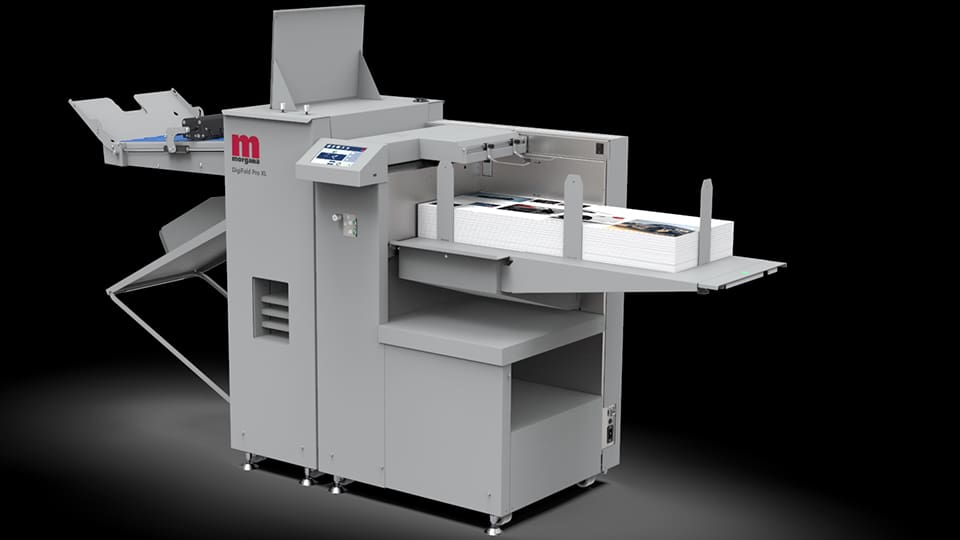
The Morgana DigiFold Pro XL is the latest addition to the DigiFold family at Plockmatic Group
On this, he offers some pointers as to what printers should be looking for in new solutions across creasing, folding, and collating. Among these are superior fold quality, with precision creasing technology preventing cracking on digitally printed or coated stocks, ensuring clean, professional folds even on heavy or sensitive materials.
High production efficiency and reduced labour costs should also be a must for printers, with automation playing a key part here, as well as accuracy and consistency, versatility across media types, seamless integration, and enhanced durability and reliability. Hudson also recommends user friendly operation, scalability for growing businesses and high return on investment.
Leading on from this, he picks out some of the options available through Plockmatic. Among these is the Morgana DigiFold Pro XL, the latest addition to the DigiFold family. This heavy-duty automatic creasing and folding system is designed to complement mid-to high-volume digital and offset production presses.
“The Morgana DigiFold Pro XL features a standard pull-out extension that enables sheet sizes up to 1,300mm,” Hudson says, continuing: “It opens doors to new applications, such as covers for landscape booklets, book covers for oversized perfect bound books, multi-panel brochures, and many other applications made from these long sheets.”
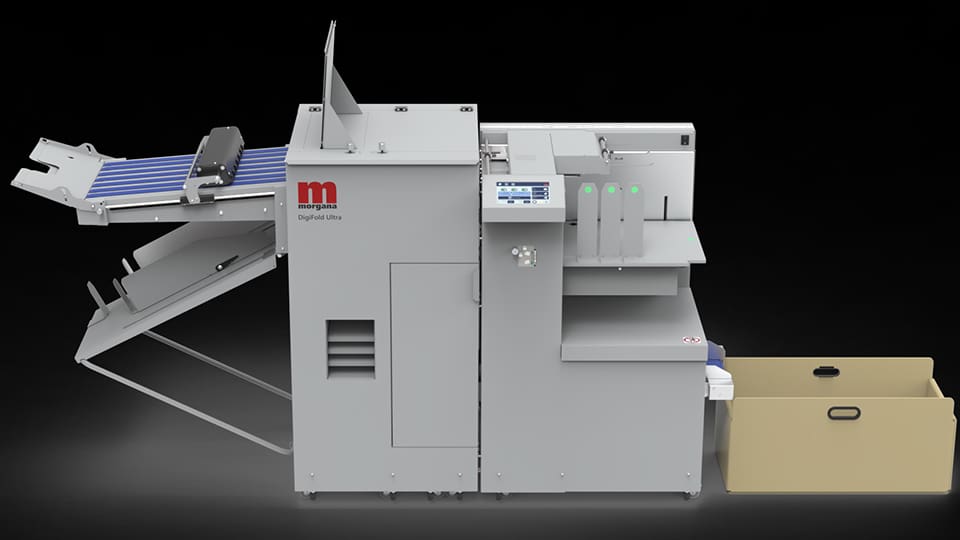
Another option is Morgana’s DigiFold Ultra, which Hudson says provides all-in-one finishing in one pass: slit, cut, crease, perforate, and fold in one pass. This, he adds, helps streamline post-press workflows and reduce manual handling.
Morgana’s DigiFold Ultra allows users to slit, cut, crease, perforate, and fold in one pass
“Robustly designed to complement mid- to high-volume digital and offset production presses, the DigiFold Ultra is versatile and has a compact footprint,” Hudson says, adding: “It builds on top of the capabilities of the DigiFold Pro XL by adding in slitting and cutting functionality for full-bleed trim applications.
“It can produce everything the DigiFold Pro XL can, but now with full bleed trim, in a single pass. High-quality applications such as full-bleed six- or eight-panel brochures become an easy task even for A4 landscape finished formats.”
Major Role in Productivity
Also in this sector is Duplo, whose head of sales for the UK, Craig Harry, says quality creasing, folding, and collating equipment protects work, improves accuracy, and ensures that the final piece looks as good as the customer expects.
“Even the best print can be ruined if the fold cracks or the creasing is inconsistent,” Harry says, continuing: “As run lengths get shorter and turnaround times get tighter, these systems also play a major role in productivity. When a single device can slit, cut, crease, perforate, and even fold in one pass, you remove handling and reduce labour.
Even the best print can be ruined if the fold cracks or the creasing is inconsistent
“Underinvesting in finishing equipment often creates hidden costs; manual steps increase the chances of mistakes, jobs take longer, and operators spend more time feeding, unloading or babysitting older machines. Bottlenecks may also appear, especially in busy environments where the finishing department is already under pressure, while labour shortages make this even worse because time spent on avoidable manual work slows everything down.
“The impact can be commercial as well as operational. A mis-folded brochure or cracked spine can lead to reprints and unhappy customers. It only takes a few quality issues to damage a printer’s reputation.”
So, what should PSPs be looking for when investing in new equipment in this sector? Harry says there several key features printers should demand, including the all-important area of automation. He recommends looking for systems with barcode-driven job recall, automatic setup, and direct integration with workflow tools like Fiery and Ultimate Impostrip – all of which reduce setup time, cut out touchpoints, and ensures every job is consistent.
Harry also says to keep an eye out for accuracy and features like registration mark scanning and image shift compensation, which ensure cuts, creases, and folds land precisely where they should, even if the printed image shifts slightly on the sheet.
Leading on from this, he says versatility is also critical, in that a strong finishing solution handles everything from small cards to long sheets, from lightweight digital stocks to thick and textured materials — and across multiple finishing tasks (slit, cut, crease, and fold) in one unit. Finally, ease of use and features like touchscreen interfaces, stored templates, and guided setup mean operators can run jobs with minimal training and fewer errors.
As to which solutions are proving most popular among Duplo customers, Harry picks out the DC range of multi finishers. He bills the DC-618 as ideal for smaller print rooms and provides automated cutting, creasing, perforating, and slitting in a single pass, while the DC-648 adds more speed and flexibility for higher volumes.
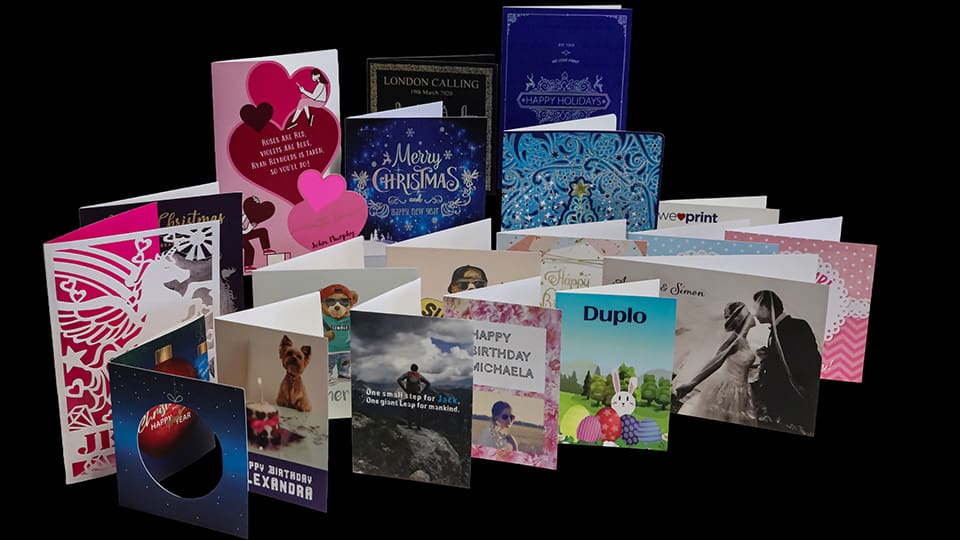
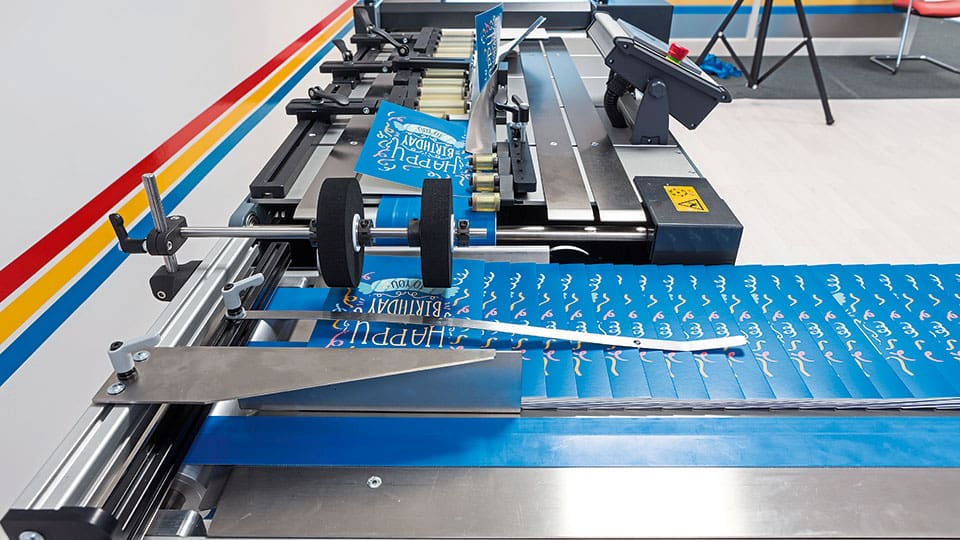
Greeting cards are among the products that require some form of folding after being printed
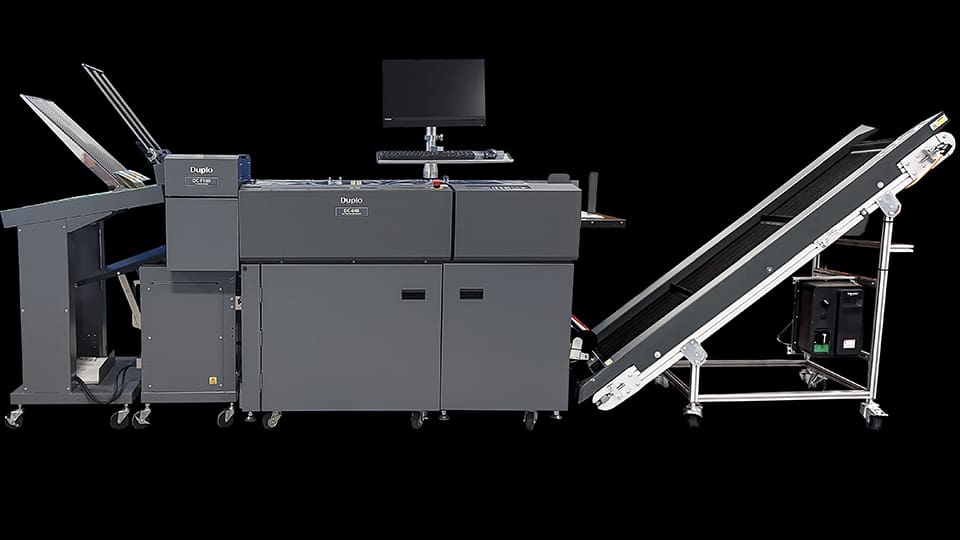
For more demanding environments, Harry says the DC-746 offers the highest throughput along with JDF connectivity for full workflow automation. Many customers are pairing these systems with the DC-F100 inline folder, which Harry says transforms what used to be a multi-step process into a single pass workflow, setting it up for work like greeting cards, menus, and brochures and removes the need for a standalone folder.
For operations that want to remove bottlenecks during stacking, Harry recommends the DC-ST100 stacker, which allows continuous production without operators having to stop and unload small piles every few minutes.
In addition, alongside Duplo’s own systems, the manufacturer offers the Multigraf Touchline range for printers that want dedicated creasing and folding performance or creasing and perforating.
“The range delivers high precision, strong automation, and reliable handling of a wide range of stocks and applications,” Harry says, adding: “The system uses Multigraf’s Swing Bar creasing and Pro Knife folding technologies, which protect the printed surface and give very clean results on digital and offset work.”
Maintain a Brand’s Integrity
Elsewhere and Paul Davidson, managing director of Encore Machinery, says high-quality creasing, folding, and collating equipment is essential for producing professional, high-quality printed products. He explains that using a high-quality creasing solution ensures fibres in the stock are compressed cleanly before folding, preventing cracking, splitting, or inconsistent folds.
“With accurate folding, it helps to maintain a brand’s integrity and ensures finished products have a premium finish,” he says, continuing: “Reliable equipment keeps workflows efficient, reducing touchpoints and manual handling.
“Bacciottini Pit Stop creasing and folding solutions are explicitly engineered for precision and consistency. Their automated set-up, controlled pressure systems, and blade-and-channel technology guarantee flawless creases on all types of digital and litho-printed stocks. Many printers and finishing houses choose Pit Stop machines as they combine high speed with exceptional accuracy, giving finished pieces a clean, crack-free, and professional appearance.”
Duplo’s DC-648 and DC-746 can be paired with the DC-F100 inline folder, transforming a multi-step process into a single pass workflow
Among the stand-out benefits of Bacciottini Pit Stop machines, are that the latest models offer high-speed creasing, perforating, and folding with automated set-up and deep customisation. Popular models include Pit Stop AFHS, Pit Stop FMHS, and the new Oxo creaser folder and butterfly three-fold unit, which Davidson says can give printers the ability to process thousands of sheets per hour with pinpoint accuracy.
“Their modular add-ons and ability to integrate into broader finishing workflows make them ideal solution for modern digital print environments,” Davidson says, adding: “The reliability, speed, and perfect crease quality have made them flagship choices for printers looking to upgrade their finishing departments.
“Their ability to handle a wide range of stocks — from lightweight paper to heavy laminated boards — makes them one of the most flexible options on the market. For any customer prioritising speed, accuracy, and simplicity, Pit Stop systems tick every box.”
Plockmatic Group counts Morgana, Intec, Renz, and KGS among its core printing finishing brands
Davidson added that as more printers gravitate toward automated creasing and folding systems that minimise manual intervention while delivering premium quality finishes, he says solutions that combine multiple finishing steps – such as creasing, perforating, and folding – in one pass are especially in demand.
“Pit Stop creasing and folding machines eliminate the risk of defects by delivering consistent, high-pressure creasing and folding at high speeds,” he says, continuing: “Their reliability dramatically reduces waste, reprints, and quality issues. Because they’re built for industrial durability, printers avoid unexpected failures and ongoing repair costs, common with cheaper alternatives. Investing in a Pit Stop is essentially investing in brand protection, customer satisfaction, and long-term profitability.”
Clearly, there are plenty of options available to printers in this sector. The running theme throughout the discussion was automation, with new machinery offering a whole host of automated features that not only improve the final finish by make life easier for whoever is operating the machine. Is it time you give your finishing department a boost with new investment?
From advances in print quality and productivity to increasing demand for automation and sustainable solutions, the wide-format market continues to evolve. Rob Fletcher looks at the latest trends, challenges, and developments in this sector
Speaking to a range of print and signage professionals, we discover how a sustainable business model can drive growth, outlining actionable strategies to cut overhead costs, improve eco-efficiency, and boost your bottom line
As finishing continues to become a great way to add extra elements to your print and wow customers, we take a look at some of the creasers, folders, and collators on the market, and ask experts their advice on finding the right solutions
(this was inserted into the PHP of a code block)
Watch our latest video of the week
Print Monthly gives you the latest video coverage of companies, people, and events from within the print industry.