Running the rule over new developments in the market, what are some of the latest toner-based machines available to the industry and how can they help print companies grow?
Rob Fletcher
July 10, 2024
To put it simply, equipment investment of any kind should be thought through and planned out properly, no matter how much money you are thinking of spending. While the old adage of “spend money to make money” is certainly true, you should ensure you are spending your money on the right sort of equipment to maximise the impact of your investment.
This is especially true when it comes to arguably the most crucial element of production: the actual press. With several technologies available to print service providers (PSPs), it is down to each company to establish which is best suited to their operation and the type of kit that will deliver the results they require.
With this in mind, Print Monthly focuses on the toner-based equipment market, speaking with several manufacturers to learn more about the technology and how their latest products can help users expand and grow in a competitive market.
High Versatility
Up first is Fujifilm, with Taro Aoki, head of digital press solutions at Fujifilm Europe, and Mark Lawn, head of POD solutions, Fujifilm Graphics Europe, both offering guidance on toner-based machines. Starting with the stand-out benefits of toner-based machines, both Aoki and Lawn say the obvious advantage is the “extremely” high level of versatility that toner technology provides. This, they say, includes the ability to print ultra-short, on-demand work, even down to run-of-one applications.
“Additionally, toner-based presses offer ease of operations, making them user-friendly and efficient for various printing tasks,” Aoki and Lawn say, adding: “Another notable benefit is the high quality of print they produce, ensuring crisp, vibrant, and professional results.
Toner-based presses offer ease of operation, making them user-friendly and efficient for various printing tasks
“Furthermore, the ability to print with special colours such as pink, metallics, white, and clear ink is yet another crucial benefit. This affords the opportunity to create a range of highly creative and visually striking applications and speciality prints. The choices of media and the versatility of media supported by toner-based presses further extend their appeal, accommodating a wide variety of substrates and expanding the scope of potential projects.”
So, what should PSPs be looking for when investing? Aoki and Lake say quality toner presses need to be able to deliver all of the aforementioned advantages and do so reliably. On this, they say PSPs should look for a machine with multiple special colour options, exceptional quality, and the versatility to print a huge range of applications on multiple substrates.
Moreover, they say PSPs should be encouraged to broaden their horizons by investing in a press that enables business growth and diversification. There is a somewhat straightforward choice; PSPs can either buy a regular four-colour press and run with the same limitations as everyone else or invest in a digital press with greater media capabilities and six channels with ten colours.
Fujifilm says its new Revoria Press GC12500 is the world’s first B2+ sized digital press using dry toner technology
“The latter option allows them to innovate, differentiate themselves from the competition, and explore new opportunities,” Aoki and Lake say.
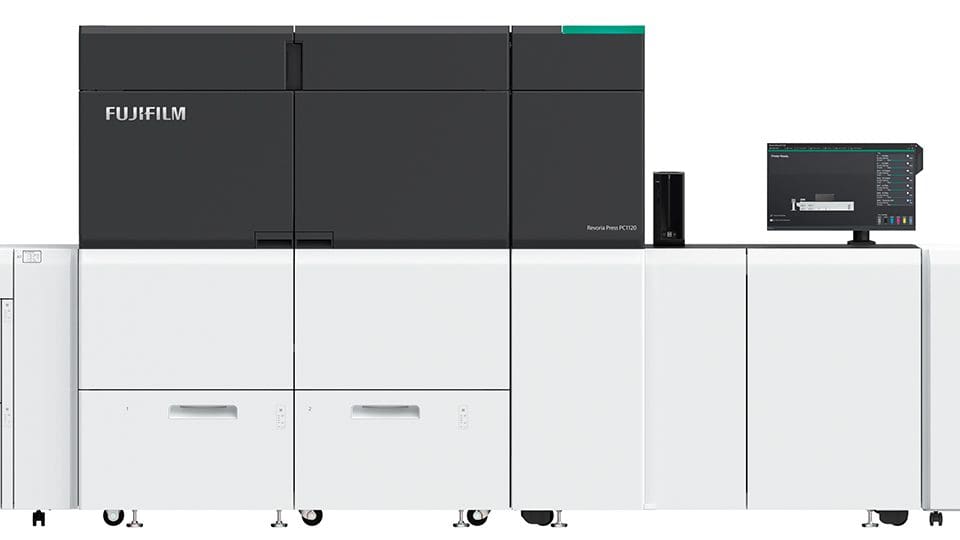
Expanding on this, Aoki and Lake go on to highlight some of the latest options available from Fujifilm. These include the Revoria Press PC1120, which has over 150 installations in Europe alone. The machine boasts six colour channels with speciality toners that can include white, gold, silver, clear, pink, and textured finishes. There is also the ability to configure the press to print one of each both before and after CMYK laydown, with an infinite number of creative possibilities.
“A significant feature of our toner-based presses is the incorporation of a static eliminator, which uniquely enables the printing of an extensive range of media, including plastic films,” Aoki and Lake say, adding: “This versatility opens up new opportunities for creative and high-impact applications. Additionally, our presses offer an expanded colour gamut, including special colours like pink, which allows for the largest printing gamut in the toner press industry.”
Fujifilm’s Revoria Press PC1120 has six colour channels with speciality toners that can include white, gold, silver, clear, pink, and textured finishes
Also from Fujifilm is the new Revoria Press GC12500, billed as the world’s first B2+ sized digital press using dry toner technology. Running at 2,500 duplex sheets per hour, Fujifilm says the device has the largest sheet size in its class at 750 x 662 mm and a segment-leading resolution of 2400 x 2400dpi. It also has a combination of unique and newly developed hardware and software technologies to optimise the B2XL print size and ensure consistent high quality and reliability.
“The B2+ format press represents the pinnacle of our toner innovation and is arguably the most ambitious challenger in the market, setting new standards for what toner-based presses can achieve,” Aoki and Lake comment.
Agility for Opportunities
Another player in this sector is Xerox. Kevin O’Donnell, head of marketing for graphic communications and production systems in the UK, Ireland and Nordics, says toner offers PSPs the tools and agility to address multiple application types and market opportunities.
“Xerox Digital toner presses have really come of age, a range of scalable highly automated and productive devices that provide users with excellent out of the box quality, support for a wide range of paper and substrates, as well as longer formats,” O’Donnell says.
“No press is an island. We believe the right press choice is important, but buyers should also look to the wider eco-system; this will support the broader business including infrastructure with service and support, workflow integration and automation, and marketing automation including e-commerce, variable content publishing, and omni-channel marketing.”
With this, O’Donnell offers advice for those in the market for a new toner-based machine. He says a new investment should have to pay its way by producing current work more efficiently and productively, but also look for new capabilities that attract new customers, new volume, and new profitable revenue.
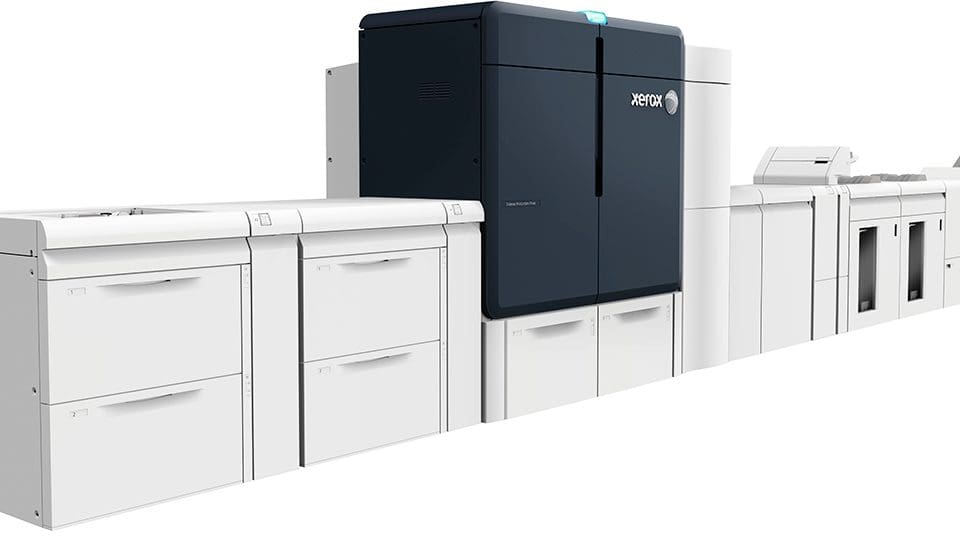
Xerox says its Iridesse model is one of the most popular digital presses in the market
“It used to be quality and price but most of today’s digital presses deliver market acceptable output, and a lower price alone may not reflect the best value for the PSP or their customer,” he explains, continuing: “So, in my mind buyers should be looking in two areas.”
The first of these, O’Donnell says, is automated operation. He explains Xerox presses have high levels of automation in their DNA, reducing manual intervention, that self-monitor and adjust colour and image consistency on the fly and drive benchmark productivity.
Secondly, O’Donnell recommends PSPs look for a platform for growth. In particular, he says to keep an eye out for a digital press that goes ‘BeyondCMYK’, not just additional colours such as gold, silver, white, and fluorescents, but also a range of capabilities such as wider paper and substrate support, smaller and larger formats, and finishing options.
Factoid: Both the Xerox Versant 280 and Xerox Iridesse feature BeyondCMYK capabilities, supporting up to 11 additional colours
“These may not be features you require today so make sure you have an upgrade path that protects your investment,” he says, adding: “An example could be a Xerox Versant 280 user running CMYK who can upgrade in the field to an adaptive kit supporting additional colours such as gold, silver, white, clear, and fluorescent, market opportunities change and you should have the ability to adapt with it.”
The Xerox Versant 280 is just one toner-based machine available from the manufacturer. As O’Donnell explains, Xerox has a portfolio of devices for the production space, starting with the Xerox Primelink through the Xerox Versant 280/4100, Xerox Iridesse, and Xerox iGen5.
“The Xerox Versant 280 and Xerox Iridesse are the most popular digital presses in the market being productive, highly automated, and feature-rich including BeyondCMYK capabilities supporting up to 11 additional colours,” he says.
Closing the Gap on Litho
Rounding off a hattrick of brands is Ricoh. Brad Hyde, business development manager of Ricoh UK Graphic Communications, says there are plenty of benefits of working with toner-based machines, from the cost of running to low maintenance requirements.
“Toner devices command much lower purchasing and running costs than their inkjet rivals,” Hyde says, continuing: “General maintenance tasks are also a factor when choosing toner over ink solutions, as toner devices have very little maintenance tasks to perform in comparison.
“Ease of use is another huge consideration, on devices like Ricoh’s C7500 and C9500, media setup and optimisation for all substrates has now been automated, including registration front to back within just ten sheets.”
During the past year, Ricoh launched the Pro C7500 five-colour engine and the flagship Pro C9500 model. Hyde says the C7500 provides the same quality as the C9500 and, being able to duplex a 960mm banner sheet in-line, has opened up new markets and new applications, such as upgraded single-pass white with four colours.
Ricoh has also been working with Fiery for a greater opportunity to control the use of neon toners and expand the colour gamut. In addition, users can now run heavier boards, which in turn, Hyde says, allows for access into the light packaging market coupled with the extra colour units available: white, clear, neon pink, neon yellow, gold, silver, and UV red.
The Pro C9500 is Ricoh’s latest flagship model
Taking a broader look at the market, Hyde says when in the market for new technology, the most sought-after factor is productivity. To facilitate this, he says PSPs need to consider ease of use and training, such as the new RGCOS (Ricoh Graphic Communication Operating System).
In addition to this, he says the front-end user interface makes the operator's life easier, which can then have a knock-on effect on productivity, something that is key in the high-volume toner market.
“The UK market has always demanded their digital output to be more ‘litho-like’; that true flat appearance that is sometimes described as the Holy Grail,” Hyde comments, adding: “That gap between litho and digital is smaller than ever now.
“Add to this the flexibility of what we can actually print onto in terms of both size and thickness, and you have something that you can sell to your customers that may otherwise need to be outsourced. “The technology in the field has been improved dramatically and continues to evolve at pace. This is where working with a trusted partner, such as Ricoh, for printing and digital service requirements provides real value.
“We understand that productivity is a huge factor with toner-based presses and invested expertise and time in developing industry leading technology to ensure printers can deliver high-quality services to their customers.”
Hyde’s closing comments offer a suitable conclusion to this discussion: investment in reliable toner-based machines from trusted and established suppliers will open all manner of new doors to the printer. Of course, this is by no means an easy decision, with many of the print industry’s leading manufacturers having a presence in the market and quality options on the table. However, by doing your research properly and speaking with brands about which machines are most suited to your business, you will soon identify the most effective investment options.
From advances in print quality and productivity to increasing demand for automation and sustainable solutions, the wide-format market continues to evolve. Rob Fletcher looks at the latest trends, challenges, and developments in this sector
Speaking to a range of print and signage professionals, we discover how a sustainable business model can drive growth, outlining actionable strategies to cut overhead costs, improve eco-efficiency, and boost your bottom line
As finishing continues to become a great way to add extra elements to your print and wow customers, we take a look at some of the creasers, folders, and collators on the market, and ask experts their advice on finding the right solutions
(this was inserted into the PHP of a code block)
Watch our latest video of the week
Print Monthly gives you the latest video coverage of companies, people, and events from within the print industry.