Taming the Ricoh Pro Z75 B2 Digital Press
Things have been a bit quiet since the late 2023 launch of Ricoh’s B2 inkjet press, but it turns out plenty has been going on behind the scenes. Michael Walker caught up with the newly trained ‘dragon’



Kodak holds the continuous feed inkjet speed prize with the PROSPER 7000 Turbo, capable of printing at up to 410m/min. Michael Walker looks at how that’s achieved and what else the press can do
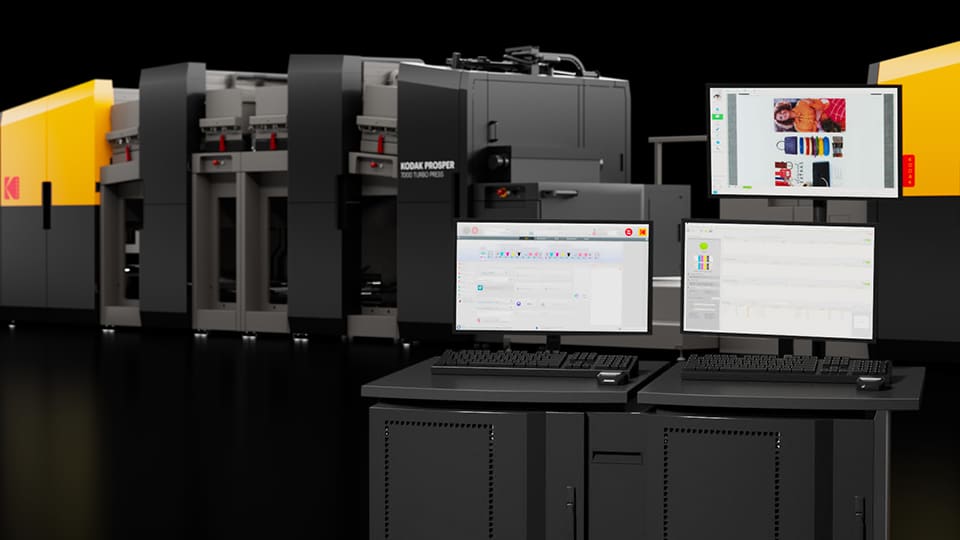
If there was a speed war among continuous feed inkjet press providers, Kodak won it decisively when it launched the PROSPER 7000 Turbo in mid-2022, a machine that can run at up to 410m/min across a printable width of 62cm. Most competitors run to 150 or 200m/min so the 7000 Turbo’s 5523 A4 pages per minute stands well clear with Kodak claiming it is 35% faster than the nearest alternative. It’s rated for over 200 million A4 pages per month and designed for 24/7 operation.
The press isn’t just intended to be run flat-out, though. Kodak stresses its flexibility, with three modes supported, trading speed for resolution and image quality. Slowest at a ‘mere’ 200m/min is the Quality mode, which prints at 600 x 900dpi and offers 175lpi-equivalent for halftone images; Performance mode gets you 600 x 600dpi and 133lpi-equivalent at 300m/min, while Turbo hits top speed by dropping resolution to 600 x 450dpi and line screen equivalent in the 85 to 100dpi range. Mode selection will depend not only on substrate type and desired quality but also coverage, with the slower modes supporting higher levels, as is usual with inkjet print.
Quite a variety of media is supported, from newsprint and recycled papers to specialist inkjet-coated types, and via Kodak’s own Optimax primers, silk and gloss coated papers, though maximum speed is restricted with the latter to 200m/min. Supported paper weights range from 45 to 270gsm. The aqueous Optimax primer can be applied inline to the press with a pre-coater unit, or applied offline/nearline, as suits. Kodak suggests that offline priming is more suitable for higher productivity. Optimax is designed to work with Kodak’s CMYK Ektacolor inks which were introduced in 2023.
Kodak claims a number of advantages for these inks, mostly driven by the requirements of printing so fast. Its pigment particles are milled to typically around 50nm diameter, which Kodak says is smaller than competitors’ and results in less light scatter, producing more intense colour from a thinner ink layer when dry.The achievable colour gamut exceeds US Gracol and SWOP standards for offset print, though no Fogra equivalent is quoted. The very small and even particle size, coupled with the Stream continuous inkjet printhead technology, also means that less humectant is required, reducing the energy requirement for drying the ink and the overall volume needed to achieve any given amount of coverage.
The Stream technology has been around for over a decade and is used in all other Kodak PROSPER presses and imprinting modules, bar the PROSPER Ultra 520 introduced at the same time as the 7000 Turbo, which uses Ultrastream, a more recent development. There are reportedly over 80 PROSPER installations around the world. Stream is a continuous flow design in which ink droplets are emitted constantly from every nozzle and deflected by airflow if they’re not needed on the substrate; deflected droplets are then recycled back into the ink system.
The advantages of this approach are that inks potentially drying and clogging less-used nozzles is avoided, allowing there to be less humectant in the ink, which benefits drying of the print. More spherical drops are produced with Stream printheads than by drop-on-demand inkjets, which produce teardrop-shaped droplets whose tails can smear when hitting fast-moving paper. This results in rounder printed dots which Kodak says brings a quality advantage; the difference is clear under the microscope, but you’d need to compare actual print samples to see how it manifests in normal viewing.
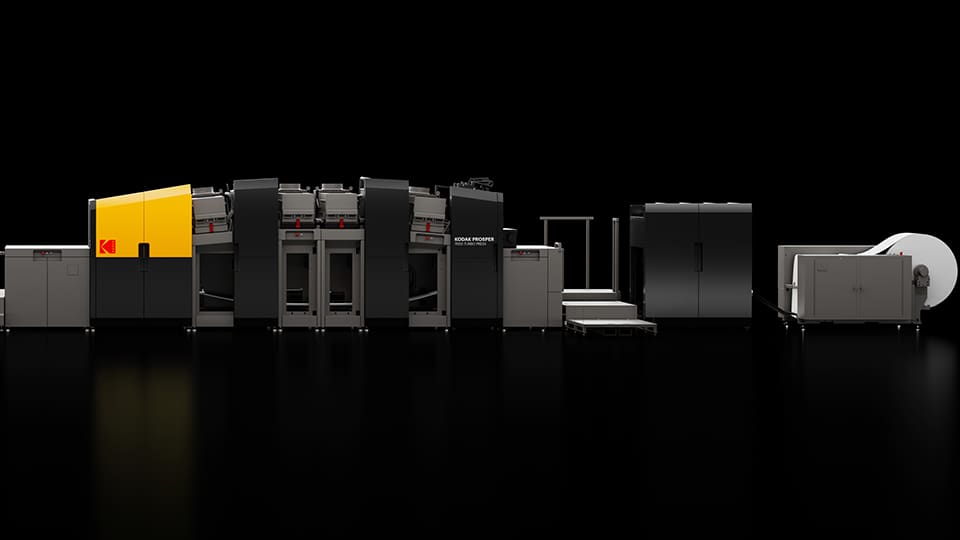
Whatever the ink dot shape, drying is a major consideration in high-speed inkjet printing. The PROSPER 7000 Turbo has eight NIR (near infra-red) dryers, one after each colour print station. There are four stations per side of the web and it’s worth noting that this allows for a choice of configurations of the press – all in a straight line, and L- or U-shapes with the banks of four stations at right angles or parallel respectively.
Kodak supplies the essential paper handling via an unwinder and rewinder. It says it’s open to third-party integration for inline finishing but notes that anything under consideration must be able to keep up with the press. Since it’s most likely that this machine will go into high-volume production environments which already have offline or nearline finishing capacity, it’s not a likely scenario.
Driving a press this fast with variable content requires some serious RIP horsepower too. The Kodak 800 Print Manager is based on the Adobe PDF Print Engine (APPE) and as well as handling regular PDF, accepts PDF/VT and a variety of other high speed print variable content formats found in the transactional print world, including PPML, IPDS, and AFP. Housed in three physical cabinets, it uses hardware acceleration to drive the press at full rated speed and is compliant with JDF/JMF and of course Kodak’s own Prinergy workflow offerings.
So how might you harness all this print power? Kodak suggests that the Quality mode produces ‘offset-class’ results for catalogues and direct mail, while Performance suits book and transactional work. The headline-grabbing Turbo mode more fully exploits the speeds of which the Stream technology is capable (up to 900m/min in some hybrid imprinting applications) to give fastest turnaround for work with ‘lower resolution and coverage requirements’, though examples of what this might be aren’t given. Kodak’s Josh Howard, senior director of Inkjet Research & Development, says that the 7000 Turbo is ideal for applications “where most volume is on uncoated stock, with the opportunity to move into coated paper on occasion”.
Statistics
Maximum Roll Width: 64.8cm, 62cm printable
Print Resolution: Up to 600 x 900dpi via 48 Kodak Stream continuous
Print Speed: Up to 410m/min in Turbo mode (5523 A4 ppm), 200m/min in Quality
Supported Media: Newsprint, uncoated, recycled, inkjet coated; silk and gloss with Optimax priming
Inks: Standard: rotary, direct, and pen; optional: oscillating, kiss-cut, and VeloTaper
Flexibility and lower running costs are said to be the strengths of the 7000 Turbo with Kodak claiming that it’s up to 20% cheaper to run than other inkjet systems. No detailed breakdown of this calculation was provided, but it seems reasonable to assume that some of this would come from the reduced operator labour-to-work ratio that a faster press brings, plus the benefits of the Ektacolor inks in terms of both volume consumed and reduced drying energy requirements.
So far, Kodak has publicised only one customer for the PROSPER 7000 Turbo, Mercury Print Productions, based in Rochester, New York, USA. Already a long-standing PROSPER site, which enabled significant growth in educational book printing, Mercury has sheet-fed and web offset, sheet-fed and web inkjet, sheet-fed toner, and wide-format inkjet printers. The addition of the 7000 Turbo has enabled the company to pursue longer run lengths than were previously feasible and opened up new business opportunities, according to chief executive officer, John Place.
If you’re hitting the limits with existing web inkjet or looking to consolidate work from toner and/or offset, then the PROSPER 7000 Turbo might be just the ticket. If you don’t need that absolute top speed, the PROSPER 6000 line is still available, offering the Quality and Performance modes via the same printhead and ink combination.