By its own admission, Epson was late to the DTF game, but now its first dedicated printer for transfer-based garment decoration is here and is aiming to provide the quality and reliability that users expect from Epson. Michael Walker unwraps the latest package
Michael Walker
December 12, 2025
Unlike some digital print technologies which start life as high-end, expensive offerings that eventually work their way down into the mainstream, direct-to-film (DTF) transfer printing for garment decoration grew from the bottom up, via a multitude of cheap and cheerful, and often home-brewed systems that offered a very appealing route into a growing market where decent margins could be made, supplementing more conventional print offerings.
This all came with a bit of a Wild West atmosphere, however, with variable quality and poor reliability being the consequence of low cost and jury-rigged equipment. But the explosive growth in uptake attracted the attention of the bigger brands in wide-format printing who had to decide whether this was just a passing fad or whether they should invest in their own product development to address it.
The announcements during 2023 of dedicated DTF machines from vendors such as Mimaki, Ricoh, Brother, InkTec, and Roland DG showed that the market was indeed being taken seriously. But the missing name was Epson, which was ironic as their print heads are favoured by many DTF printer builders, with stories circulating of far-eastern suppliers buying Epson’s other printers simply in order to extract the printheads to build into their own systems.
Epson was certainly more than aware of the gap in its textile-focused offering by the time of international textile show ITMA in mid-2023, and was working on its offering, but the official announcement of the SureColor G6000 didn’t come until the beginning of 2025, with commercial availability following a few months later.
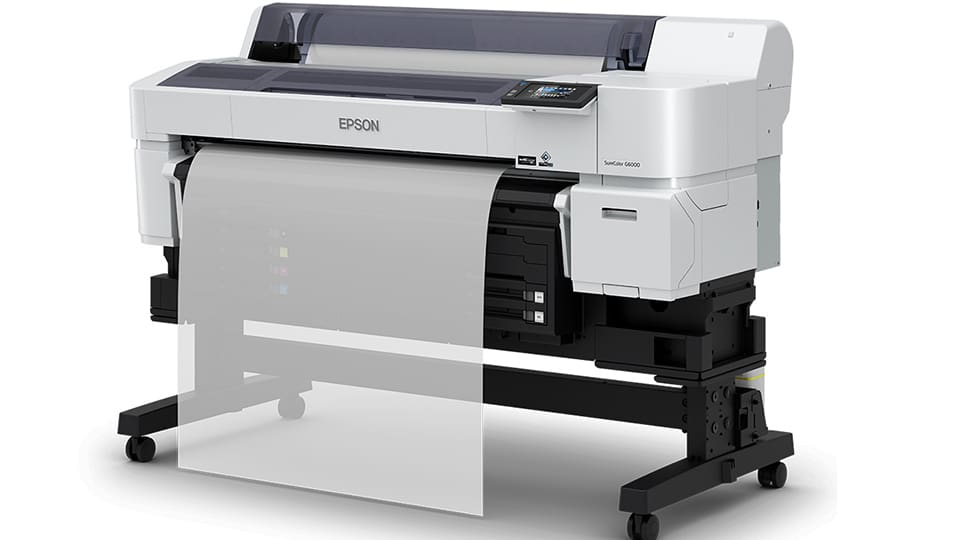
The SureColor G6000 is a roll-fed DTF printer for the print, garment, and signage sectors
According to Epson UK’s head of sales for Commercial & Industrial, Phil McMullin, there was a substantial pent-up demand for the Epson offering. “Forward orders have been huge,” he commented in a preview video for The Print Show, where the SureColor G6000 made its UK debut. Subsequent to the show, he commented: “We had a very busy show and around 40% of the leads we took were for the G6000.”
So, what is it that the punters are so keen to get their hands on?
The SureColor G6000 is a 900mm width roll-fed DTF printer which uses a single Epson PrecisionCore printhead to print Epson’s Ultrachrome DF inks in CMYK plus white onto transfer films. These then need to be processed through an adhesive powder coating unit before being heat pressed onto a wide range of fabric types. The UltraChrome inks are supplied in 1.6l containers and are GOTS-approved, and have Oeko-Tex Eco Passport certification and so are suitable for use on garments.
A recirculation system is built in for the white ink to avoid settling or clumping of the pigments, though a daily agitation of the ink bag is advised; the design of the printer enables the bags to lie horizontally rather than standing vertically, which should reduce the depth of any deposition that does occur. There is also an automated printhead wiping system to keep the heads clear and ready for use, while nozzle status electronics allow for detection and correction of any blockages during printing.
Feel the Width, and the Quality
The print width is wider than in many DTF printers, which typically offer 60 or 75cm, and this coupled with the ability to print to pretty well all of it (the data sheet specifies a 3mm margin at each side), should enable a decent level of productivity and minimal transfer film wastage. Though as ever, there’ll be some cutting out to do before individual items can be heat pressed onto garments, unlike vinyl transfers. With that said, there’s no weeding to do after pressing, which is one of the attractions of DTF.
Resolutions range from 300 x 600 to 600 x 1200dpi, but Epson is a bit reticent in providing performance figures, referring in this case to seven ‘levels’ that correspond to the various resolution options and number of passes. The machine provides values of 4.2 and 3.4 sqm/hr for levels four and five respectively, both running at 600 x 1200dpi and printing in bi-directional mode, but with different numbers of passes. These figures are for CMYK-plus-white printing, with the latter requiring a separate set of passes; they double for CMYK-only or white-only printing, so reaching 8.4sqm/hr in Level 4 mode.
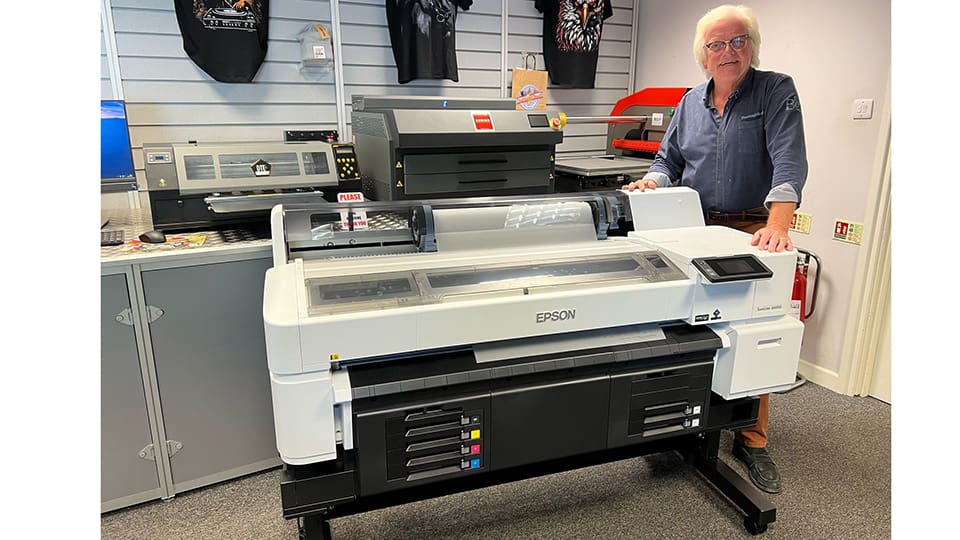
Whatever the numbers, raw print speed is only part of the DTF productivity equation, given the number of (usually) manual production stages that have to follow. The powder/shaking process can be automated, though, and Epson demonstrated the G6000 at The Print Show with an Adkins unit hooked up, though it doesn’t endorse any particular supplier and recommendations will be made via its resellers, such as The Magic Touch, which added the G6000 to its roster in the summer of 2025.
Whatever the numbers, raw print speed is only part of the DTF productivity equation, given the number of (usually) manual production stages that have to follow
Epson doesn’t make specific claims for the colour gamut achievable or the durability of finished pressed transfers, as there are too many variables in materials and process, though it does claim “crisp, stand-out imagery no matter what the fabric quality” in its product brochure.
The supplied software, Epson Edge Print Pro, aims to maximise the use of media, by nesting designs for output. It also offers settings for a range of output media and final textile types, covering caps, pockets, and shoes as well as the more typical t-shirts and tote bags. Epson’s 2024 acquisition of Fiery brought with it the Digital Factory textile pre-press software, which is available as an optional extra for the G6000.
The Magic Touch was annouced as a G6000 reseller in July, 2025
This provides pre-flighting capabilities, colour profiling tools, and step-and-repeat artwork generation, plus sophisticated controls for white ink generation and rendering of vignettes and other options that optimise image quality plus ink and media use, while also enabling aesthetic treatments such as very coarse resolution ‘mesh’ screening for ‘vintage’ effects.
Epson makes both the inks and the printheads for the SureColor G6000 so should be able to achieve the optimum performance in terms of both finished print quality and reliable operation. Epson’s Customer Experience Centre lead Alex Matravers says: “The aim is for confident eight-hour working”. While it’s true that you can get a DTF printer for well under half of the G6000’s price tag of around £9,500 (plus VAT), lost time, wasted materials, and energy, plus dissatisfied customers can very quickly erode that difference.
It’s clear from The Print Show that many prospective users preferred to wait for Epson reliability – or found the hard way that they didn’t have it – so if you want the security of a brand that you already know and trust, look no further.
Statistics
Maximum Roll Width: 900mm Resolution: Up to 600 x 1200dpi Speed: 1.9 to 17 sqm/hr, depending on quality and number of colours Ink Type: Epson UltraChrome DF Colour set: CMYK plus white
Michael Walker is a trade journalist, technical writer, and editor with over 37 years’ experience in the print, prepress, photography, and digital imaging sectors, with a particular interest in the digital transformation of processes. In addition to editing Desktop Publishing Today and Digital Printer magazines, he is co-author with Neil Barstow of Getting Colour Right (Ilex Press, 2004) and Practical Colour Management for Photographers and Digital Image Makers (2009, self-published e-book) and winner of a Communicators in Business Gold Award.
Cutting and creasing are key finishing operations in all kinds of print, but shorter runs mean that flexibility and automation are as important for overall throughput as raw speed. Michael Walker sizes up Plockmatic’s latest flagship model that brings it all together
Things have been a bit quiet since the late 2023 launch of Ricoh’s B2 inkjet press, but it turns out plenty has been going on behind the scenes. Michael Walker caught up with the newly trained ‘dragon’
UV DTF presents a new option for object decoration, making stickers that can be used on the irregular and hard-to-get-to surfaces that desktop UV and cylinder printers can’t reach. Michael Walker gets stuck in with Mimaki’s new offering in this sector
(this was inserted into the PHP of a code block)
Watch our latest video of the week
Print Monthly gives you the latest video coverage of companies, people, and events from within the print industry.