Understanding Fujifilm’s Water-Based UV LED Printer
Fujifilm and Mutoh announced earlier this year versions of what is essentially the same machine, a 1.6m
water-based UV printer, claiming to offer the best of both ink worlds. Michael Walker dives into the details
Michael Walker
September 17, 2025
It’s not often that a genuinely new contender enters the field of wide-format inkjet inks. Most of the stalwarts – eco-solvent, UV, even latex – have been around for a decade or more, and some of them for over three. Resin inks appeared with printers from Mutoh in 2018, followed by Epson in 2020 and Roland in 2023, but these water-based inks so far seem to have remained something of a niche offering alongside more established alternatives.
This year, Fujifilm hopes to have found the holy grail in the form of AQUAFUZE, a water-based UV-curable ink that aims to combine the best characteristics of both ink types and the downsides of neither. To recap those advantages, aqueous inks are ‘greener’, containing fewer hazardous chemicals, particularly volatile organic compounds (VOCs), and thus expand the range of applications to places like schools and hospitals. UV-cured inks stick well to most substrates without special priming, have good light and scratch/scuff resistance and perhaps most importantly, emerge from the printer immediately ready for finishing or further processing.
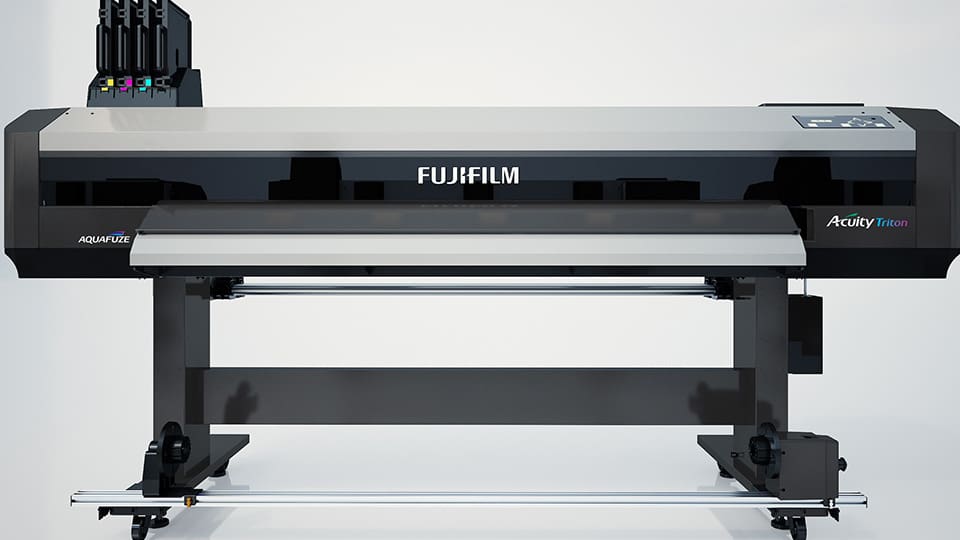
The Acuity Triton was launched at this year’s FESPA Global Print Expo in Berlin
The downsides are that the water has to be driven off in aqueous printing (resin and latex) and this can entail temperatures that rule out using some heat-sensitive substrate types. Some materials also have to be primed or pre-treated in order for aqueous inks to behave correctly on contact, without smearing or soaking in. The finished print also tends to be more fragile in respect of scuffs and scratches. Meanwhile, UV inks contain chemical components that are skin irritants and can still emit VOCs after curing, making them unsuitable for close-range indoor environments. The pile height of the ink, which when cured essentially forms a plastic layer on top of the substrate, can also make lamination more difficult, producing silvering effects around type or other elements surrounding unprinted areas.
Give Out the Good, Leave Out the Bad
Fujifilm says it has been working on developing the ‘ultimate’ ink since around 2014. According to Michael Bush, marketing communications manager at Fujifilm Speciality Ink Systems, based in Broadstairs, Kent, the aim was to offer an ink that would be “smooth and durable across all substrates, safe to use, and ready to finish straight away”. He notes that Fujifilm’s expertise in single-pass aqueous ink technology, as used in the JetPress sheet-fed (and more recently continuous-feed) inkjet presses, and UV inks developed for Inca Digital before its acquisition by Agfa, coupled with the parent company’s expertise in polymer chemistry and novel material manufacturing, provided a portfolio of high-end technologies that could be brought to bear.
The result is the AQUAFUZE inks, which were previewed at drupa in 2024, and first launched by Mutoh, together with the Hydraton 1642 printer. AQUAFUZE was announced in February 2025 and shown at FESPA in May, where Fujifilm unveiled its version of the printer, the Acuity Triton.
Both versions of the printer are built on a standard 1.6m chassis built by Mutoh, supporting CMYK inks that come in one-litre cartridges and offering print resolutions up to 1200 x 2400dpi, and throughput of up to 17m2/hr, though production mode at 1200 x 1200dpi is quoted at 12m2/hr. Drop size is operator selectable, from 3.4 to 10.6pl, allowing a further quality-versus-speed trade-off. Both Mutoh and Fujifilm versions are supplied with Mutoh’s VerteLith RIP software.
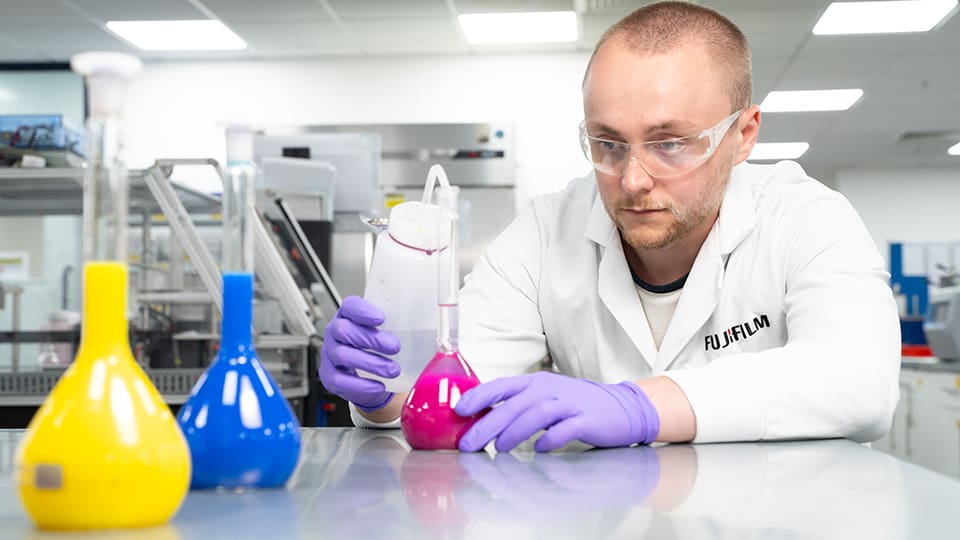
Fujfilm has developed AQUAFUZE as a new water-based ink technology
While the raw print speeds aren’t breathtaking, the point of this printer is what else you don’t have to do after you’ve printed. You don’t have to wait hours for outgassing as you would with eco-solvent. Depending on the application, you might not have to laminate for certain jobs, as the ink is said to demonstrate good scratch and scuff resistance, and if you do, the low pile height means that cold lamination with lighter less adhesive-heavy materials should typically be possible, saving both costs and energy.
Applications include all the usual roll-media options, but also extend to vehicle wrapping, as the ink has the elasticity needed and can print directly onto suitable media without requiring a laminate structure. It’s also good for polyester mesh printing in soft signage or display applications, something that Gareth Newman, technical applications manager at Fujifilm distributor, Soyang, points out is usually only an option for much larger and more expensive printers.
The pile height is nearly non-existent, you can’t feel where it is on vinyl, and it’s nearly as soft as unprinted fabric on textile
Once the AQUAFUZE inks are laid down, the print is first dried, then the ink cured via UV LEDs, with media temperatures reaching only around 50 to 60°C. This not only increases the range of substrates than can be printed but reduces energy consumption compared to other water-based alternatives. The ink is described by Fujifilm as ‘low VOC, low odour’ and appropriate for use in a normal ventilated print shop environment, and prints come out dry and immediately ready for further processing as needed. The inks are Greenguard Gold certified and have various other European safety certifications, making them suitable for applications such as wallpaper, where Newman notes that the lower drying temperature avoids the media stretch that other aqueous technologies can exhibit.
Print quality is said to be similar to conventional UV, but with the benefit of a smoother, lower build in printed areas. Newman says: “The pile height is nearly non-existent, you can’t feel where it is on vinyl, and it’s nearly as soft as unprinted fabric on textile.” He also says it works very well for backlit display applications.
So, has Fujifilm found (or made) the holy grail? Bush thinks the new ink and printer combination is a game-changer in that it “changes what people can do, [covering] the full range of applications”, though he also notes that it’s the first generation, implying that the technology will be extended to other – presumably larger and faster – printers.
The Acuity Triton launch at FESPA was supported by The Vinyl Guys, whose reported end-customer endorsements of quality and application flexibility feature in the Fujifilm product brochure, while Newman reports good interest with several sales of the Fujifilm machine in the pipeline.
If getting print into finishing has been a bottleneck, or you’ve been restricted on substates with water-based printing, you could certainly do worse than checking it out for yourself.
Statistics
Maximum Roll Width/Weight: 1625mm (1615mm printable), 30kgi Resolution: Up to 1200 x 2400dpi Speed: Up to 17 m2/hr (draft mode 1200 x 600dpi; 12 m2/hr in 1200 x 1200dpi production mode) Ink Type/Media Compatibility: AQUAFUZE aqueous UV-LED; wide range of roll media Colour Set: CMYK
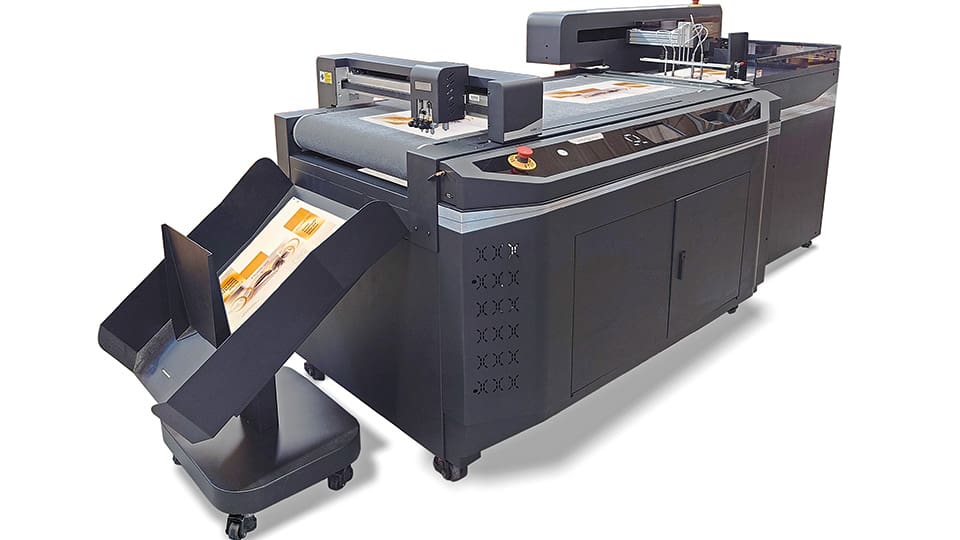
Cutting and creasing are key finishing operations in all kinds of print, but shorter runs mean that flexibility and automation are as important for overall throughput as raw speed. Michael Walker sizes up Plockmatic’s latest flagship model that brings it all together
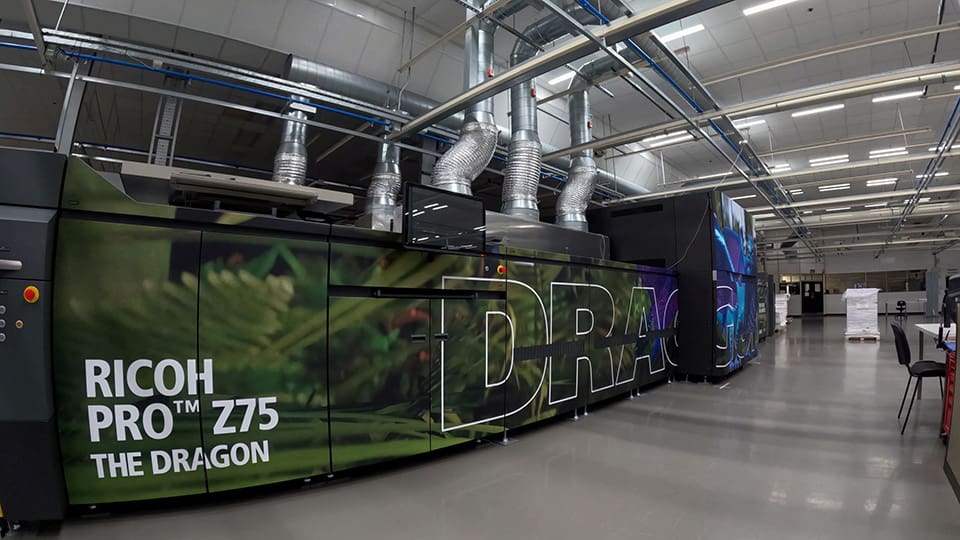
Things have been a bit quiet since the late 2023 launch of Ricoh’s B2 inkjet press, but it turns out plenty has been going on behind the scenes. Michael Walker caught up with the newly trained ‘dragon’
UV DTF presents a new option for object decoration, making stickers that can be used on the irregular and hard-to-get-to surfaces that desktop UV and cylinder printers can’t reach. Michael Walker gets stuck in with Mimaki’s new offering in this sector
(this was inserted into the PHP of a code block)
Watch our latest video of the week
Print Monthly gives you the latest video coverage of companies, people, and events from within the print industry.