Things have been a bit quiet since the late 2023 launch of Ricoh’s B2 inkjet press, but it turns out plenty has been going on behind the scenes. Michael Walker caught up with the newly trained ‘dragon’
Michael Walker
July 29, 2026
The Pro Z75 is supplied with a Fiery FS500 Pro digital front end incorporating an APPE 5 RIP
B2 digital print is an odd segment in that several vendors have made attempts to introduce sheet-fed inkjet machines in the popular offset format, but few have succeeded or stuck with it. An early entrant was Screen’s Truepress JetSX announced at drupa 2008, but quietly dropped a few years later. Canon showed a prototype at drupa 2016 code-named Voyager but that too was withdrawn on the grounds of not being ‘commercially viable’. Fujifilm did bring its non-duplexing JetPress to market and sold several hundred, both in the original 720mm sheet length and the subsequent 750mm incarnations, but earlier this year dropped it.
Konica Minolta announced its KM-1 UV curing B2 press in 2012 and has also sold several hundred around the world since 2015, with subsequent refinements and name changes appearing at intervals.
At drupa 2024, Fujifilm announced a B2 toner press in its Revoria line while Canon also announced another go at B2 inkjet in 2024 and stated at the end of 2025 that the VarioPress iV7 would be available from the second quarter of 2026. Meanwhile, the B2 digital space is dominated by HP Indigo, which has been successfully selling its ElectroInk presses in this format for a good decade or more, since the introduction of the Indigo 10000.
Tim Carter, director at Ricoh UK
Which brings us to Ricoh. After dropping broad hints for some time, the company revealed the name of its B2 ‘dragon’ inkjet, the Pro Z75, back in 2020, releasing a more detailed specification in 2021, followed by an official launch in late 2023 naming a US beta site, quickly followed by two European customers in the following months. Since then it’s been a bit quiet on the publicity front, but speaking to Tim Carter, director at Ricoh UK, it’s clear that plenty of work has been going on, addressing a number of challenges that real-world use of a new press of any kind can present.
Carter admits that some of these challenges hadn’t been anticipated, particularly around drying of sheets ready for duplex printing, but is emphatic that the press is now stable and reliable.
Ready to Roar
What then does a Ricoh Pro Z75 offer? Starting from the format, it’s an oversize B2 with a maximum sheet size of 585 x 750mm (571 x 735mm printable) that suits certain impositions, book formats, and types of step-and-repeat work better than regular B2. The press is rated for 4500sph simplex, half that duplex on materials up to 310gsm, slowing to 3000sph simplex/1500sph duplex on materials up to 400gsm; Carter notes that some heavier materials can be handled, but the thickness of the media is the deciding factor at this end of the scale, with up to 600 micron being the upper limit. The lightest compatible stock is 60gsm simplex or 80gsm duplex.
Carter explains that that the press was designed to achieve as flat a paper path as possible from air-assisted and vacuum-picked sheet input to stacked output. Ricoh developed its own chassis for the Pro Z75 rather than adapting an existing offset one, but sought advice from its partner HEIDELBERG throughout, hence the press uses gripper-to-gripper feeding for wrapping round the imaging drum and reversing for duplexing. Ricoh also offers HEIDELBERG’s pallet feeder which it says is the best available. Standard input is via a vacuum feed 5000-sheet unit with an option for a second one.
The colour gamut achievable is larger than that of offset equivalents and while Ricoh hasn’t formally measured it yet, user reports suggest that this makes it easier to hit certain otherwise problematic brand colours
The paper feed system is combined with a scaled-up version of Ricoh’s swing and shift front-to-back registration system developed for the company’s 9200/9500 series of sheetfed toner presses. Ricoh doesn’t quote specific figures for accuracy here, but Carter says they are well within the tolerances that would be expected for a commercial offset press of this size.
The press delivers a resolution of 1200 x 1200dpi with two bits per drop, delivered by Ricoh’s own v5.5 printheads. These allow three drop sizes which improve subtle gradations in colour as well as supporting very fine detail in type and line graphics. The inks are pigment water-based types and printhead life is said by Carter to be of the order of three to five years, depending on usage. The Pro Z75 is rated for a monthly duty cycle of 1.7 million B2 impressions.
The press works with offset uncoated, coated, and inkjet-treated stocks. Ricoh doesn’t mandate priming for any of these, as the inks will work with all of them, but Carter reports that all dozen or so user sites – bar one that is focused solely on packaging – have taken the option to have an inline primer unit as this increases flexibility, particularly enabling more colour lift on uncoated stock. As is common with pigment-based inkjet, the colour gamut achievable is larger than that of offset equivalents and while Ricoh hasn’t formally measured it yet, user reports suggest that this makes it easier to hit certain otherwise problematic brand colours.
Room to Spare
Perhaps of greater interest for the future is the fact that the printhead arrays feature two ‘spare’ channels alongside the CMYK ones. While nothing has been formally announced, Carter suggests that these might be adapted for additional primary colour or embellishment purposes, such as spot UV, enhancing the flexibility of the press, particularly in packaging applications.
One of the early challenges Carter alluded to was drying. With the typically high coverage levels that come with high-quality work, getting the system to dry water-based ink rapidly enough without shrinking or cockling sheets that were about to be turned and printed on the reverse turned out to be more difficult than anticipated, but he says this has been overcome via a hybrid drying system that combines hot air, near infra-red (NIR), and UV techniques.
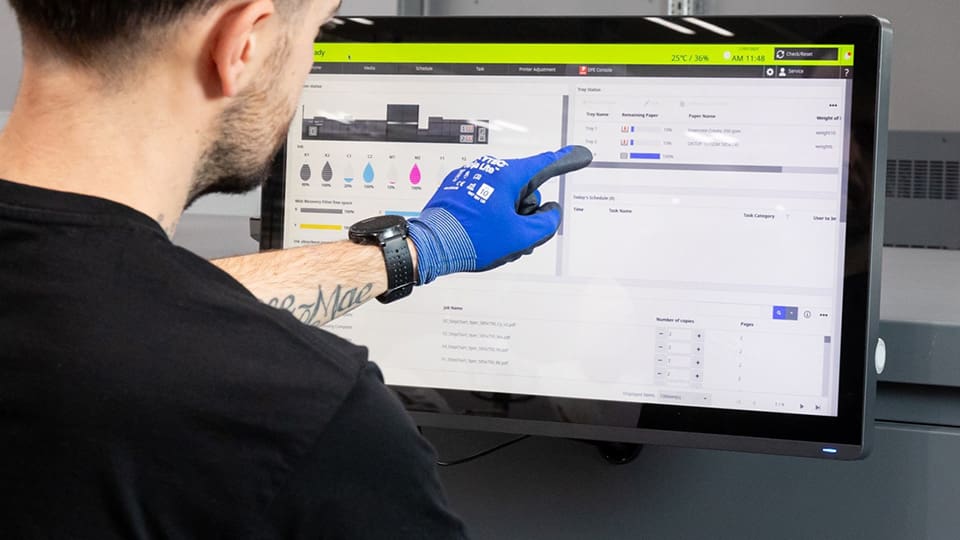
The Pro Z75 is supplied with a Fiery FS500 Pro digital front end incorporating an APPE 5 RIP, and capable of keeping up with the engine speed and accepting all the main graphic arts file input formats, including PDF/VT as well as various PDF/X standards. This can be integrated with Ricoh’s various workflow offerings, such as Process Director and the Ricoh Auto Color Adjuster profiling device for matching colour to existing workflows.
After a little time finding its feet in the real world, it looks like the Pro Z75 is now a serious contender. Carter notes: “It took massive resource and commitment to get to where we are now. Ricoh is in this for the long term.” He adds: “We are a lot more confident about the value proposition, ROI calculation and ability of migrate offset volumes to digital.”
Statistics
Press Format: B2+ 585 x 750mm Ink Type: Water-based CMYK pigment inks Print Resolution: 1,200 x 1,200dpi Speed: Up to 4,500sph simplex, 2,250sph duplex Media Types: Offset coated, uncoated, and digital media to 400gsm
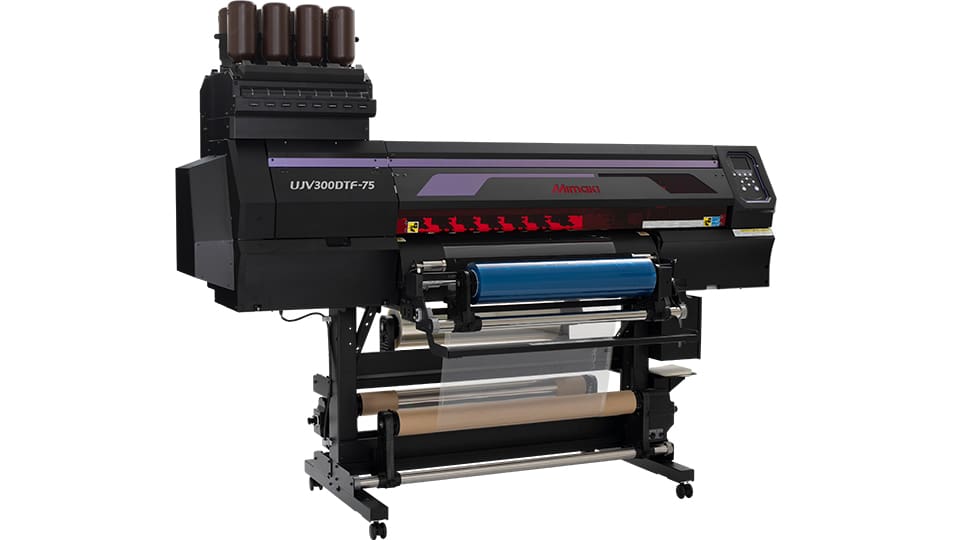
UV DTF presents a new option for object decoration, making stickers that can be used on the irregular and hard-to-get-to surfaces that desktop UV and cylinder printers can’t reach. Michael Walker gets stuck in with Mimaki’s new offering in this sector
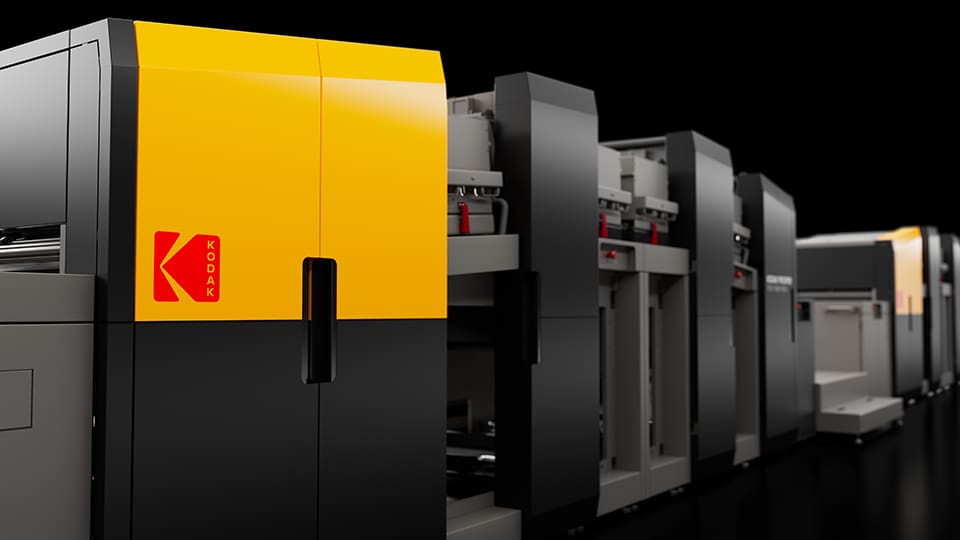
Kodak holds the continuous feed inkjet speed prize with the PROSPER 7000 Turbo, capable of printing at up to 410m/min. Michael Walker looks at how that’s achieved and what else the press can do
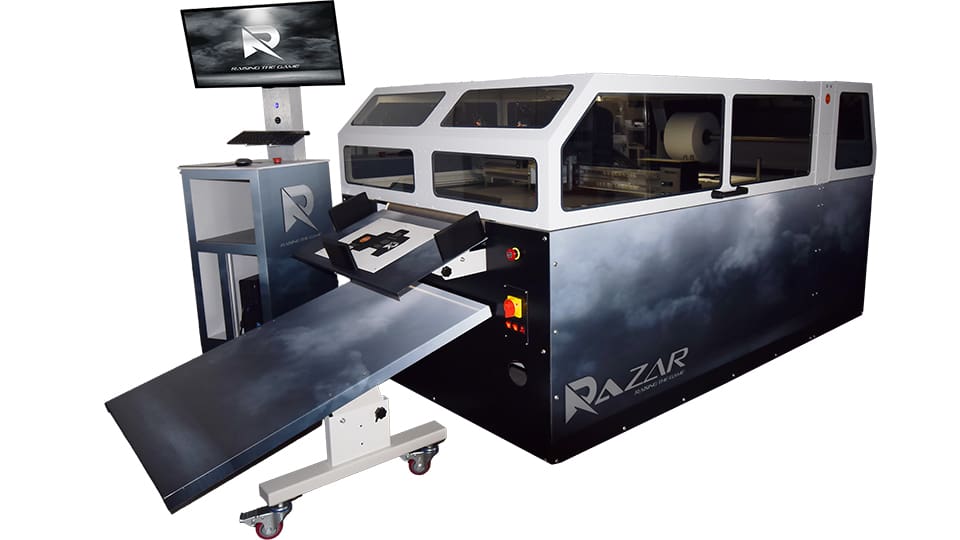
Putting digital spot UV printing in the same box as flatbed cutting and creasing is one of those ideas that seems obvious in retrospect, but Vivid thought of it first. Michael Walker traces the
path from holiday inspiration to trade show launch
(this was inserted into the PHP of a code block)
Watch our latest video of the week
Print Monthly gives you the latest video coverage of companies, people, and events from within the print industry.