HP has added a compact new model capable of printing to rigid substrates to its Latex line-up, aiming to give smaller print shops a ‘do everything’ machine. Michael Walker takes a look
Michael Walker
July 16, 2025
HP’s water-based Latex ink has been around for quite a while now and can certainly claim to be a tried, tested, and proven inkjet printing technology. The first models were announced at drupa 2008 and the 15-year anniversary was reached in 2023. During that time, both the inks and printers have evolved, with the ink reaching a fourth generation in 2022, adding what HP describes as a non-yellowing white and requiring lower temperatures to dry, which both expanded the range of printable substrates to more heat-sensitive types, and reduced the overall energy requirement. Latex also allows the texture of the substrate to show through, in a way that UV doesn’t. This can suit some applications very well, like printing on wood, increasing the visual appeal – and potentially the profit margin – of this kind of work.
The vast majority of HP’s Latex line have been roll-fed printers, typically occupying the smaller end of the wide-format width range (though there are 3.2m models) and suitable for a variety of flexible substrates, where they compete with solvent, resin, and UV machines. HP has always stressed the environmental benefits of its ink, being free of both VOCs and UV photo-initiators, and thus suitable for some applications that UV in particular can’t be used for. For a while, the company also pushed Latex as a suitable technology for fabric and textile printing, before admitting that dye sublimation was a better option, with the introduction in 2019 of its Stitch line.
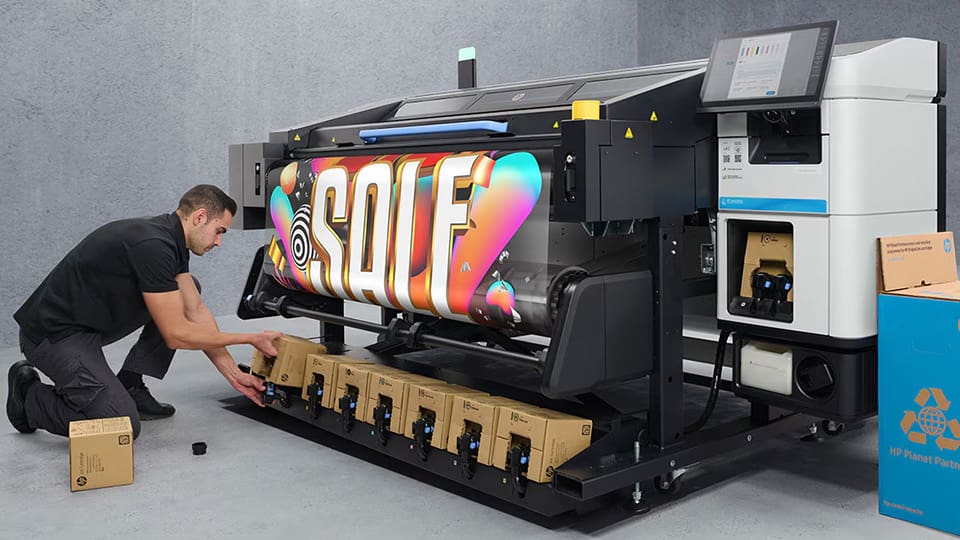
HP inks come in recyclable packing and can be returned for re-use
What HP didn’t offer was a true flatbed Latex printer, but to address the occasional requirement for printing directly onto rigid materials without having to print then laminate, it introduced in 2018 the R2000, a 2.5m width hybrid Latex printer that allowed the printing of rigid display boards by adding tables in front of and behind what is still essentially a roll-fed printer, albeit with an adapted feed mechanism for rigid and heavier substrates. This model was swiftly joined by the narrower 1.6m R1000 later the same year; both were updated in 2020 and the refreshed ‘Plus’ models would probably have debuted at FESPA and/or drupa that year had the Covid-19 pandemic not prevented both shows. HP’s rigid printer portfolio rested there, until March of this year, when the R530 was announced.
New Kid on the Block
The new machine is aimed at small-to-medium sized print shops and although it still offers a 1.6m printable width, it has a more compact design at 2.6 x 1.7m without tables, growing to a depth of 3.2m with the tables deployed. For comparison, the R1000, which is still available, is over 4m wide and 2m deep in roll-only guise, growing to 3.6m front to back with the tables for rigid media attached. The R530 also runs off a single-phase power supply, which will simplify installation in smaller businesses.
The printer’s ten printheads support resolutions up to 1200 x 600dpi and allow for standard CMYK, light cyan, and light magenta, two white channels plus HP Latex Optimiser (a primer for certain tricky substrates) and HP Latex Overcoat for scratch and scuff resistance without needing post-print lamination. All inks are UL Ecologo certified in terms of human health and environmental impacts and are supplied in 3l cartridges. Automated white ink recirculation and printhead cleaning are intended to increase uptime and reduce maintenance costs. The cartridges are returnable for re-use and the printer itself uses 25% recycled plastic in the appropriate places.
Automated white ink recirculation and printhead cleaning are intended to increase uptime and reduce maintenance costs
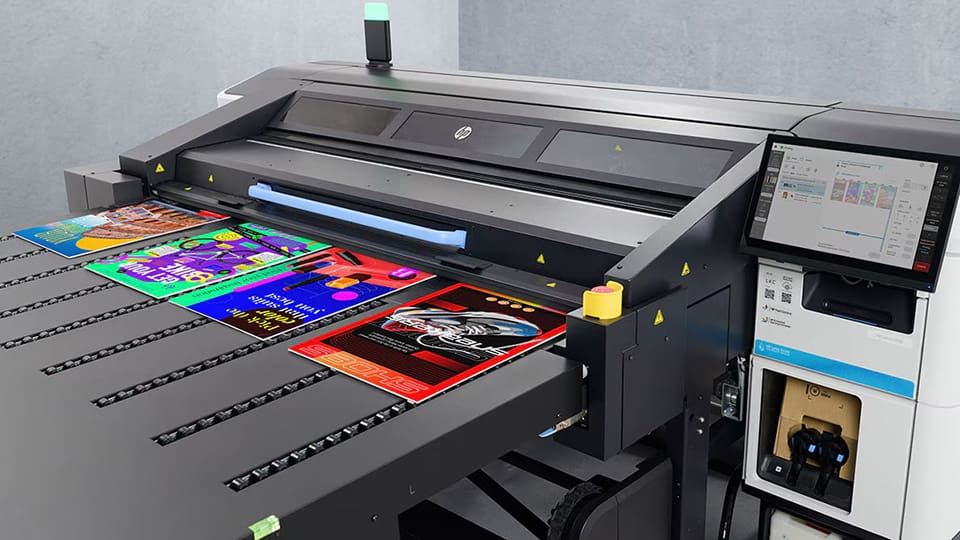
HP stresses the application flexibility of the R530, saying that it can switch between flexible and rigid media quickly and easily, a process that doesn’t require much more than wheeling up the tables and attaching them front and back. This lets the R530 add rigid media capability to roll-fed only sites or to expand it without having to go the dedicated flatbed route in larger businesses. On the roll-fed side the printer handles rolls up to 1.6m wide and weighing up to 55kg, but with spindle-less loading. Suggested roll applications include indoor and outdoor display graphics, backlit displays, thermoformed plastics, wall and window decoration, vehicle graphics, wraps and decals, soft signage, and short-run packaging or prototyping.
Bigger prints are possible thanks to machine's extendable tables
Rigid sheets of up to 1.6 x nearly 5m can be handled, if the maximum configuration with two sets of extension tables is used; otherwise it’s 1.6 x 1.5m. Media up to 50mm thick can be handled by the printer’s vacuum drive belt, covering a wide range of paper and plastic-based display graphic materials, plus glass, wood and ceramic materials, subject to a total board weight of 68kg.
On the software side, built-in HP Pixel Control is claimed to produce smoother gradients and solid colours on all substrates, while HP announced PrintOS Production Hub at the same time as the R530. This is workflow software that combines order management and remote production control in a ‘centralised real-time platform’. It’s not tied specifically to the R530 – it supports all HP Latex and HP Stitch printers – and indeed is possibly outside the scope for many of the smaller print shops that the new printer is aimed at, though as your business grows and more (HP) printers are added, the case becomes stronger. The Production Hub software is available via HP Professional Print Service Plans.
In terms of productivity, the R530 hits just under 24sqm/hr in ‘fast’ (six-pass) mode, dropping to 15.5sqm/hr in ‘standard’ (12-pass) or 11.5sqm/hr in top quality 16-pass mode. Using the white ink options for undercoat slows things further but does permit three- and five-layer printing for double-sided window graphics or day/night front/backlit products. While these figures aren’t going to set the world alight for brute force throughput, the premise of the printer is that it’s a neat and adaptable unit that can do everything a smaller print shop might need to turn its hand to, without the investment, training and space demands of separate roll-fed and flatbed machines. That’s got to appeal to a lot of smaller sign shops, as well as to general printers looking to move into wide-format.
Michael Walker is a trade journalist, technical writer, and editor with over 37 years’ experience in the print, prepress, photography, and digital imaging sectors, with a particular interest in the digital transformation of processes. In addition to editing Desktop Publishing Today and Digital Printer magazines, he is co-author with Neil Barstow of Getting Colour Right (Ilex Press, 2004) and Practical Colour Management for Photographers and Digital Image Makers (2009, self-published e-book) and winner of a Communicators in Business Gold Award.
Statistics
Print resolution – Up to 1200 x 600dpi Ink types – Water-based HP Latex inks Printheads - ten (2 cyan/black, 2 magenta/yellow, 2 light cyan/light magenta, 2 white,1 HP Latex Optimiser, and 1 HP Latex Overcoat) Roll size – 18 to 64inch Sheet size - 5.8 x 8.3inch to 63.6 x 60inch (up to 63.6 x 236inch with two sets of optional extension tables)
Cutting and creasing are key finishing operations in all kinds of print, but shorter runs mean that flexibility and automation are as important for overall throughput as raw speed. Michael Walker sizes up Plockmatic’s latest flagship model that brings it all together
Things have been a bit quiet since the late 2023 launch of Ricoh’s B2 inkjet press, but it turns out plenty has been going on behind the scenes. Michael Walker caught up with the newly trained ‘dragon’
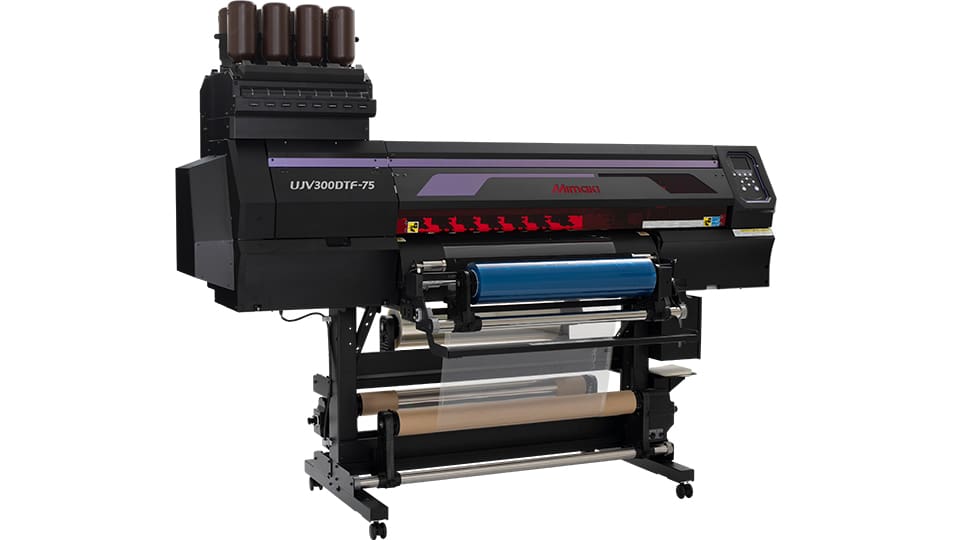
UV DTF presents a new option for object decoration, making stickers that can be used on the irregular and hard-to-get-to surfaces that desktop UV and cylinder printers can’t reach. Michael Walker gets stuck in with Mimaki’s new offering in this sector
(this was inserted into the PHP of a code block)
Watch our latest video of the week
Print Monthly gives you the latest video coverage of companies, people, and events from within the print industry.