Vivid’s New “Razar Sharp” Digital Spot UV and Cutter
Putting digital spot UV printing in the same box as flatbed cutting and creasing is one of those ideas that seems obvious in retrospect, but Vivid thought of it first. Michael Walker traces the
path from holiday inspiration to trade show launch
Michael Walker
January 21, 2026
Sometimes we can’t see the blinkers we’re wearing and keep on doing things the way they’ve always been done, even as new tools and possibilities creep into daily usage. Finishing has been around as long as printing has, and even the idea of digital special effects printing, now more often referred to as ‘embellishment’, has notched up at least a couple of decades. But so far, the equipment to carry out the respective processes has been separate, with digital ‘die-cutters’ and multi-finishers on one side and ‘embellishment presses’ that could apply spot UV and usually foil too, on the other.
Ne’er the Twain
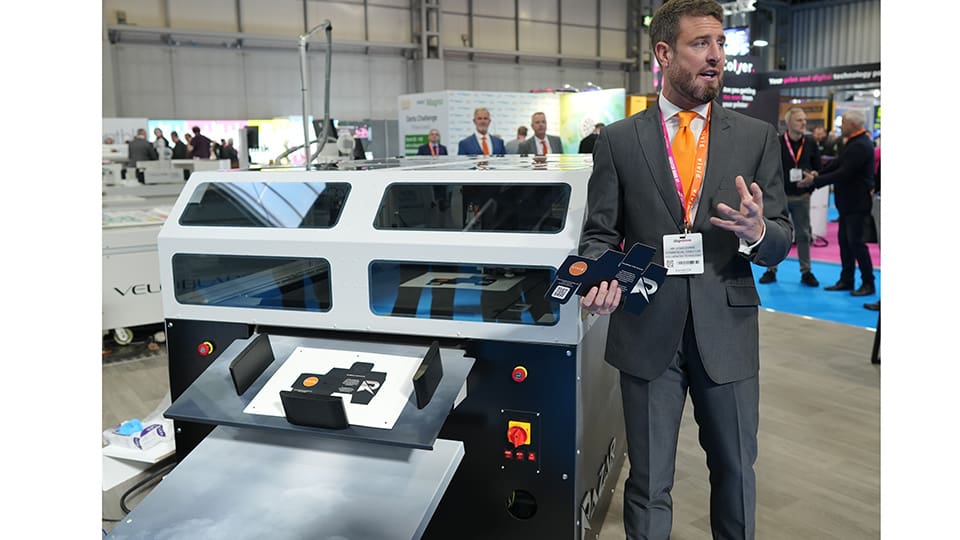
Die-cutters and embellishment presses were once separate, until September 2025 when Vivid Laminating Systems used The Print Show as the platform to launch the Razar, a combination of a digital spot UV printer and flatbed cutter and creaser based on the company’s established VeloBlade line.
Vivid director, Lewis Evans says the idea to combine these functions into one machine came to him while on holiday in the Greek island of Mykonos in the summer of 2022, to the immediate acclaim of his colleagues. The intervening period spent turning the idea into a sellable product was extended by a certain degree of (probably justifiable) paranoia about the idea being copied before the necessary patents could be secured, which limited the choice of development partners that Vivid felt comfortable working with and resulted in various things having to be developed in-house from scratch. Evans estimates this added around 18 months to the development process.
Vivid director Lewis Evans says the idea to combine these functions into one machine came to him while on holiday in the Greek island of Mykonos in the summer of 2022
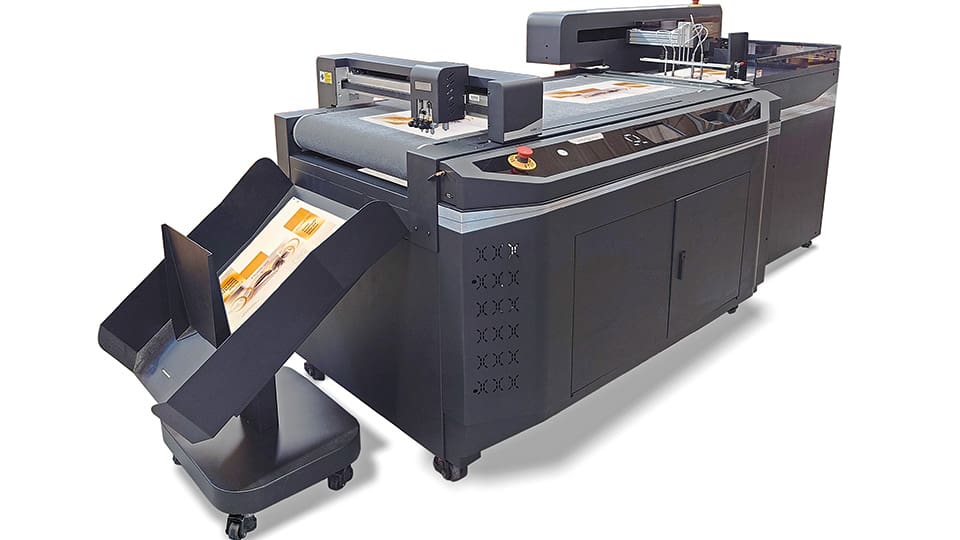
So, what do you get if you buy a Razar? On the finishing side, you have a cutter and creaser that can handle sheets up to B1 (1000 x 770mm) in size, with a range of cutting tools to cut or perforate roll and sheet media up to 5mm thick, with an optional extension via an oscillating tool to handle suitable media up to 10mm. Rotary and direct cutting tools are complemented by a creasing wheel as standard, while other options include a kiss-cut tool and Vivid’s VeloTaper, which applies double-sided adhesive tape for simple closure or assembly of finished items without requiring spot gluing. Also, standard is a pen tool that can be used to code or even ‘sign’ printed items with simulated fonts or handwriting.
Lewis Evans introducing the Razar at The Print Show 2025
Media that can be handled include card, paper, stickers and label stock, KT board, foam or ABS boards, corrugated, and various reflective materials. Maximum cutting speed is 1000mm/sec and repeated accuracy is given as ±0.1mm via a CCD registration system. There is also a camera that can read barcodes or QR codes and automatically load job parameters via the supplied control software. This technology comes from Vivid’s established VeloBlade line but Evans is keen to point out that the Razar isn’t a cutter with a spot UV printer, but “a spot UV machine that can cut and crease”, and this is where its capabilities become quite distinct from any other finishing equipment.
Spot the Difference
The digital spot UV print capability is provided by Xaar printheads and ink, offering up to 1440dpi resolution – more than enough to pick out fine details in type or line art – but only across a B2 area. This could be ‘windowed’ onto a B1 sheet but Vivid sees it as more likely that users will operate at B2 since that’s the effective limit for the vast majority of the digital presses with which the Razar is likely to be coupled. While thinking about supported formats, it’s also worth noting that while the minimum sheet size is A4 (297 x 210mm), with the correct feeds, narrow web label material can also be handled; the combination of spot UV and kiss-cutting of self-adhesive label stock is one of many new applications that Vivid is exploring. Via suitable jigs, small items like pens, coasters, smartphone cases, or even pieces of slate can also be spot coated, subject only to the 10mm material height limitation.
The Razar is described as a spot UV machine that can both cut and crease
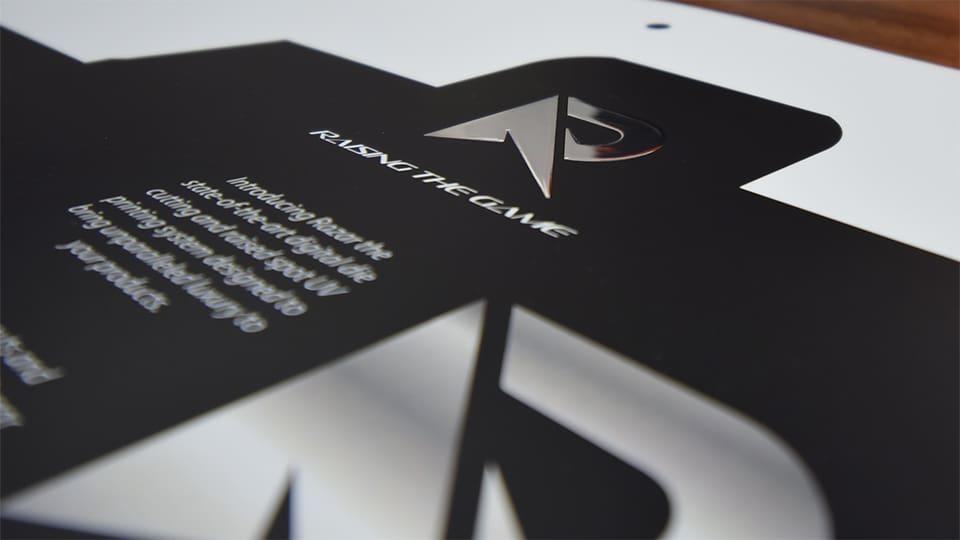
The UV finish for the moment is gloss, but Vivid is working on a matte version that Evans says will be available in early 2026. A single-pass coating can build depth up to 100 microns, and a second pass can double that, bringing Braille or deeply textured options within reach. Within each pass, the thickness can be varied between one and 100% and that can vary across the sheet, opening up considerable creative capabilities to affect both look and feel of the finished item.
There are tools in Vivid’s supplied software to enable the spot UV to be applied to different parts of a job based on its content, and the system is also compatible with Fiery controllers, so it’s not necessary for clients to provide specialised artwork in order to benefit from the spot UV capability. It is possible for them to do so if they wish, however, by adding an appropriately configured spot UV layer into their PDFs.
The spot UV can be applied to pretty much any substrate, including uncoated papers, without requiring any lamination or other coating, making possible some eye-catching combinations and effects. Evans points out that if you want to add foiling too, you can pass jobs through the existing Matrix line of foil-over-toner laminators and stresses the decade-plus of experience that Vivid has in this type of embellishment.
Statistics
Maximum Sheet Size: Cut/crease only: B1; spot UV: B2
Spot UV Resolution: Up to 1440dpi
UV Thickness: Up to 200µ (two-pass), continuously
variable and within the job
Cutting Speed: Up to 1000mm/sec
Cutting/Plotting Tools: Standard: rotary, direct, and pen; optional: oscillating, kiss-cut, and VeloTaper
Vivid has already taken orders for several Razar units, though at the time of writing they haven't been installed. Evans says that customers are planning to use it in direct mail, on envelopes, in web-to-print/ecommerce products such as wedding or event invitations, and in luxury packaging, but add that in terms of potential applications, “we’re only just getting going”.
As with many products that offer a novel set of new capabilities, it’s not hard to imagine that many new and unanticipated applications will be found, but even for the purposes mentioned here it’s not hard to see the appeal of the space, staff, and cost saving (the Razar starts from around £60,000) that such an all-in-one device can offer for short and mid-runs for “anyone with a digital press”, as Evans put it.
Michael Walker is a trade journalist, technical writer, and editor with over 37 years’ experience in the print, prepress, photography, and digital imaging sectors, with a particular interest in the digital transformation of processes. In addition to editing Desktop Publishing Today and Digital Printer magazines, he is co-author with Neil Barstow of Getting Colour Right (Ilex Press, 2004) and Practical Colour Management for Photographers and Digital Image Makers (2009, self-published e-book) and winner of a Communicators in Business Gold Award.
Cutting and creasing are key finishing operations in all kinds of print, but shorter runs mean that flexibility and automation are as important for overall throughput as raw speed. Michael Walker sizes up Plockmatic’s latest flagship model that brings it all together
Things have been a bit quiet since the late 2023 launch of Ricoh’s B2 inkjet press, but it turns out plenty has been going on behind the scenes. Michael Walker caught up with the newly trained ‘dragon’
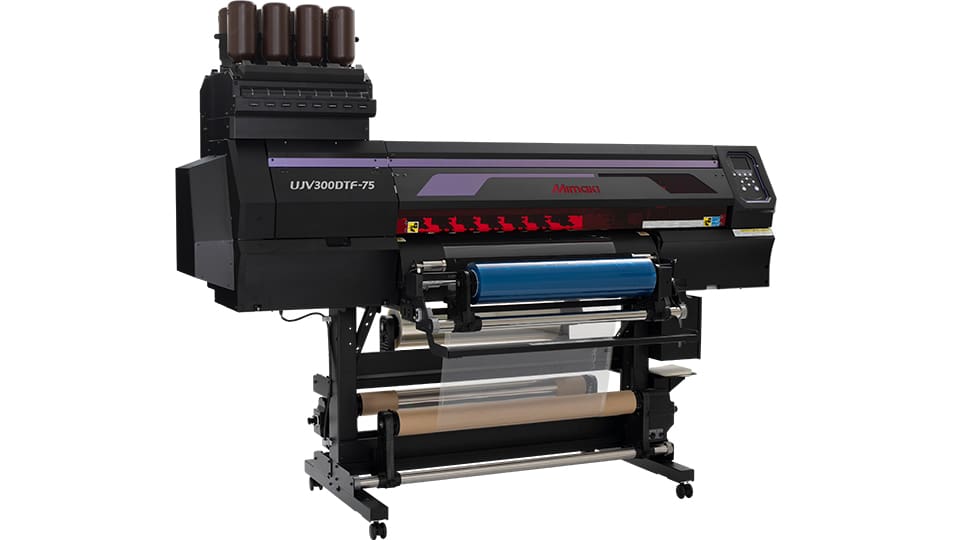
UV DTF presents a new option for object decoration, making stickers that can be used on the irregular and hard-to-get-to surfaces that desktop UV and cylinder printers can’t reach. Michael Walker gets stuck in with Mimaki’s new offering in this sector
(this was inserted into the PHP of a code block)
Watch our latest video of the week
Print Monthly gives you the latest video coverage of companies, people, and events from within the print industry.