Canon Labelstream LS2000: New Markets, New Standards
Canon has unveiled new printers featuring brand new water-based inkjet systems that put capacity and quality in short- to medium-run label printing. Brian Sims finds out more
Guest Writer
May 8, 2024
The drive to greener products with a low carbon footprint impact is now almost a given when we are looking for consumer products. Purchasers are seeking assurances from printers that when they place an order for labelling products or point of sale materials, they can be certain the product is as green as possible.
For a number of years, manufacturers have slowly migrated across to water-based inks which we all know are safer to use for foods and consumer products. The main issue is that the enthusiasm for moving to green offerings needs massive changes in technology to match the desires.
By its nature, research and development takes time and money, and when developing brand new products it takes deep pockets but equally a thorough understanding of what the market will need in five or seven years’ time from sitting down with a blank sheet of paper.
One company you can rely on to have the resources and know-how to complete this is Canon. Being a world leader in digital printing products for some years now, it is of no surprise the company is bringing to market a brand new product which will set new standards in both print quality and production volumes in the consumer label market.
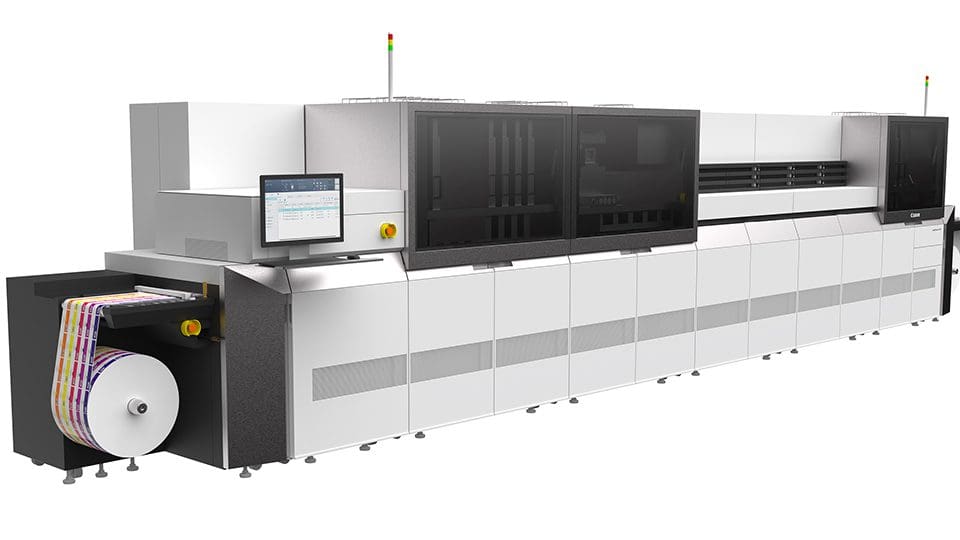
Canon has unveiled the LabelStream LS2000 which will be available for us to all see at drupa 2024 but keen for everyone to have interest at fever pitch before June, it was recently shown to the public in Yokohama, and it did not disappoint.
Water-based Inks
Canon has previously worked with other partners when it comes to printheads and associated printers, but the LabelStream LS2000 has been built and developed completely in-house making it an ‘all-Canon product’.
The manufacturer has recognised that there is a growing market for self-adhesive labels which are eco-friendly for consumer products but is finding the run lengths are dropping and quality is heading upwards at an ever-demanding level. To meet this challenge, Canon has designed not only a brand new reel-to-reel printer but has produced a water-based inkjet printhead which has both speed and quality all wrapped in one.
Engineers have gone back to the drawing board and in their many research and development sites in Japan, the Netherlands, and Germany, they have developed a printer with new high-definition, thermal printheads producing a resolution of 2,400 x 1,200dpi. For a label printer, this positions it right next to offset lithography for quality.
The heads themselves are only part of the solution of high quality and production, integral to the head is a completely new ink circulation system within it which automatically decides the best route for the ink to get to the nozzles.
As ensuring effective ink deployment for quality purposes is only part of the issue of maintaining quality, this new technology almost eliminates the clogging of nozzles, keeping print quality at the highest levels and extending the life- time of the printhead itself.
Green credentials come to the fore here as well. The water-based products make the labels food safe and Canon ensures they will comply with international food standards meaning the labels can be applied on any product with confidence.
Easy Colour Control
The inks themselves are new, come with high colour density, and are polymer-based. They are laid on the substrate with great precision and low thickness which ensure a wide printing gamut. Depending on the product choices you need, the LabelStream LS2000 can print with the process set CMYK and if needed a white which can add great opacity to any label.
The application of this base undercoat of white ink can be used for transparent substrates or when applied on solid materials, it has the effect of greatly improving the vividness of the colours laid on top.
All this technology, be it new inks or inkjet heads, clearly needs back office systems within the printer to keep the hardware and printed products at the highest and most productive levels.
A built-in spectrophotometer can control the printed image within standards on the run and produce ICC profiles when needed
For colour, the LabelStream LS2000 has an onboard spectrophotometry which will keep the printed copy within the required standard in a closed-loop system and adjust where needed on the fly. It can self-calibrate when needed and has the capacity for ICC profile creation.
As you would expect from Canon the user interface is simple and easy to use, and any calibration or colour adjustment can be done by someone with little or no colour management expertise The head itself also has onboard technology to automatically keep the nozzles and ink ways in top condition but there are also manual controls should the user feel an intervention is required.
Flexibility is Key
So much for the inkjet heads and inks, but this is only half the picture. What can the LabelStream LS2000 print on and how quickly can it do it?
Referring back to the market for this printer, the substrate list that the LabelStream LS2000 can process comprises a wide range of self-adhesive label materials from coated to synthetic paper and films which should mean any number of new markets could be available should you have this printer. The width of the substrate is up to 340mm, and reel to reel and the processing of whichever substrate you need to use is up to 40m/min when printing in CMYK mode.
The combination of inks and substrates positions the LabelStream L2000 in a very good position to tackle the opportunity presented by short to medium production runs needed but coupled with the high print quality now being taken for granted on consumer products.
It goes without saying that the machine itself has been well engineered from an aesthetic point of view. Simple user interfaces are built into the long white printer itself. Access to the web and printheads is through transparent windows or panels making the operation of the machine simple and trouble free.
The machine will be available to end-users in Europe in 2025 but it will no doubt generate great interest as it is likely to be a main focus point of the Canon stand at drupa later this year.
Statistics
Maximum speed 40 m/min Substrate width 340mm Colours CMYK + W Resolution 2,400 x 1,200dpi
Brian Sims Principal Consultant, Metis Print Consultancy, www.metis-uk.eu
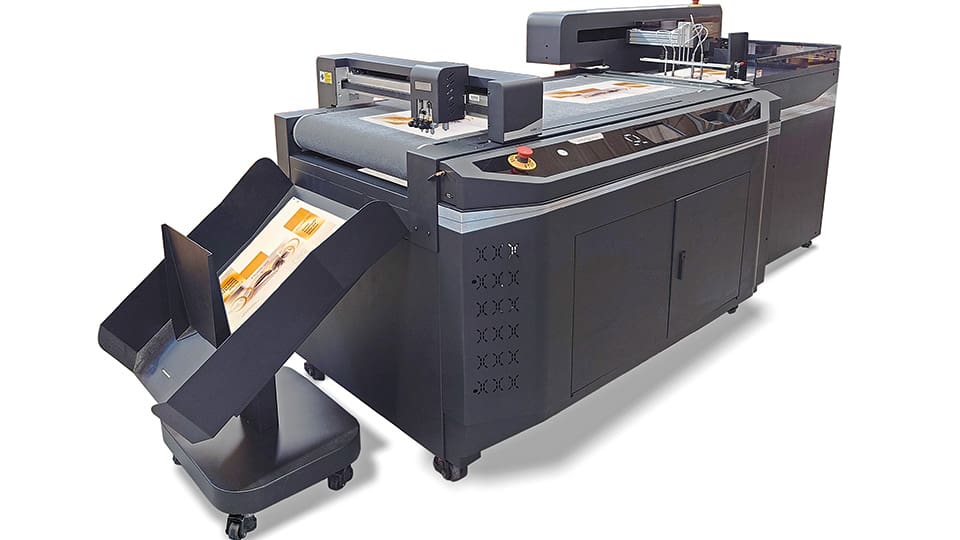
Cutting and creasing are key finishing operations in all kinds of print, but shorter runs mean that flexibility and automation are as important for overall throughput as raw speed. Michael Walker sizes up Plockmatic’s latest flagship model that brings it all together
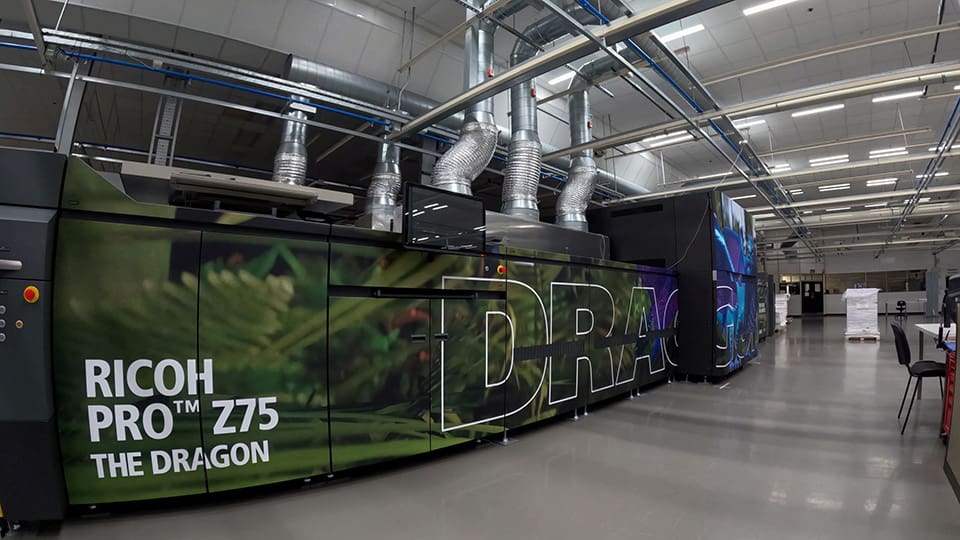
Things have been a bit quiet since the late 2023 launch of Ricoh’s B2 inkjet press, but it turns out plenty has been going on behind the scenes. Michael Walker caught up with the newly trained ‘dragon’
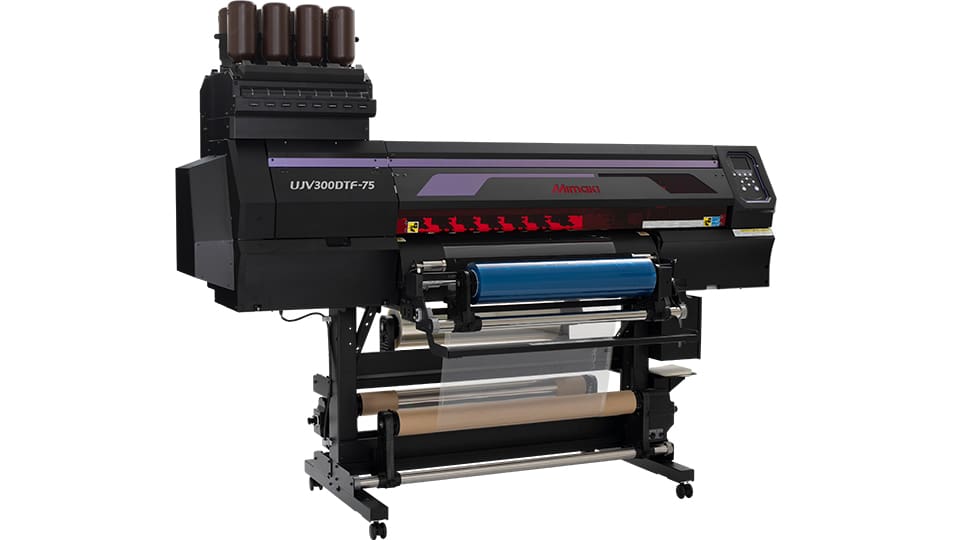
UV DTF presents a new option for object decoration, making stickers that can be used on the irregular and hard-to-get-to surfaces that desktop UV and cylinder printers can’t reach. Michael Walker gets stuck in with Mimaki’s new offering in this sector
(this was inserted into the PHP of a code block)
Watch our latest video of the week
Print Monthly gives you the latest video coverage of companies, people, and events from within the print industry.